

NASA’s MAVEN detected a unique solar event that drastically affected Mars’ atmosphere, offering vital insights into the planet’s interaction with solar phenomena.
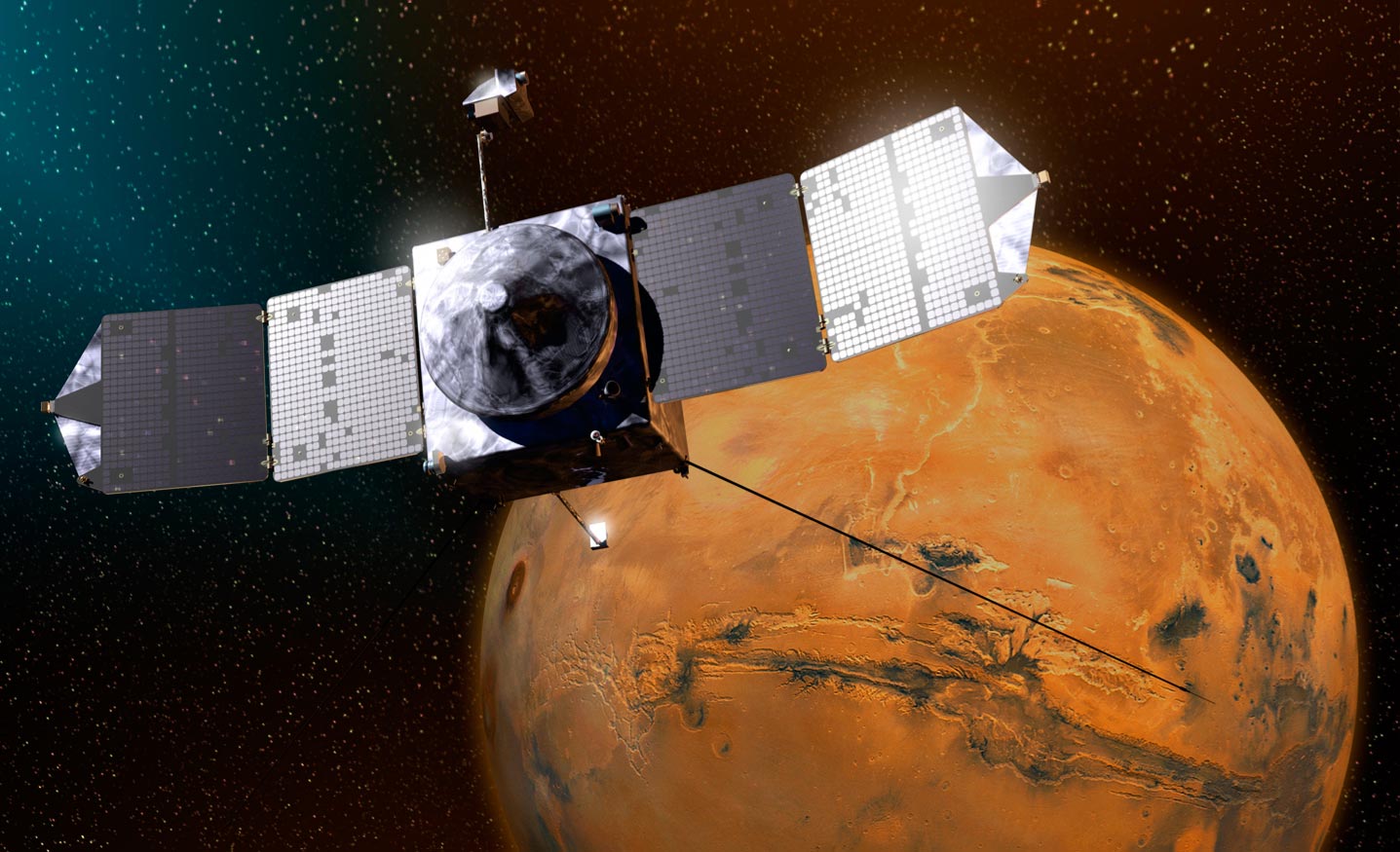
In December 2022, NASA’s MAVEN (Mars Atmosphere and Volatile EvolutioN) mission observed the dramatic and unexpected “disappearance” of a stream of charged particles constantly emanating off the Sun, known as the solar wind. This was caused by a special type of solar event that was so powerful, it created a void in its wake as it traveled through the solar system.
Due to this event, MAVEN’s measurements at Mars showed that the number of particles making up the solar wind dropped significantly. Without the pressure of the solar wind, the Martian atmosphere and magnetosphere expanded by thousands of kilometers. MAVEN is the only asset currently at Mars able to simultaneously observe both the Sun’s activity and the response of the Martian atmosphere to these solar influences.
“When we first saw the data, and how dramatic the drop in the solar wind was, it was almost unbelievable,” said Jasper Halekas, professor at the University of Iowa and the lead author on a new study on the event. “We formed a working group to study the event, and we have found this time period to be rich with incredible findings.”
Learn about the “disappearance” of the solar wind at Mars that was witnessed by MAVEN – an event last seen nearly a quarter-century ago at Earth. Credit: NASA’s Goddard Space Flight Center
Understanding the Solar Wind Disappearance
Mars, like all the planets in our solar system, is constantly immersed in the solar wind. The solar wind exerts pressure on the Martian magnetosphere and ionosphere, and drives much of the escape of the atmosphere. The solar event in December 2022 was caused by faster-moving solar wind that overtook slower moving solar wind, which acted like a broom, sweeping and compressing the two regions together. This interaction, called a stream interaction region, left behind a rare void of extremely low-density solar wind in its wake, which was observed by MAVEN. This “disappearance” of the solar wind led to some incredible interactions within Mars’ magnetosphere and ionosphere.
Consequences of the Event
As the density of the solar wind dropped by a factor of 100, it caused the pressure to decrease and the magnetosphere and ionosphere of the planet were able to expand by thousands of kilometers—more than tripled the typical size—and dramatically changed in character. The Sun’s magnetic field that typically is embedded within the Martian ionosphere was pushed outwards, which transformed the ionosphere from a magnetized to unmagnetized state. At the same time, the layer between the solar wind and the magnetosphere became unusually electromagnetically quiet. MAVEN’s observations of this dramatic event and subsequent transformation and expansion of the whole system is important to better understand the physics that drive atmospheric and water loss at Mars.
“We are really getting to see how Mars responds when the solar wind is effectively removed,” Halekas added. “It makes for a great outlier study on what Mars would be like if it were orbiting a less ‘windy’ star.”
Significance of MAVEN’s Observations
Disappearing solar wind events on this scale are extremely rare and are produced at a time of increasing solar activity, so this was the first time the MAVEN mission had the opportunity to observe such a phenomenon. While other spacecraft at Mars and Earth also observed aspects of this event, only MAVEN was able to simultaneously take measurements from both the Sun and the Martian atmosphere’s response to it.
“Observing extreme conditions is always scientifically invaluable,” said Shannon Curry, principal investigator for MAVEN at the University of California, Berkeley. “MAVEN was designed to observe these types of interactions between the Sun and the Martian atmosphere, and the spacecraft provided exceptional data during this truly anomalous solar event.”
As the Sun moves toward solar maximum, the peak of its 11-year activity cycle, the MAVEN mission could have an even bigger impact on our understanding of extreme solar events.
Collaborative Effort and Future Plans
“This really shows the cross-divisional role that MAVEN plays at Mars,” said Gina DiBraccio, MAVEN deputy principal investigator and deputy director of the Heliophysics Science Division at NASA’s Goddard Space Flight Center in Greenbelt, Maryland. “MAVEN is not only observing the dynamics of the Martian atmosphere, it is also monitoring solar inputs to enhance our understanding of the Sun.”
The study is being presented at the American Geophysical Union Fall Meeting in San Francisco.
MAVEN’s principal investigator is based at the University of California, Berkeley, while NASA’s Goddard Space Flight Center in Greenbelt, Maryland, manages the MAVEN mission. Lockheed Martin Space built the spacecraft and is responsible for mission operations. NASA’s Jet Propulsion Laboratory in Southern California provides navigation and Deep Space Network support. The Laboratory for Atmospheric and Space Physics at the University of Colorado Boulder is responsible for managing science operations and public outreach and communications. The MAVEN team is preparing to celebrate the spacecraft’s 10th year at Mars in September 2024.
Never miss a breakthrough: Join the SciTechDaily newsletter.
Follow us on Google and Google News.
1 Comment
So did this happen in 2022 or 2023. If 2022 why no follow up answers. Surely we are not still waiting for data?