
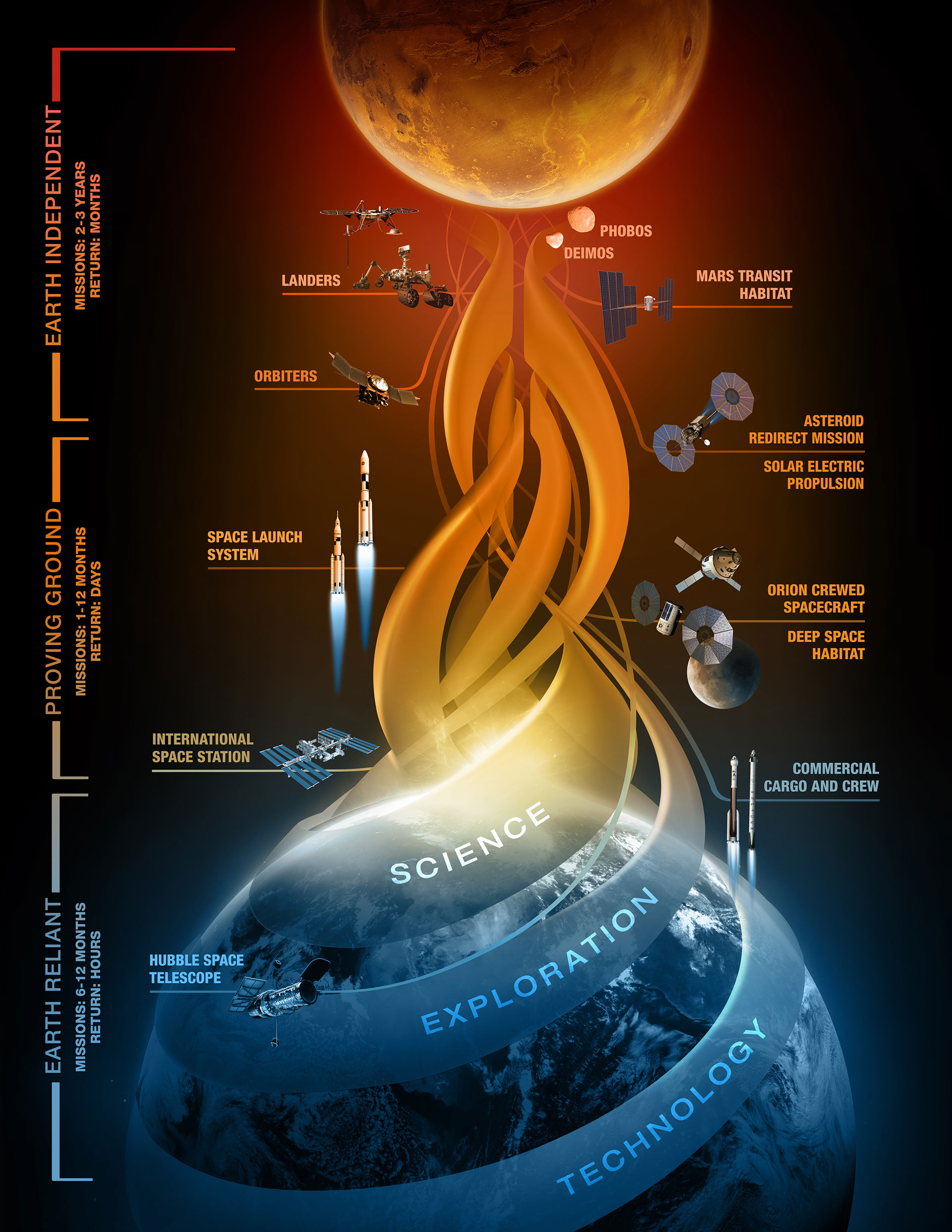
NASA has released a detailed outline of the journey to Mars, “NASA’s Journey to Mars: Pioneering Next Steps in Space Exploration.”
“NASA is closer to sending American astronauts to Mars than at any point in our history,” said NASA Administrator Charles Bolden. “Today, we are publishing additional details about our journey to Mars plan and how we are aligning all of our work in support of this goal. In the coming weeks, I look forward to continuing to discuss the details of our plan with members of Congress, as well as our commercial and our international partners, many of whom will be attending the International Astronautical Congress next week.”
The plan can be read online at: http://go.nasa.gov/1VHDXxg
The journey to Mars crosses three thresholds, each with increasing challenges as humans move farther from Earth. NASA is managing these challenges by developing and demonstrating capabilities in incremental steps:
Earth Reliant exploration is focused on research aboard the International Space Station. From this world-class microgravity laboratory, we are testing technologies and advancing human health and performance research that will enable deep space, long-duration missions.
In the Proving Ground, NASA will learn to conduct complex operations in a deep space environment that allows crews to return to Earth in a matter of days. Primarily operating in cislunar space—the volume of space around the moon featuring multiple possible stable staging orbits for future deep space missions—NASA will advance and validate capabilities required for humans to live and work at distances much farther away from our home planet, such as at Mars.
Earth Independent activities build on what we learn on the space station and in deep space to enable human missions to the Mars vicinity, possibly to low-Mars orbit or one of the Martian moons, and eventually the Martian surface. Future Mars missions will represent a collaborative effort between NASA and its partners—a global achievement that marks a transition in humanity’s expansion as we go to Mars to seek the potential for sustainable life beyond Earth.
“NASA’s strategy connects near-term activities and capability development to the journey to Mars and a future with a sustainable human presence in deep space,” said William Gerstenmaier, associate administrator for Human Exploration and Operations at NASA Headquarters. “This strategy charts a course toward horizon goals, while delivering near-term benefits, and defining a resilient architecture that can accommodate budgetary changes, political priorities, new scientific discoveries, technological breakthroughs, and evolving partnerships.”
NASA is charting new territory, and we will adapt to new scientific discoveries and new opportunities. Our current efforts are focused on pieces of the architecture that we know are needed. In parallel, we continue to refine an evolving architecture for the capabilities that require further investigation. These efforts will define the next two decades on the journey to Mars.
CHALLENGES FOR SPACE PIONEERS
Living and working in space require accepting risks—and the journey to Mars is worth the risks. A new and powerful space transportation system is key to the journey, but NASA also will need to learn new ways of operating in space, based on self-reliance and increased system reliability. We will use proving ground missions to validate transportation and habitation capabilities as well as new operational approaches to stay productive in space while reducing reliance on Earth.
We identify the technological and operational challenges in three categories: transportation, sending humans and cargo through space efficiently, safely, and reliably; working in space, enabling productive operations for crew and robotic systems; and staying healthy, developing habitation systems that provide safe, healthy, and sustainable human exploration. Bridging these three categories are the overarching logistical challenges facing crewed missions lasting up to 1,100 days and exploration campaigns that span decades.
STRATEGIC INVESTMENTS TO ADDRESS PIONEERING CHALLENGES
NASA is investing in powerful capabilities and state-of-the-art technologies that benefit both NASA and our industry partners while minimizing overall costs through innovative partnerships. Through our evolvable transportation infrastructure, ongoing spaceflight architecture studies, and rapid prototyping activities, we are developing resilient architecture concepts that focus on critical capabilities across a range of potential missions. We are investing in technologies that provide large returns, and maximizing flexibility and adaptability through commonality, modularity, and reusability.
On the space station, we are advancing human health and behavioral research for Mars-class missions. We are pushing the state-of-the-art life support systems, printing 3-D parts, and analyzing material handling techniques for in-situ resource utilization. The upcoming eighth SpaceX commercial resupply services mission will launch the Bigelow Expandable Activity Module, a capability demonstration for inflatable space habitats.
With the Space Launch System, Orion crewed spacecraft, and revitalized space launch complex, we are developing core transportation capabilities for the journey to Mars and ensuring continued access for our commercial crew and cargo partners to maintain operations and stimulate new economic activity in low-Earth orbit. This secured U.S. commercial access to low-Earth orbit allows NASA to continue leveraging the station as a microgravity test bed while preparing for missions in the proving ground of deep space and beyond.
Through the Asteroid Redirect Mission (ARM), we will demonstrate an advanced solar electric propulsion capability that will be a critical component of our journey to Mars. ARM will also provide an unprecedented opportunity for us to validate new spacewalk and sample handling techniques as astronauts investigate several tons of an asteroid boulder – potentially opening new scientific discoveries about the formation of our solar system and the beginning of life on Earth
We are managing and directing the ground-based facilities and services provided by the Deep Space Network (DSN), Near Earth Network (NEN), and Space Network (SN) – critical communications capabilities that we continue to advance for human and robotic communication throughout the solar system.
Through our robotic emissaries, we have already been on and around Mars for 40 years, taking nearly every opportunity to send orbiters, landers, and rovers with increasingly complex experiments and sensing systems. These orbiters and rovers have returned vital data about the Martian environment, helping us understand what challenges we may face and what resources we may encounter. The revolutionary Curiosity sky crane placed nearly one metric ton – about the size of a small car – safely on the surface of Mars, but we need to be able to land at least 10 times that weight with humans – and then be able to get them off the surface.
These challenges are solvable, and NASA and its partners are working on the solutions every day so we can answer some of humanity’s fundamental questions about life beyond Earth: Was Mars home to microbial life? Is it today? Could it be a safe home for humans one day? What can it teach us about life elsewhere in the cosmos or how life began on Earth? What can it teach us about Earth’s past, present, and future?
The journey to Mars is a historic pioneering endeavor—a journey made possible by a sustained effort of science and exploration missions beyond low-Earth orbit with successively more capable technologies and partnerships.
Never miss a breakthrough: Join the SciTechDaily newsletter.
Follow us on Google and Google News.