
Close Menu
    Facebook X (Twitter) Instagram
    SciTechDaily
    • Biology
    • Chemistry
    • Earth
    • Health
    • Physics
    • Science
    • Space
    • Technology
    Facebook X (Twitter) Pinterest YouTube RSS
    SciTechDaily
    Home»Space»New Map of Mars Shows Signs of Ancient Lakes and Quakes
    Space

    New Map of Mars Shows Signs of Ancient Lakes and Quakes

    By Guy Webster, Jet Propulsion LaboratoryDecember 15, 2014No Comments2 Mins Read
    Facebook Twitter Pinterest Telegram LinkedIn WhatsApp Email Reddit
    Share
    Facebook Twitter LinkedIn Pinterest Telegram Email Reddit

    A new geological map based on NASA images shows signs of ancient lakes and quakes on Mars.


    This animation simulates a flyover of a portion of a Martian canyon detailed in a geological map produced by the U.S. Geological Survey and based on observations by the HiRISE camera on NASA’s Mars Reconnaissance Orbiter. The landforms include a series of hills called Candor Colles.

    Long ago, in the largest canyon system in our solar system, vibrations from “marsquakes” shook soft sediments that had accumulated in Martian lakes.

    The shaken sediments formed features that now appear as a series of low hills apparent in a geological map based on NASA images. The map was released today by the U.S. Geological Survey (USGS).

    This map of the western Candor Chasma canyon within Mars’ Valles Marineris is the highest-resolution Martian geological map ever released by USGS. It is derived from images taken by the High Resolution Imaging Science Experiment (HiRISE) camera on NASA’s Mars Reconnaissance Orbiter, which reveal details smaller than a desk.
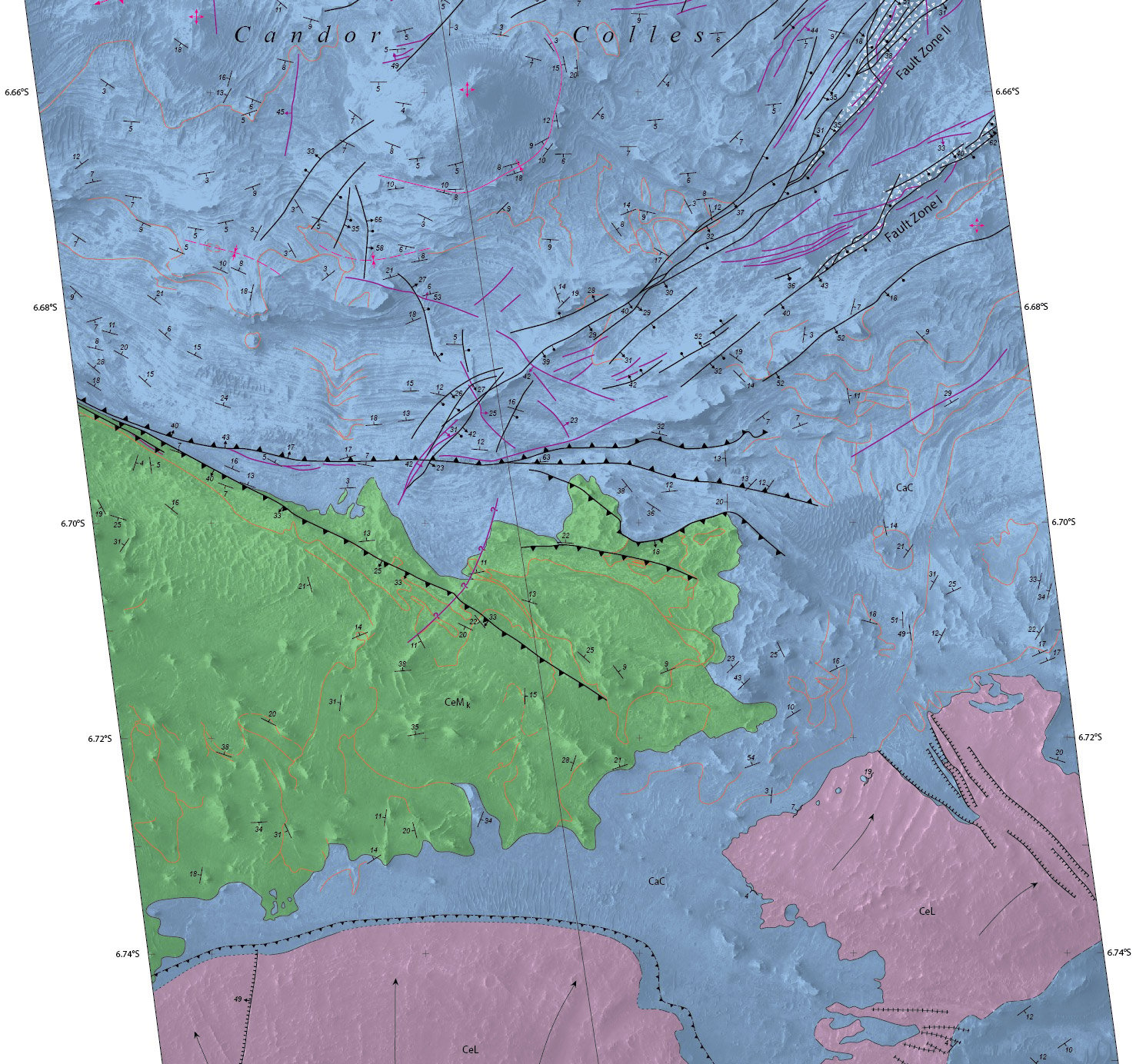
    Signs of Ancient Mars Lakes and Quakes Seen in New Map
    Details of hilly terrain within a large Martian canyon are shown on a geological map based on observations from NASA’s Mars Reconnaissance Orbiter and produced by the U.S. Geological Survey. Credit: NASA/JPL-Caltech/University of Arizona/USGS

    “This new map shows that at the time these sediments were deposited, a part of west Candor Chasma, specifically Condor Colles, contained numerous shallow, spring-fed lakes,” said map author Chris Okubo of the USGS Astrogeology Science Center, Flagstaff, Arizona. “These lakes helped to trap wind-blown sand and dust, which accumulated over time and formed the extensive sedimentary deposits we see today.”

    The wet sediments experienced seismic shaking in “marsquakes” related to movement along several large geological faults in the area. A series of low hills resulted.

    Valles Marineris is more than 2,500 miles (4,000 kilometers) long. The conditions under which sedimentary deposits in it formed have been an open issue for decades. Possibilities proposed have included accumulation in lakebeds, volcanic eruptions under glaciers within the canyons, and accumulation of wind-blown sand and dust.

    HiRISE is operated by the University of Arizona, Tucson. The instrument was built by Ball Aerospace & Technologies Corp. of Boulder, Colorado. The Mars Reconnaissance Orbiter Project is managed for NASA’s Science Mission Directorate in Washington, by NASA’s Jet Propulsion Laboratory, Pasadena, California, a division of the California Institute of Technology, also in Pasadena.

    Never miss a breakthrough: Join the SciTechDaily newsletter.
    Follow us on Google and Google News.

    Astrogeology Astronomy Geophysics Mars NASA Planetary Science USGS
    Share. Facebook Twitter Pinterest LinkedIn Email Reddit

    Related Articles

    NASA Discovers Further Evidence of Dry Ice Gullies on Mars

    Curiosity Finds Ancient Streambed on Mars

    NASA’s Opportunity Discovers Geological Mystery on Mars

    NASA Data Suggests “Dry Ice” Snowfall on Mars

    NASA’s Curiosity Prepares for Use of Its Arm and Tools

    Curiosity Sends Back Radioed Words and New Telephoto View of Mars

    NASA’s Curiosity Readies for First Drive on Mars

    Color HiRISE Image of Curiosity Rover on Mars

    First 360-Degree Color Panorama From NASA’s Curiosity Mars Rover

    Leave A Reply Cancel Reply

    • Facebook
    • Twitter
    • Pinterest
    • YouTube

    Don't Miss a Discovery

    Subscribe for the Latest in Science & Tech!

    Trending News

    Popular Vitamin B3 Supplements May Help Cancer Cells Survive, Scientists Warn

    Scientists Discover Strange Property of Rice and Turn It Into a Smart Material

    NASA Artemis II Skips Burn As Astronaut Captures Stunning View of Earth

    NASA’s Artemis II: Humans Just Left Earth Orbit for the First Time Since 1972

    What Causes Chronic Pain? Scientists Identify Key Culprit in the Brain

    Semaglutide Shows Surprising Mental Health Benefits in Massive 100,000-Person Study

    This Liquid Snapped Instead of Flowing and Scientists Were Shocked

    Breakthrough Alzheimer’s Drug Rewires the Brain Instead of Just Clearing Plaques

    Follow SciTechDaily
    • Facebook
    • Twitter
    • YouTube
    • Pinterest
    • Newsletter
    • RSS
    SciTech News
    • Biology News
    • Chemistry News
    • Earth News
    • Health News
    • Physics News
    • Science News
    • Space News
    • Technology News
    Recent Posts
    • Astronomers Discover the Most Pristine Star Ever Found
    • New Study Suggests Gravitational Waves May Have Created Dark Matter
    • Scientists Solve 60-Year-Old Mystery of Strange Magnetic Surges Above the Moon
    • Scientists Discover How Multiple Sclerosis Kills Brain Cells
    • Scientists Discover Why the Brain Gets Stuck in Schizophrenia
    Copyright © 1998 - 2026 SciTechDaily. All Rights Reserved.
    • Science News
    • About
    • Contact
    • Editorial Board
    • Privacy Policy
    • Terms of Use

    Type above and press Enter to search. Press Esc to cancel.