
Close Menu
    Facebook X (Twitter) Instagram
    SciTechDaily
    • Biology
    • Chemistry
    • Earth
    • Health
    • Physics
    • Science
    • Space
    • Technology
    Facebook X (Twitter) Pinterest YouTube RSS
    SciTechDaily
    Home»Science»Neanderthal Genes Reveal How Old Our Ancestors Were When They Had Children
    Science

    Neanderthal Genes Reveal How Old Our Ancestors Were When They Had Children

    By Aarhus UniversitySeptember 10, 20212 Comments3 Mins Read
    Facebook Twitter Pinterest Telegram LinkedIn WhatsApp Email Reddit
    Share
    Facebook Twitter LinkedIn Pinterest Telegram Email Reddit
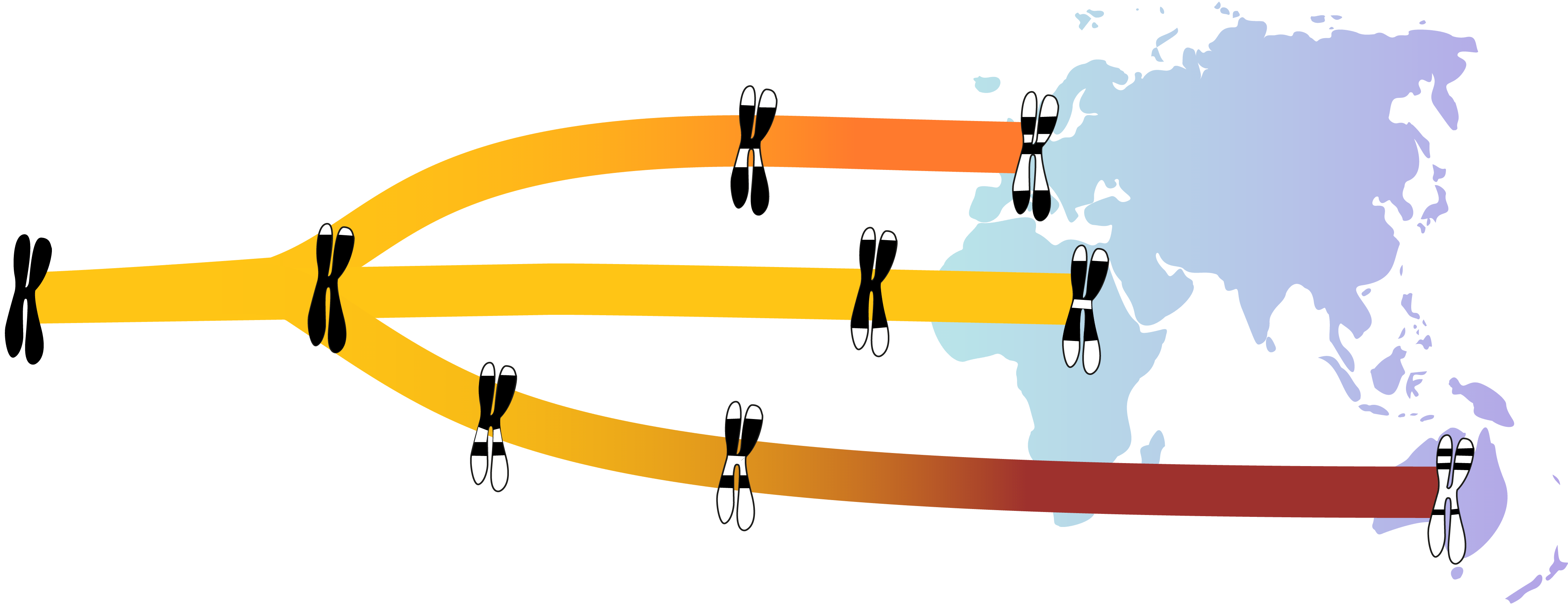
    Archaic Sequence Length Decay
    Archaic sequence length decay (black bands on chromosomes) for different populations sampled at multiple time points. The length of generation intervals (GI) is represented by the color gradient on the tree (yellow : long GI; maroon : short GI). Credit: Moisès Coll Macià, Aarhus University

    Researchers found that the age at which humans reproduced changed over the last 40,000 years, reflecting both environmental and cultural influences.

    A new study suggests that generation intervals have fluctuated during the past 40,000 years of human evolution in contrast to what has been commonly assumed. The results indicate that human life history can change appreciably in response to external and cultural factors

    The authors from Aarhus University in Denmark and the Max Planck Institute for Evolutionary Anthropology in Germany used Neanderthal fragments scattered in non-African genomes as molecular clocks to estimate generation intervals in Eurasian and American populations.

    “This new way of using genomic data enabled us to retrieve information about our human life traits buried in the past, which complements what can be learned from archaeology about our history,” says Professor Mikkel Heide Schierup, leader of the project.

    The research team reported in Nature Communications on September 7, 2021, that humans in populations in Europe reproduced on average at a younger age than populations from east Eurasia and America over the past 40,000 years.

    “We estimate a difference of 3 to 5 years between the mean generation interval among populations. We believe that this difference was probably more dramatic. If the change happened during the last 10,000 years, for example, we are probably diluting the signal over the 40,000 years period we study,” says PhD student Moisès Coll Macià, first author of the study.

    Genomic Evidence of Parental Age Differences

    The results obtained about generation intervals are reflected in the accumulation of genetic changes in different parts of the world.

    “Older parents transmit different mutations than younger ones to their children. In this study, we find that populations estimated to have older parents from their Neanderthal legacy also have mutations suggesting older parenthood” says Coll Macià.

    These mutational differences also allowed the researchers to tease apart whether changes in generation interval are due to changes in the fathers’ age at reproduction, the mothers’ age at reproduction, or both.

    “For instance, we see that east Asian populations tended to have older fathers than mothers, while European populations had similar ages for both,” says Coll Marcià.

    Environmental and Cultural Drivers of Generation Gaps

    So why did the lengths of generations differ historically around the world?

    The authors speculate that this was probably a response to changes in the environment. Differences in climate, but also technological and cultural developments in human societies, might have made living conditions more or less favorable to reproduction and thus played an important role in deciding which was the best time to have descendants.

    “In the future, we will be able to use the wealth of ancient and modern human genome sequences appearing at a fast rate to make a fine map of changes to age of human reproduction, that we can relate to environmental and cultural conditions,” professor Schierup suggests.

    Reference: “Different historical generation intervals in human populations inferred from Neanderthal fragment lengths and mutation signatures” by Moisès Coll Macià, Laurits Skov, Benjamin Marco Peter and Mikkel Heide Schierup, 7 September 2021, Nature Communications.
    DOI: 10.1038/s41467-021-25524-4

    Never miss a breakthrough: Join the SciTechDaily newsletter.
    Follow us on Google and Google News.

    Aarhus University Anthropology Bioinformatics Genetics Neanderthals
    Share. Facebook Twitter Pinterest LinkedIn Email Reddit

    Related Articles

    Unlocking the Ancient Secrets Behind Our Carb Cravings

    Rewriting Hominin History: New Discoveries Unveil Ancient Human-Neanderthal Connections

    Ancient Neanderthal DNA Shaping Modern Morning Habits

    The Neanderthal Handshake: Unraveling the Genetic Origins of “Viking Disease”

    Neanderthal Legacy: Unraveling the Genetic Threads of “Viking Disease”

    What Did Ancient Noses Smell? New Study Provides Insight

    First Neanderthal Family Revealed by DNA From Remote Siberian Cave

    Nuclear DNA From Cave Sediments Helps Unlock Ancient Human History

    Oldest Modern Human Genome Reconstructed Using DNA From 45,000-Year-Old Skull

    2 Comments

    1. Mitchell on September 10, 2021 10:49 pm

      East Asians seem to have the most Neanderthal DNA in their genomes, followed by those of European ancestry. Africans, long thought to have no Neanderthal DNA, were recently found to have genes from the hominins comprising around 0.3 percent of their genome.

      https://www.myccpay.pro/

      Reply
    2. Nayan on January 16, 2024 8:30 pm

      Thanks for sharing

      Reply
    Leave A Reply Cancel Reply

    • Facebook
    • Twitter
    • Pinterest
    • YouTube

    Don't Miss a Discovery

    Subscribe for the Latest in Science & Tech!

    Trending News

    AI Could Detect Early Signs of Alzheimer’s in Under a Minute – Far Before Traditional Tests

    What if Dark Matter Has Two Forms? Bold New Hypothesis Could Explain a Cosmic Mystery

    This Metal Melts in Your Hand – and Scientists Just Discovered Something Strange

    Beef vs. Chicken: Surprising Results From New Prediabetes Study

    Alzheimer’s Breakthrough: Scientists Discover Key Protein May Prevent Toxic Protein Clumps in the Brain

    Quantum Reality Gets Stranger: Physicists Put a Lump of Metal in Two Places at Once

    Scientists May Have Found the Key to Jupiter and Saturn’s Moon Mystery

    Scientists Uncover Brain Changes That Link Pain to Depression

    Follow SciTechDaily
    • Facebook
    • Twitter
    • YouTube
    • Pinterest
    • Newsletter
    • RSS
    SciTech News
    • Biology News
    • Chemistry News
    • Earth News
    • Health News
    • Physics News
    • Science News
    • Space News
    • Technology News
    Recent Posts
    • Living With Roommates Might Be Changing Your Gut Microbiome Without You Knowing
    • Simple and Cheap Blood Test Could Detect Cancer and Other Diseases Before Symptoms Appear
    • Century-Old Cleaning Chemical Linked to 500% Increased Risk of Parkinson’s Disease
    • What if Your Memories Never Happened? Physicists Take a New Look at the Boltzmann Brain Paradox
    • Students Found an Ancient Star That Shouldn’t Be in the Milky Way
    Copyright © 1998 - 2026 SciTechDaily. All Rights Reserved.
    • Science News
    • About
    • Contact
    • Editorial Board
    • Privacy Policy
    • Terms of Use

    Type above and press Enter to search. Press Esc to cancel.