

Recent observations of the internal structure of the rare isotope ruthenium-88 shed new light on the internal structure of atomic nuclei, a breakthrough which could also lead to further insights into how some chemical elements in nature and their isotopes are formed.
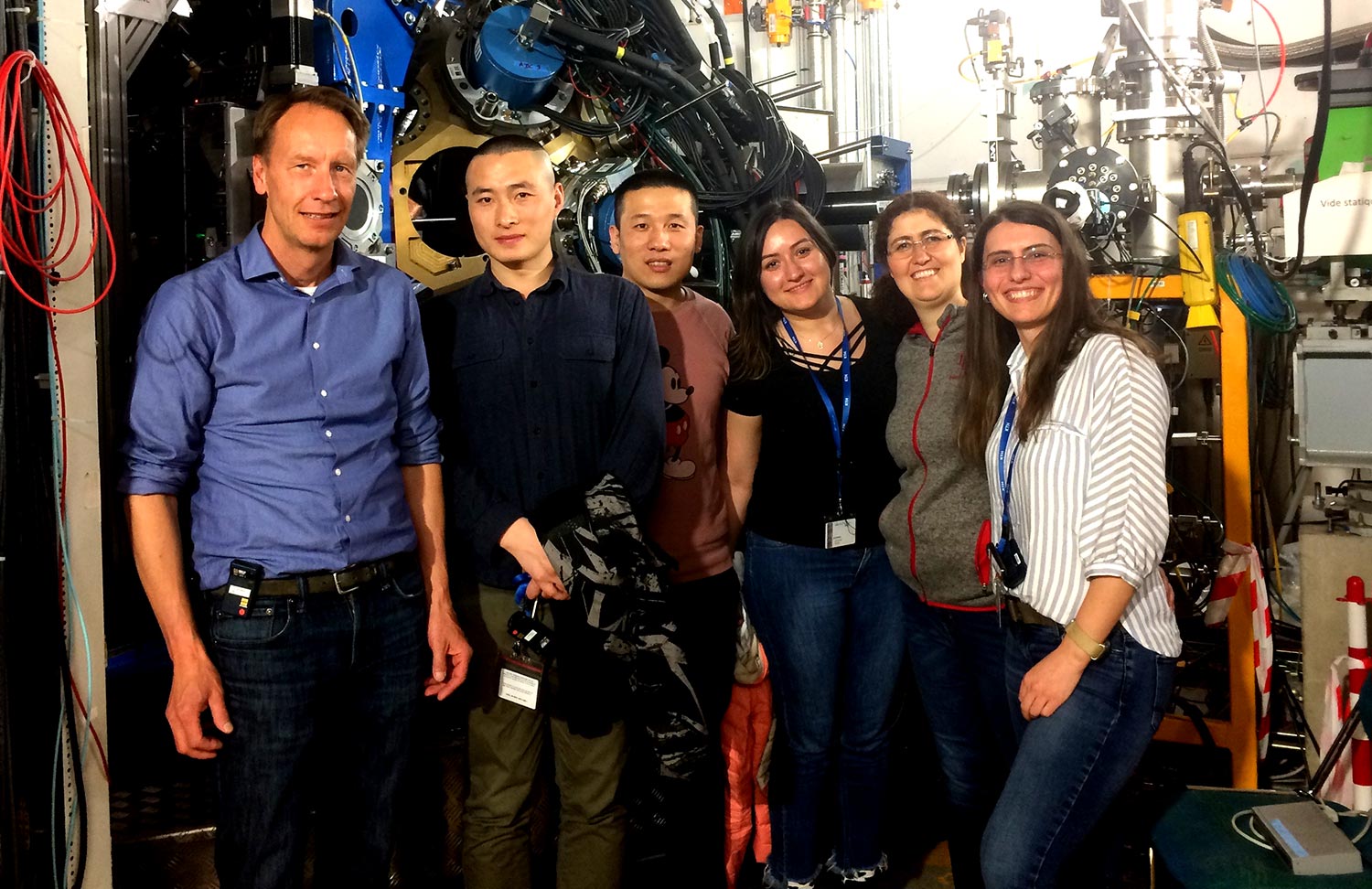
Led by Bo Cederwall, Professor of Experimental Nuclear Physics at KTH Royal Institute of Technology, an international research team identified new rotational states in the extremely neutron-deficient, deformed, atomic nucleus 88Ru. The results suggest that the structure of this exotic nuclear system is heavily influenced by the presence of strongly-coupled neutron-proton pairs.
“Such a structure is fundamentally different from the normal conditions observed in atomic nuclei, where neutrons and protons interact in pairs in separate systems, forming a near-superfluid state,” Cederwall says.
The results may also suggest alternative explanations for how the production of different chemical elements, and in particular their most neutron-poor isotopes, proceeds in the nucleosynthesis reactions in certain stellar environments such as neutron star-red giant binaries, he says.
The discovery, which was published February 12, 2020, in the journal, Physical Review Letters, results from an experiment at the Grand Accélérateur National d’Ions Lourds (GANIL), France, using the Advanced Gamma Tracking Array (AGATA).
The researchers used nuclear collisions to create highly unstable atomic nuclei with equal numbers of neutrons and protons. Their structure was studied by using sensitive instruments, including AGATA, detecting the radiation they emit in the form of high-energy photons, neutrons, protons, and other particles.
According to the Standard Model of particle physics describing the elementary particles and their interactions, there are two general types of particles in nature; bosons and fermions, which have integer and half-integer spins, respectively. Examples of fermions are fundamental particles like the electron and the electron neutrino but also composite particles like the proton and the neutron and their fundamental building blocks, the quarks. Examples of bosons are the fundamental force carriers; the photon, the intermediate vector bosons, the gluons and the graviton.
The properties of a system of particles differ considerably depending on whether it is based on fermions or bosons. As a result of the Pauli principle of quantum mechanics, in a system of fermions (such as an atomic nucleus) only one particle can hold a certain quantum state at a certain point in space and time. For several fermions to appear together, at least one property of each fermion, such as its spin, must be different. At low temperature systems of many fermions can exhibit condensates of paired particles manifested as superfluidity for uncharged particles (for example, the superfluid 3He), and superconductivity for charged particles, such as electrons in a superconductor below the critical temperature. Bosons, on the other hand, can condense individually with an unlimited number of particles in the same state, so-called Bose-Einstein condensates.
In most atomic nuclei that are close to the line of beta stability and in their ground state, or excited to an energy not too high above it, the basic structure appears to be based on pair-correlated condensates of particles with the same isospin quantum number but with opposite spins. This means that neutrons and protons are paired separately from each other. These isovector pair correlations give rise to properties similar to superfluidity and superconductivity. In deformed nuclei, this structure is for example revealed as discontinuities in the rotational frequency when the rotational excitation energy of the nucleus is increased.
Such discontinuities, which were discovered already in the early 1970s by KTH Professor emeritus Arne Johnson, have been labeled “backbending.” The backbending frequency is a measure of the energy required to break a neutron or proton pair and therefore also reflects the energy released by the formation of a pair of nucleons in the nucleus. There are long-standing theoretical predictions that systems of neutron-proton pairs can be mixed with, or even replace, the standard isovector pair correlations in exotic atomic nuclei with equal numbers of protons and neutrons. The nuclear structure resulting from the isoscalar component of such pair correlations is different from that found in “ordinary” atomic nuclei close to stability. Among different possible experimental observables, the backbending frequency in deformed nuclei is predicted to increase significantly compared with nuclei with different numbers of neutrons and protons.
The KTH research group has previously observed evidence of strong neutron-proton correlations in the spherical nuclear nucleus 92Pd, which was published in the journal Nature (B. Cederwall et al., Nature, volume 469, p 68-71 (2011)). The ruthenium isotope 88Ru, with 44 neutrons and 44 protons, is deformed and exhibits a rotation-like structure that has now been observed up to higher spin, or rotational frequency, than previously possible. The new measurement provides a different angle on nuclear pair correlations compared with the previous work. By confirming the theoretical predictions of a shift towards higher backbending frequency it provides complementary evidence for the occurrence of strong isoscalar pair correlations in the heaviest nuclear systems with equal numbers of neutrons and protons.
Reference: “Isospin Properties of Nuclear Pair Correlations from the Level Structure of the Self-Conjugate Nucleus 88Ru” by B. Cederwall, X. Liu, Ö. Aktas, A. Ertoprak, W. Zhang, C. Qi, E. Clément, G. de France, D. Ralet, A. Gadea, A. Goasduff, G. Jaworski, I. Kuti, B. M. Nyakó, J. Nyberg, M. Palacz, R. Wadsworth, J. J. Valiente-Dobón, H. Al-Azri, A. Ataç Nyberg, T. Bäck, G. de Angelis, M. Doncel, J. Dudouet, A. Gottardo, M. Jurado, J. Ljungvall, D. Mengoni, D. R. Napoli, C. M. Petrache, D. Sohler, J. Timár, D. Barrientos, P. Bednarczyk, G. Benzoni, B. Birkenbach, A. J. Boston, H. C. Boston, I. Burrows, L. Charles, M. Ciemala, F. C. L. Crespi, D. M. Cullen, P. Désesquelles, C. Domingo-Pardo, J. Eberth, N. Erduran, S. Ertürk, V. González, J. Goupil, H. Hess, T. Huyuk, A. Jungclaus, W. Korten, A. Lemasson, S. Leoni, A. Maj, R. Menegazzo, B. Million, R. M. Perez-Vidal, Zs. Podolyak, A. Pullia, F. Recchia, P. Reiter, F. Saillant, M. D. Salsac, E. Sanchis, J. Simpson, O. Stezowski, Ch. Theisen and M. Zielinska, 12 February 2020, Physical Review Letters.
DOI: 10.1103/PhysRevLett.124.062501
Never miss a breakthrough: Join the SciTechDaily newsletter.
Follow us on Google and Google News.