
Physicists Peer Into Mirror Nuclei
The atomic nucleus is a busy place. Its protons and neutrons periodically collide and fly apart with high momentum before snapping back together like the ends of a stretched rubber band. Physicists researching these energetic collisions in light nuclei discovered something unexpected: protons collide with their fellow protons and neutrons with their fellow neutrons more often than expected.
An international team of scientists, including researchers from the Department of Energy’s Lawrence Berkeley National Laboratory (Berkeley Lab), made the discovery while using the Continuous Electron Beam Accelerator Facility at the DOE’s Thomas Jefferson National Accelerator Facility (Jefferson Lab) in Virginia. Their findings were published recently in the journal Nature.
Understanding these collisions is critical for understanding data from a broad variety of basic particle physics experiments. It will also aid scientists in better understanding the structure of neutron stars, which are collapsed cores of enormous stars and among the densest forms of matter in the universe.
Berkeley Lab scientist John Arrington is one of four project spokespersons, and the paper’s lead author, Shujie Li, is a Berkeley Lab postdoc. Both work in the Nuclear Science Division of Berkeley Lab.
The particles that make up atomic nuclei, protons, and neutrons, are referred to collectively as nucleons. Physicists have previously explored intense two-nucleon collisions in a variety of nuclei ranging from carbon (with 12 nucleons) to lead (with 208). Proton-neutron collisions accounted for over 95% of all collisions, with proton-proton and neutron-neutron collisions accounting for the remaining 5%.
The new experiment at Jefferson Lab studied collisions in two “mirror nuclei” with three nucleons each, and found that proton-proton and neutron-neutron collisions were responsible for a much larger share of the total – roughly 20%. “We wanted to make a significantly more precise measurement, but we weren’t expecting it to be dramatically different,” said Arrington.
Using One Collision To Study Another
Atomic nuclei are often depicted as tight clusters of protons and neutrons stuck together, but these nucleons are actually constantly orbiting each other. “It’s like the solar system but much more crowded,” said Arrington. In most nuclei, nucleons spend about 20% of their lives in high-momentum excited states resulting from two-nucleon collisions.
To study these collisions, physicists zap nuclei with beams of high-energy electrons. By measuring the energy and recoil angle of a scattered electron, they can infer how fast the nucleon it hit must have been moving. “It’s like the difference between bouncing a ping-pong ball off a moving windshield or a stationary windshield,” said Arrington. This enables them to pick out events in which an electron scattered off a high-momentum proton that recently collided with another nucleon.
In these electron-proton collisions, the incoming electron packs enough energy to knock the already excited proton out of the nucleus altogether. This breaks the rubber band-like interaction that normally reins in the excited nucleon pair, so the second nucleon escapes the nucleus as well.
In previous studies of two-body collisions, physicists focused on scattering events in which they detected the rebounding electron along with both ejected nucleons. By tagging all the particles, they could tally up the relative number of proton-proton pairs and proton-neutron pairs. But such “triple coincidence” events are relatively rare, and the analysis required careful accounting for additional interactions between nucleons that could distort the count.
Mirror Nuclei Boost Precision
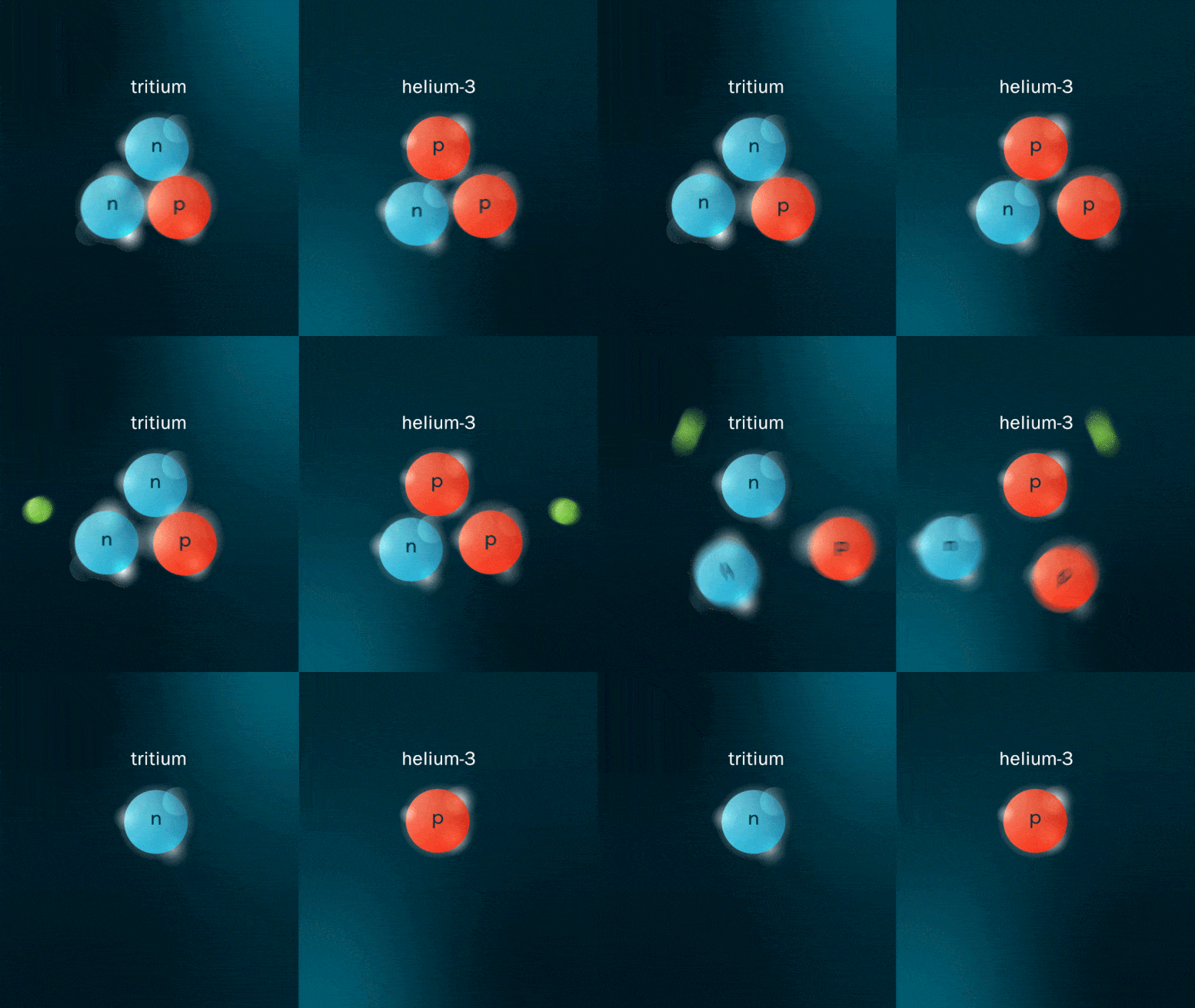
The authors of the new work found a way to establish the relative number of proton-proton and proton-neutron pairs without detecting the ejected nucleons. The trick was to measure scattering from two “mirror nuclei” with the same number of nucleons: tritium, a rare isotope of hydrogen with a single proton and two neutrons, and helium-3, which has two protons and a single neutron. Helium-3 looks just like tritium with protons and neutrons swapped, and this symmetry enabled physicists to distinguish collisions involving protons from those involving neutrons by comparing their two data sets.
The mirror nucleus effort got started after Jefferson Lab physicists made plans to develop a tritium gas cell for electron scattering experiments – the first such use of this rare and temperamental isotope in decades. Arrington and his collaborators saw a unique opportunity to study two-body collisions inside the nucleus in a new way.
The new experiment was able to gather much more data than previous experiments because the analysis didn’t require rare triple coincidence events. This enabled the team to improve on the precision of previous measurements by a factor of ten. They didn’t have reason to expect two-nucleon collisions would work differently in tritium and helium-3 than in heavier nuclei, so the results came as quite a surprise.
Strong Force Mysteries Remain
The strong nuclear force is well-understood at the most fundamental level, where it governs subatomic particles called quarks and gluons. But despite these firm foundations, the interactions of composite particles like nucleons are very difficult to calculate. These details are important for analyzing data in high-energy experiments studying quarks, gluons, and other elementary particles like neutrinos. They’re also relevant to how nucleons interact in the extreme conditions that prevail in neutron stars.
Arrington has a guess as to what might be going on. The dominant scattering process inside nuclei only happens for proton-neutron pairs. But the importance of this process relative to other types of scattering that don’t distinguish protons from neutrons may depend on the average separation between nucleons, which tends to be larger in light nuclei like helium-3 than in heavier nuclei.
More measurements using other light nuclei will be required to test this hypothesis. “It’s clear helium-3 is different from the handful of heavy nuclei that were measured,” Arrington said. “Now we want to push for more precise measurements on other light nuclei to yield a definitive answer.”
Reference: “Revealing the short-range structure of the mirror nuclei 3H and 3He” by S. Li, R. Cruz-Torres, N. Santiesteban, Z. H. Ye, D. Abrams, S. Alsalmi, D. Androic, K. Aniol, J. Arrington, T. Averett, C. Ayerbe Gayoso, J. Bane, S. Barcus, J. Barrow, A. Beck, V. Bellini, H. Bhatt, D. Bhetuwal, D. Biswas, D. Bulumulla, A. Camsonne, J. Castellanos, J. Chen, J.-P. Chen, D. Chrisman, M. E. Christy, C. Clarke, S. Covrig, K. Craycraft, D. Day, D. Dutta, E. Fuchey, C. Gal, F. Garibaldi, T. N. Gautam, T. Gogami, J. Gomez, P. Guèye, A. Habarakada, T. J. Hague, J. O. Hansen, F. Hauenstein, W. Henry, D. W. Higinbotham, R. J. Holt, C. Hyde, T. Itabashi, M. Kaneta, A. Karki, A. T. Katramatou, C. E. Keppel, M. Khachatryan, V. Khachatryan, P. M. King, I. Korover, L. Kurbany, T. Kutz, N. Lashley-Colthirst, W. B. Li, H. Liu, N. Liyanage, E. Long, J. Mammei, P. Markowitz, R. E. McClellan, F. Meddi, D. Meekins, S. Mey-Tal Beck, R. Michaels, M. Mihovilovič, A. Moyer, S. Nagao, V. Nelyubin, D. Nguyen, M. Nycz, M. Olson, L. Ou, V. Owen, C. Palatchi, B. Pandey, A. Papadopoulou, S. Park, S. Paul, T. Petkovic, R. Pomatsalyuk, S. Premathilake, V. Punjabi, R. D. Ransome, P. E. Reimer, J. Reinhold, S. Riordan, J. Roche, V. M. Rodriguez, A. Schmidt, B. Schmookler, E. P. Segarra, A. Shahinyan, K. Slifer, P. Solvignon, S. Širca, T. Su, R. Suleiman, H. Szumila-Vance, L. Tang, Y. Tian, W. Tireman, F. Tortorici, Y. Toyama, K. Uehara, G. M. Urciuoli, D. Votaw, J. Williamson, B. Wojtsekhowski, S. Wood, J. Zhang and X. Zheng, 31 August 2022, Nature.
DOI: 10.1038/s41586-022-05007-2
The study was funded by the Department of Energy Office of Science.
Never miss a breakthrough: Join the SciTechDaily newsletter.
Follow us on Google and Google News.
2 Comments
Topology is a subject that truly describes nature, research on it could greatly expand the boundaries of human cognition.The interaction of topological vortex field is the basis of the evolution of cosmic matter movement, covers all short-distance and long-distance contributions. If there is no physical environment with dark matter and dark energy topological vortexes, there can be neither all kinds of celestial bodies and microscopic particles nor the interaction of them.
… in order to understand the stars, the scientists should understand how shoe lace works… and it doesn’t have anything to do with genes, not this time…