Close Menu
    Facebook X (Twitter) Instagram
    SciTechDaily
    • Biology
    • Chemistry
    • Earth
    • Health
    • Physics
    • Science
    • Space
    • Technology
    Facebook X (Twitter) Pinterest YouTube RSS
    SciTechDaily
    Home»Technology»Soft, Stretchy and Strong Electronic Skin Mimics Natural Functions of Human Skin
    Technology

    Soft, Stretchy and Strong Electronic Skin Mimics Natural Functions of Human Skin

    By King Abdullah University of Science & Technology (KAUST)December 1, 2020No Comments3 Mins Read
    Facebook Twitter Pinterest Telegram LinkedIn WhatsApp Email Reddit
    Share
    Facebook Twitter LinkedIn Pinterest Telegram Email Reddit
    KAUST Electronic Skin
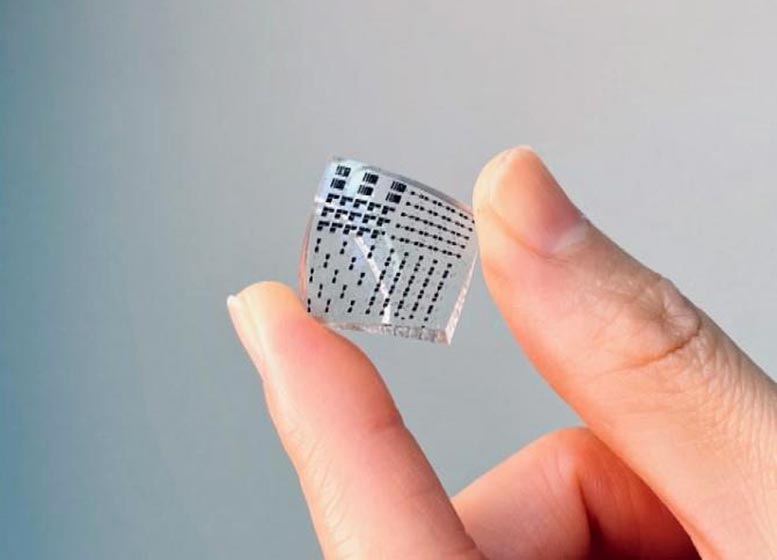
    KAUST researchers have developed a durable “electronic skin” that can mimic natural functions of human skin, such as sensing temperature and touch. Credit: © 2020 KAUST

    Soft, stretchy, slimline, and strong electronics could accelerate the arrival of artificial skin.

    A material that mimics human skin in strength, stretchability, and sensitivity could be used to collect biological data in real time. Electronic skin, or e-skin, may play an important role in next-generation prosthetics, personalized medicine, soft robotics, and artificial intelligence.

    “The ideal e-skin will mimic the many natural functions of human skin, such as sensing temperature and touch, accurately and in real time,” says KAUST postdoc Yichen Cai. However, making suitably flexible electronics that can perform such delicate tasks while also enduring the bumps and scrapes of everyday life is challenging, and each material involved must be carefully engineered.

    Most e-skins are made by layering an active nanomaterial (the sensor) on a stretchy surface that attaches to human skin. However, the connection between these layers is often too weak, which reduces the durability and sensitivity of the material; alternatively, if it is too strong, flexibility becomes limited, making it more likely to crack and break the circuit.

    Hydrogel Reinforced Electronic Skin
    A durable e-skin developed at KAUST using a hydrogel reinforced with silica nanoparticles forms a strong and stretchy substrate. Credit: © 2020 KAUST

    “The landscape of skin electronics keeps shifting at a spectacular pace,” says Cai. “The emergence of 2D sensors has accelerated efforts to integrate these atomically thin, mechanically strong materials into functional, durable artificial skins.”

    A team led by Cai and colleague Jie Shen has now created a durable e-skin using a hydrogel reinforced with silica nanoparticles as a strong and stretchy substrate and a 2D titanium carbide MXene as the sensing layer, bound together with highly conductive nanowires.

    “Hydrogels are more than 70 percent water, making them very compatible with human skin tissues,” explains Shen. By pre-stretching the hydrogel in all directions, applying a layer of nanowires, and then carefully controlling its release, the researchers created conductive pathways to the sensor layer that remained intact even when the material was stretched to 28 times its original size.
    Their prototype e-skin could sense objects from 20 centimeters (8 inches) away, respond to stimuli in less than one-tenth of a second, and when used as a pressure sensor, could distinguish handwriting written upon it. It continued to work well after 5,000 deformations, recovering in about a quarter of a second each time. “It is a striking achievement for an e-skin to maintain toughness after repeated use,” says Shen, “which mimics the elasticity and rapid recovery of human skin.”
    This type of e-skin could monitor a range of biological information, such as changes in blood pressure, which can be detected from vibrations in the arteries, and movements of large limbs and joints. This data can then be shared and stored on the cloud via Wi-Fi.
    “One remaining obstacle to the widespread use of e-skins lies in scaling up of high-resolution sensors,” adds group leader Vincent Tung; “however, laser-assisted additive manufacturing offers new promise.”
    “We envisage a future for this technology beyond biology,” adds Cai. “Stretchable sensor tape could one day monitor the structural health of inanimate objects, such as furniture and aircraft.”

    Never miss a breakthrough: Join the SciTechDaily newsletter.
    Follow us on Google and Google News.

    Biomedical Engineering Biotechnology KAUST Materials Science
    Share. Facebook Twitter Pinterest LinkedIn Email Reddit

    Related Articles

    Sweat-Proof Electronic “Smart Skin” Takes Reliable Vitals, Even During Workouts

    Revolutionary Self-Aware Materials Build the Foundation for Living Structures

    Patching Up Your Health: Ultrathin Self-Powered E-health Patches

    Stretchy “Electronic Skin” Promises Cheap and Recyclable Alternative to Wearable Devices

    New 3D-Printable Material Developed That Mimics Biological Tissues

    Stretchable High Efficiency Solar Cells for Wearable Electronics or Flexible Robot Skin

    Artificial Magnetic Skin Ensures the Force Is With You [Video]

    New Nanofiber Dressings Dramatically Accelerate Healing and Tissue Regeneration

    This Ultrathin Miniaturized System Can Deliver Drugs Directly to the Brain

    Leave A Reply Cancel Reply

    • Facebook
    • Twitter
    • Pinterest
    • YouTube

    Don't Miss a Discovery

    Subscribe for the Latest in Science & Tech!

    Trending News

    Monster Storms on Jupiter Unleash Lightning Beyond Anything on Earth

    Scientists Create “Liquid Gears” That Spin Without Touching

    The Simple Habit That Could Help Prevent Cancer

    Millions Take These IBS Drugs, But a New Study Finds Serious Risks

    Scientists Unlock Hidden Secrets of 2,300-Year-Old Mummies Using Cutting-Edge CT Scanner

    Bread Might Be Making You Gain Weight Even Without Eating More Calories

    Scientists Discover Massive Magma Reservoir Beneath Tuscany

    Europe’s Most Active Volcano Just Got Stranger – Here’s Why Scientists Are Rethinking It

    Follow SciTechDaily
    • Facebook
    • Twitter
    • YouTube
    • Pinterest
    • Newsletter
    • RSS
    SciTech News
    • Biology News
    • Chemistry News
    • Earth News
    • Health News
    • Physics News
    • Science News
    • Space News
    • Technology News
    Recent Posts
    • New Brain Discovery Challenges Long-Held Theory of Teenage Brain Development
    • Sharks Are Overheating as Warming Oceans Push Them to the Edge
    • Scientists Discover Plants “Scream” – We Just Couldn’t Hear Them Until Now
    • 25-Year Study Uncovers Hidden Paths and Early Warning Signs of Blood Cancer
    • Not Just Snoring – New Research Reveals Sleep Apnea May Be Damaging Your Muscles
    Copyright © 1998 - 2026 SciTechDaily. All Rights Reserved.
    • Science News
    • About
    • Contact
    • Editorial Board
    • Privacy Policy
    • Terms of Use

    Type above and press Enter to search. Press Esc to cancel.