
Close Menu
    Facebook X (Twitter) Instagram
    SciTechDaily
    • Biology
    • Chemistry
    • Earth
    • Health
    • Physics
    • Science
    • Space
    • Technology
    Facebook X (Twitter) Pinterest YouTube RSS
    SciTechDaily
    Home»Technology»Stretchable High Efficiency Solar Cells for Wearable Electronics or Flexible Robot Skin
    Technology

    Stretchable High Efficiency Solar Cells for Wearable Electronics or Flexible Robot Skin

    By King Abdullah University of Science & Technology (KAUST)December 23, 2019No Comments3 Mins Read
    Facebook Twitter Pinterest Telegram LinkedIn WhatsApp Email Reddit
    Share
    Facebook Twitter LinkedIn Pinterest Telegram Email Reddit
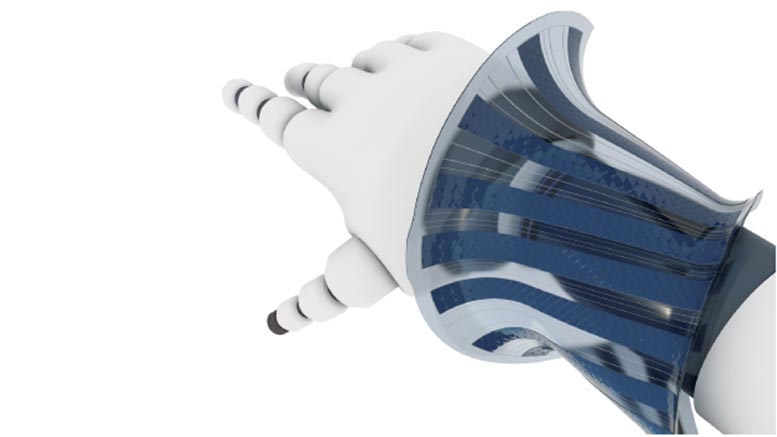
    Flexible Solar Cell Illustration
    Combining silicon with a highly elastic polymer backing produces solar cells that have record-breaking stretchability and high efficiency. Credit: © 2019 KAUST; Heno Hwang

    Combining silicon with a highly elastic polymer backing produces solar cells that have record-breaking stretchability and high efficiency.

    Crystalline silicon solar panels could be just as effective when incorporated into stretchy wearable electronics or flexible robot skin as they are when used as rigid rooftop panels. KAUST researchers have devised a way to turn rigid silicon into solar cells that can be stretched by a record-breaking 95 percent, while retaining high solar energy capture efficiency of 19 percent.

    Although many new solar materials are being investigated, silicon remains by far the photovoltaic industry’s favorite. “Monocrystalline silicon remains the material of choice in the PV industry due to its low cost, nontoxicity, excellent reliability, good efficiency and maturity of the manufacturing process,” says Nazek El-Atab, a postdoctoral researcher in the labs of Muhammad Mustafa Hussain.

    One drawback of silicon, for certain applications, is its rigidity, unlike some thin film solar cells. However, these flexible cells either consist of low-cost, low-efficiency organic materials or more efficient but very expensive inorganic materials. Hussain and his team have now taken a significant step toward overcoming this limitation by developing low-cost, high-efficiency, silicon-based stretchy solar cells.
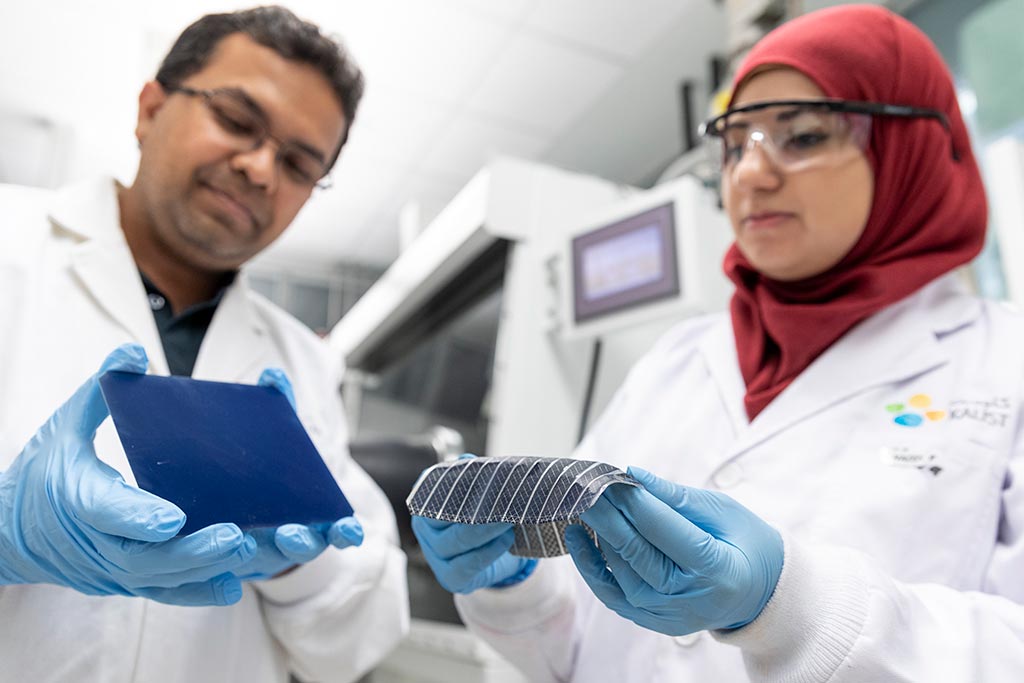
    Rigid vs Flexible Solar Cells
    Muhammad Mustafa Hussain (left) Nazek El-Atab compare the flexibility of their solar cell with the rigid nature of a typical silicon solar cell. Credit: © 2019 KAUST

    The key step was to take a commercially available rigid silicon panel and coat the back of the panel with a highly stretchable, inexpensive, biocompatible elastomer called ecoflex. The team then used a laser to cut the rigid cell into multiple silicon islands, which were held together by the elastomer backing. Each silicon island remained electrically connected to its neighbors via interdigitated back contacts that ran the length of the flexible solar cell.
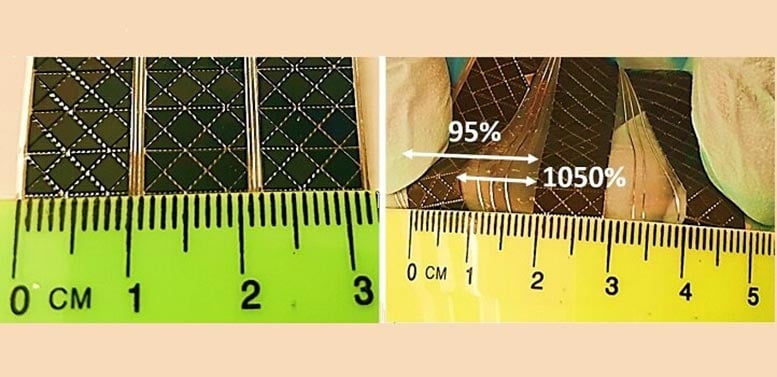
    Triangle Pattern Stretchable Solar Cell
    The triangular pattern proved to be the most stretchy design. Credit: Wiley-VCH

    The team initially made rectangle-shaped silicon islands, which could be stretched to around 54 percent, Hussain says. “Beyond this value, the strain of stretching led to diagonal cracks within the brittle silicon islands,” he says. The team tried different designs to push the stretchability further, mindful that each slice of silicon they removed reduced the area available for light capture. The team tried a diamond pattern before settling on triangles. “Using the triangular pattern, we achieve world record stretchability and efficiency,” Hussain says.

    The team plans to incorporate the stretchy silicon solar material to power a multisensory artificial skin developed by Hussain’s lab. Making solar panels that stretch with even greater flexibility is also a target. “The demonstrated solar cells can be mainly stretched in one direction—parallel to the interdigitated back contacts grid,” Hussain says. “We are working to improve the multidirectional stretching capability.”

    Reference: “Corrugation Enabled Asymmetrically Ultrastretchable (95%) Monocrystalline Silicon Solar Cells with High Efficiency (19%)” by Nazek El‐Atab, Nadeem Qaiser, Rabab Bahabry and Muhammad Mustafa Hussain, 16 October 2019, Advanced Energy Materials.
    DOI: 10.1002/aenm.201902883

    Never miss a breakthrough: Join the SciTechDaily newsletter.
    Follow us on Google and Google News.

    Biotechnology KAUST Materials Science Popular Solar Cells
    Share. Facebook Twitter Pinterest LinkedIn Email Reddit

    Related Articles

    Soft, Stretchy and Strong Electronic Skin Mimics Natural Functions of Human Skin

    Stretchy “Electronic Skin” Promises Cheap and Recyclable Alternative to Wearable Devices

    Coating Dental and Orthopedic Implants With “Artificial Bone” to Prevent Inflammation

    Two Layers Are Better Than One for Efficient Solar Cells – Affordable, Thin Film Solar Cells With 34% Efficiency

    New Material Can Generate Hydrogen From Fresh, Salt, or Polluted Water by Exposure to Sunlight

    Breakthrough Self-Assembly Innovation Enables Cheaper Solar Energy Production

    New Efficiency Record Set by Novel Multi-Material Solar Cells

    Artificial Magnetic Skin Ensures the Force Is With You [Video]

    Solar Cell Performance Boosted by Biological Material That Mimics Photosynthesis

    Leave A Reply Cancel Reply

    • Facebook
    • Twitter
    • Pinterest
    • YouTube

    Don't Miss a Discovery

    Subscribe for the Latest in Science & Tech!

    Trending News

    The Universe Is Expanding Too Fast and Scientists Can’t Explain Why

    “Like Liquid Metal”: Scientists Create Strange Shape-Shifting Material

    Early Warning Signals of Esophageal Cancer May Be Hiding in Plain Sight

    Common Blood Pressure Drug Shows Surprising Power Against Deadly Antibiotic-Resistant Superbug

    Scientists Uncover Dangerous Connection Between Serotonin and Heart Valve Disease

    Scientists Discover a “Protector” Protein That Could Help Reverse Hair Loss

    Bone-Strengthening Discovery Could Reverse Osteoporosis

    Scientists Uncover Hidden Trigger Behind Stem Cell Aging

    Follow SciTechDaily
    • Facebook
    • Twitter
    • YouTube
    • Pinterest
    • Newsletter
    • RSS
    SciTech News
    • Biology News
    • Chemistry News
    • Earth News
    • Health News
    • Physics News
    • Science News
    • Space News
    • Technology News
    Recent Posts
    • Scientists Overcome Major Quantum Bottleneck, Potentially Transforming Teleportation and Computing
    • Quantum Physics’ Strangest Problem May Hold the Key to Time Itself
    • Scientists Create “Liquid Gears” That Spin Without Touching
    • The Simple Habit That Could Help Prevent Cancer
    • Forgotten Medicinal Plant Shows Promise in Fighting Dangerous Superbugs
    Copyright © 1998 - 2026 SciTechDaily. All Rights Reserved.
    • Science News
    • About
    • Contact
    • Editorial Board
    • Privacy Policy
    • Terms of Use

    Type above and press Enter to search. Press Esc to cancel.