
Solar cells have come a long way, but inexpensive, thin-film solar cells are still far behind more expensive, crystalline solar cells in efficiency. Now, a team of researchers suggests that using two thin films of different materials may be the way to go to create affordable, thin film cells with about 34% efficiency.
“Ten years ago I knew very little about solar cells, but it became clear to me they were very important,” said Akhlesh Lakhtakia, Evan Pugh University Professor and Charles Godfrey Binder Professor of Engineering Science and Mechanics, Penn State.
Investigating the field, he found that researchers approached solar cells from two sides, the optical side — looking on how the sun’s light is collected — and the electrical side — looking at how the collected sunlight is converted into electricity. Optical researchers strive to optimize light capture, while electrical researchers strive to optimize conversion to electricity, both sides simplifying the other.
“I decided to create a model in which both electrical and optical aspects will be treated equally,” said Lakhtakia. “We needed to increase actual efficiency, because if the efficiency of a cell is less than 30% it isn’t going to make a difference.” The researchers report their results in a recent issue of Applied Physics Letters.
Lakhtakia is a theoretician. He does not make thin films in a laboratory, but creates mathematical models to test the possibilities of configurations and materials so that others can test the results. The problem, he said, was that the mathematical structure of optimizing the optical and the electrical are very different.
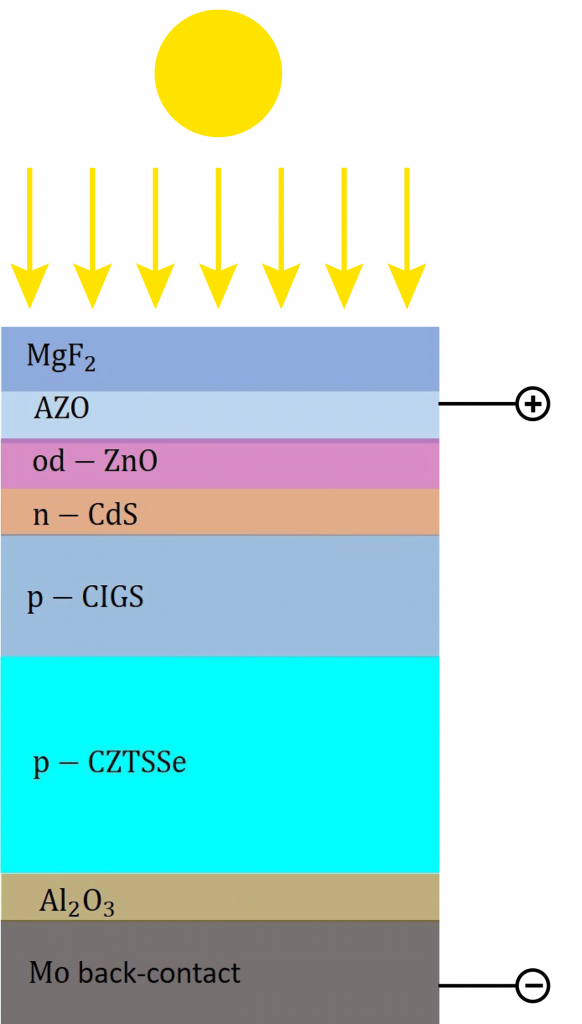
Solar cells appear to be simple devices, he explained. A clear top layer allows sunlight to fall on an energy conversion layer. The material chosen to convert the energy, absorbs the light and produces streams of negatively charged electrons and positively charged holes moving in opposite directions. The differently charged particles get transferred to a top contact layer and a bottom contact layer that channel the electricity out of the cell for use. The amount of energy a cell can produce depends on the amount of sunlight collected and the ability of the conversion layer. Different materials react to and convert different wavelengths of light.
“I realized that to increase efficiency we had to absorb more light,” said Lakhtakia. “To do that we had to make the absorbent layer nonhomogeneous in a special way.”
That special way was to use two different absorbent materials in two different thin films. The researchers chose commercially available CIGS — copper indium gallium diselenide — and CZTSSe — copper zinc tin sulfur selenide — for the layers. By itself, CIGS’s efficiency is about 20% and CZTSSe’s is about 11%.
These two materials work in a solar cell because the structure of both materials is the same. They have roughly the same lattice structure, so they can be grown one on top of the other, and they absorb different frequencies of the spectrum so they should increase efficiency, according to Lakhtakia.
“It was amazing,” said Lakhtakia. “Together they produced a solar cell with 34% efficiency. This creates a new solar cell architecture — layer upon layer. Others who can actually make solar cells can find other formulations of layers and perhaps do better.”
According to the researchers, the next step is to create these experimentally and see what the options are to get the final, best answers.
Reference: “Double-absorber thin-film solar cell with 34% efficiency” by Faiz Ahmad, Akhlesh Lakhtakia and Peter B. Monk, 20 July 2020, Applied Physics Letters.
DOI: 10.1063/5.0017916
The first author of the paper is Faiz Ahmad, doctoral student in engineering science and mechanics, Penn State. Peter B. Monk, Unidel Professor of Mathematical Sciences, University of Delaware, filled out the research team.
The National Science Foundation supported this research.
Never miss a breakthrough: Join the SciTechDaily newsletter.
Follow us on Google and Google News.
12 Comments
… Something like CD and DVD, and DVD is better than CD, but…
What about the toxic waste it produces at eol?
What about mining lithium, the fracking, gases and carbon created just mining.
Solar is a scam
Broccoli and all the other plants, we eat, and they animals eat, must be a scam too. They are less than 6% efficient…with most below 4%. The sun is a scam!!
Dude, you don’t care about toxins.
Copper indium gallium diselenide, and copper zinc tin sulfur selenide?
None of those are particularly toxic.
Copper, selenium, zinc, tin and sulfur are needed for human nutrition. That leaves indium and gallium. Indium is classified as mildly toxic. Gallium is nontoxic.
These are not the bad boys. The bad boys being: lead, arsenic, cadmium and mercury.
This is the solar module paradigm that the solar module industry has been suffering through for its entire existence.
Develop a high efficiency, very exciting solar cell in the lab but with no idea about how to manufacture it at scale to move the cost and supply needles in an appreciable amount. A CIGS semiconductor manufacturing line at present will not result in a $0.15/W module ASP. And then there is the indium rare earth problem.
Someone correct me if I am wrong on the CIGS manufacturing platform issue but if we are to sorely needed innovation to meet the solar decarbonization pathway increase of 3X – 5X, this is not likely the winner.
Shut up Joe and suck your OIL
Dave, production costs fall as experience is gained. That is as true with solar panels as with other products.
When a new technology becomes available, such as this two-absorber thin film solar converter, the production costs will start much higher than existing technology. Often, though not always, the learning curve allows manufacturing costs to fall for the new technology below the manufacturing cost of the existing technology.
Joe, where did you get that lithium?! Did you read beyond the title? Of course not, only lazy people share your bs opinions.
Very informative and encouraging progress toward sustainable energy
This is in open that Boing have been making 5 junction (multi layered) solar cells for space appli ations with approx 50% effeciency. NREL tested systems that achieved upto 54% effeciency. Good to see that cost effective efforts in multijunctions have started.
Still theoretical. But I love theoretical exploration. Eventually we will find solutions capable of absorbing and converting many more wavelengths in one layer. Optimizing the lattice structures within, not on top of, each other… they is going to be the way to go. Of course your layers will end up looking like patches on a soccer ball (ahem… football) and there goes your “thin” definition. But we humans are pretty good at solving weird problems. Just not when money is the factor preventing further experimentation.
If this is in fact true, then prismatic light septation might allow for strips of differing materials (rather then layers) optimized for absorbsion of specific wavelengths to be employed to more fully utalize ( boost efficiency) the given capture area.
I am assuming that the two cells are in series, which would up the voltage, but if the two cells are not matched current wise, will cause the lesser of the two to limit the max current…
But it could be that the two cells are in parallel… If the two are not electrical force matched the higher voltage would block the lower voltage cell until load draws it down to match, and then you can add the current of the two….