
Key step towards cheaper and more effective solar energy.
A new study reports the highest efficiency ever recorded for full roll-to-roll printed perovskite solar cells (PSCs), marking a key step on the way to cheaper and more efficient ways of generating solar energy.
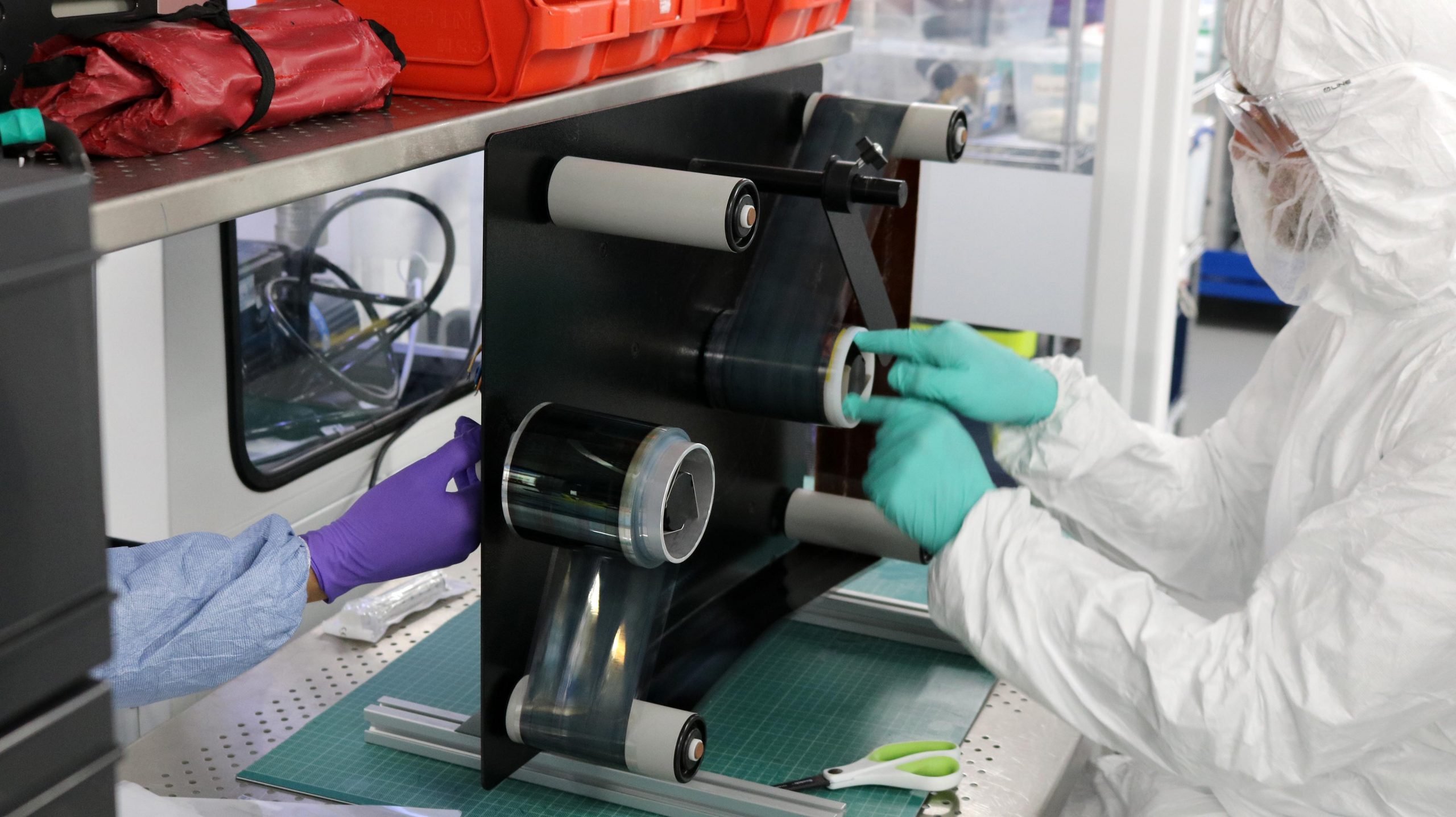
A team at Swansea University’s SPECIFIC Innovation and Knowledge Centre, led by Professor Trystan Watson, has reported using a roll-to-roll fabrication method for four layers of slot-die-coated PSCs.
The PSCs gave the stable power output of 12.2% — the highest efficiency recorded for four layers of roll-to-roll printed PSCs to date.
A newcomer to the photovoltaic industry, PSCs have gathered remarkable attention from researchers around the globe. With efficiency reaching similar levels to those of silicon photovoltaics (PV), the current market leader, attention has been diverted towards upscaling PSCs.
In contrast to silicon PV, which requires high temperature and high vacuum depositions, PSCs can be solution-processed at a low temperature, which significantly reduces the manufacturing cost.
Low temperature processing makes it possible to use plastic substrates to create flexible solar cells.
The ability to solution-process provides the opportunity to apply various well-developed printing and coating techniques:
- Screen printing
- Inkjet printing
- Gravure printing
- Slot-die coating
- Spray coating
These advantages made it possible for Swansea University researchers to use roll-to-roll manufacturing for four layers of PSCs.
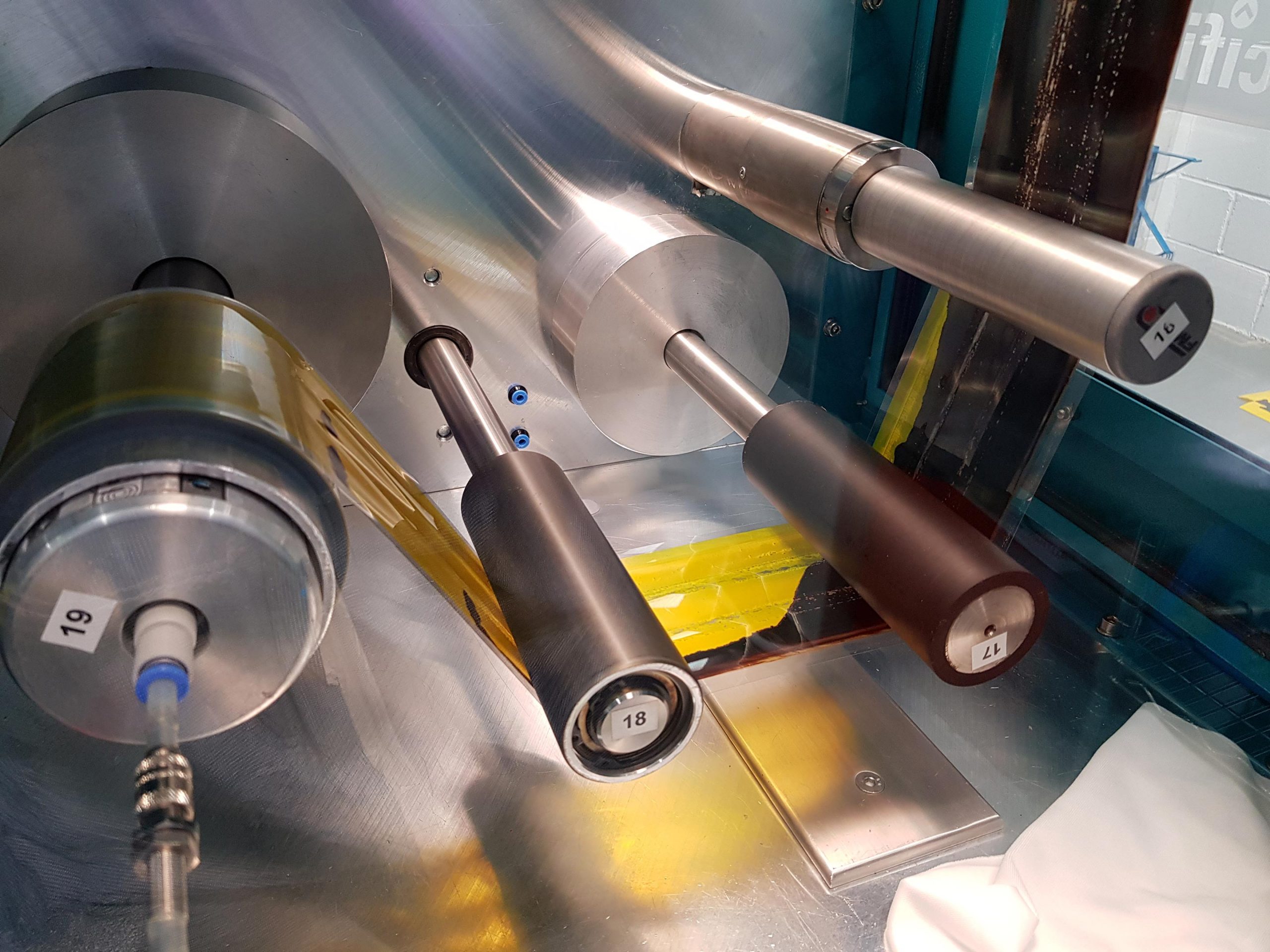
Slot-die coating provides several advantages over the alternatives: it is a pre-metered technique, which means the wet film thickness can be controlled before coating. It is also highly efficient in material usage, with minimal loss of material compared with spray coating or screen printing.
Using the necessary toxic solvents at an industrial scale requires a lot of air handling to stay under the safety limits, which can incur significant and unnecessary expenses. For this reason, an acetonitrile-based system was used. This system has a rheological advantage due to low viscosity and low surface tension, which results in better coatings.
Along with this, a ternary blend of high workplace exposure limit solvents was introduced, replacing chlorobenzene for the deposition of hole transport material. In this research, the PSCs gave the stable power output of 12.2%, which is the highest efficiency reported for four layers of roll-to-roll printed PSCs.
A complete solar cell for a chosen architecture requires coating five layers. In this case, four layers were coated using slot-die coating and the top contact was put on using thermal evaporation. Slot-die coating the fifth (top) contact without destroying any layers underneath has not yet been achieved. Solving this would enable the manufacture of a fully roll-to-roll printed PSC.
Rahul Patidar of SPECIFIC, lead researcher on the project, said:
“Perovskite solar cells aim to increase the efficiency and lower the cost of traditional solar energy generation. They have the potential to be highly efficient and relatively cheap to manufacture, so the aim is to improve fabrication methods for upscaling.
This study signifies the next step towards commercialization.”
The research was published in Sustainable Energy and Fuels.
Reference: “Roll-to-roll slot-die coated P–I–N perovskite solar cells using acetonitrile based single step perovskite solvent system” by Daniel Burkitt, Rahul Patidar, Peter Greenwood, Katherine Hooper, James McGettrick, Stoichko Dimitrov, Matteo Colombo, Vasil Stoichkov, David Richards, David Beynon, Matthew Davies and Trystan Watson, 4 May 2020, Sustainable Energy and Fuels.
DOI: 10.1039/D0SE00460J
SPECIFIC Innovation & Knowledge Centre aims to reduce carbon emissions from buildings by developing a range of technologies that use solar energy to generate, store and release heat and electricity in buildings. The center works at all scales from the fundamental lab science to full-scale demonstration on buildings and works with industry partners to bring new technologies to market. SPECIFIC is led by Swansea University and is funded by the European Regional Development Fund through the Welsh Government, Innovate UK and EPSRC.
Never miss a breakthrough: Join the SciTechDaily newsletter.
Follow us on Google and Google News.