
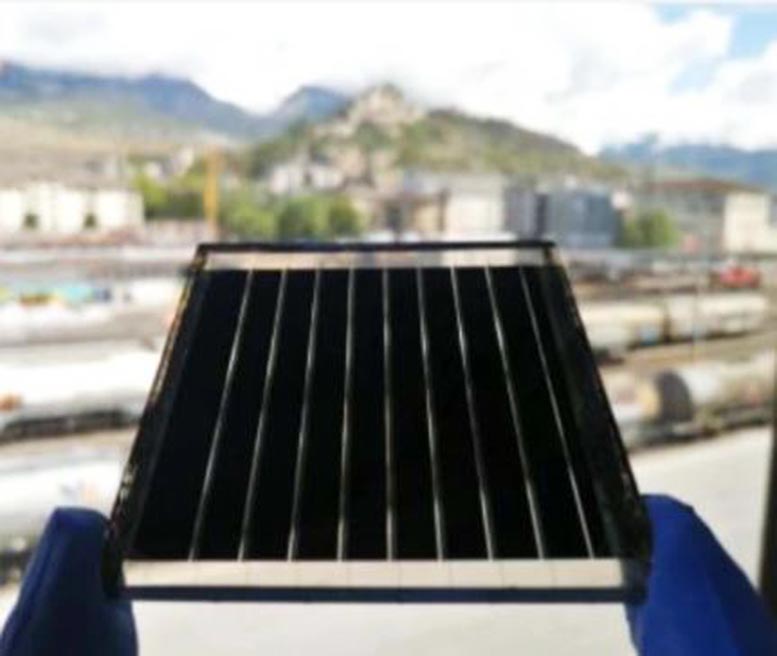
A group of chemists synthesized materials that were used for constructing a record-breaking perovskite solar module, with an efficiency of 21.4 percent. This was achieved through the passivation of the active solar cell layer, which increases the efficiency of the cell and significantly improves its stability.
Perovskite solar cells (PSCs) are one of the world’s fastest-growing solar cell technologies. These elements are thin-layered, lightweight, flexible, and are made of low-cost materials. However, this type of solar cell still faces a major issue: quick degradation of perovskite material under environmental conditions.
Passivation is a simple but effective way to improve the stability of perovskite solar cells and has been considered as one of the most effective strategies for eliminating the defects of perovskite materials and their negative effects. The passivated perovskite surface becomes more resistant to ambient conditions as temperature or humidity, and more stable, extending the durability of the device.
Synthesized Materials Were Used in Solar Mini-Modules
Kaunas University of Technology (KTU), Lithuania chemists, together with researchers from science centers in China, Italy, Lithuania, Switzerland, and Luxembourg, significantly improved the stability of perovskite solar cells using the passivation method. The perovskite surface becomes chemically inactive during passivation, thereby eliminating perovskite defects that occur during manufacture. The ensuing perovskite solar cells achieve an efficiency of 23.9 percent with long-term operational stability (over 1000 h).

“Passivation has been applied previously, but so far, a two-dimensional (2D) layer of perovskite is being formed on the traditional three-dimensional (3D) perovskite light absorber, making it difficult for carriers to move, especially at higher temperatures. It is critical to avoid this because the solar cells become hot,” says co-author of the invention, KTU chief researcher Dr. Kasparas Rakštys.
To address this issue, an international team of researchers conducted a study that estimated the minimum energy required to form 2D perovskites. The surface of the 3D perovskite layer was passivated by different isomers of phenylethylammonium iodide synthesized by KTU. These isomers have the same molecular formula but different arrangements of atoms in space, determining the probability of 2D perovskite formation.
Researchers from the Lausanne Federal Institute of Technology (EPFL) in Switzerland tested the materials in perovskite solar mini-modules with an active area over 300 times larger than typical, laboratory-scale perovskite solar cells. These mini-modules achieved a record solar energy conversion efficiency of 21.4 percent. The surface of the perovskite layer of the record-breaking mini-solar modules was coated with materials developed by KTU chemists.
“The study proved to be quite effective in preventing the negative effects of passivation on solar cells. It has been discovered that an isomer with the passivation groups closest to each other leads to the most efficient passivation due to the steric hindrance that avoids 2D perovskite formation. Interestingly, steric hindrance is also used as a tool in different areas of chemistry to prevent or slow down undesirable reactions,” says the KTU researcher.
Achievements and Future Directions
The study was published in Nature Communications, one of the world’s most respected scientific journals.
At the moment, KTU researchers are working with colleagues from other countries to produce functional, hole-transporting materials and new perovskite compositions. According to Dr. Rakštys: “International cooperation in science is vital because it is impossible to cover all the areas as chemistry, physics, and materials science working in such interdisciplinary field.”
After graduating with MSc in Applied Chemistry from KTU, Dr. Rakštys earned his PhD in EPFL, Switzerland, and later continued as a postdoctoral researcher in UQ, Australia. Today he is working at KTU.
Commitment to Local and Global Scientific Advancement
“After spending over 6 years in prestigious foreign research institutions, I decided to realize my scientific ideas in Lithuania, and thus contribute to the successful growth and popularisation of science in Lithuania. I believe that working in your own country can provide more meaning, inspiration, and self-realization. The financial support provided by the MJJ Foundation has contributed significantly to this decision,” says Dr. Rakštys.
Researchers at KTU synthesize, test, and aim to apply new materials for the production of more efficient and stable solar cells.
“This is a very appealing area because perovskite solar cells are currently one of the fastest-growing technologies, and their successful commercialization could contribute to climate change solutions,” says Dr. Rakštys.
This is not the first time that KTU scientists have set a world record in solar technologies. KTU chemists, together with physicists at Berlin’s Helmholtz-Zentrum (HZB) Research Institute in Berlin, have improved the efficiency of tandem silicon-perovskite solar cells, which now stands at 29.8 percent. It is a world record for this type of solar element.
Reference: “Tuning structural isomers of phenylenediammonium to afford efficient and stable perovskite solar cells and modules” by Cheng Liu, Yi Yang, Kasparas Rakstys, Arup Mahata, Marius Franckevicius, Edoardo Mosconi, Raminta Skackauskaite, Bin Ding, Keith G. Brooks, Onovbaramwen Jennifer Usiobo, Jean-Nicolas Audinot, Hiroyuki Kanda, Simonas Driukas, Gabriele Kavaliauskaite, Vidmantas Gulbinas, Marc Dessimoz, Vytautas Getautis, Filippo De Angelis, Yong Ding, Songyuan Dai, Paul J. Dyson and Mohammad Khaja Nazeeruddin, 4 November 2021, Nature Communications.
DOI: 10.1038/s41467-021-26754-2
Never miss a breakthrough: Join the SciTechDaily newsletter.
Follow us on Google and Google News.