
Close Menu
    Facebook X (Twitter) Instagram
    SciTechDaily
    • Biology
    • Chemistry
    • Earth
    • Health
    • Physics
    • Science
    • Space
    • Technology
    Facebook X (Twitter) Pinterest YouTube RSS
    SciTechDaily
    Home»Technology»New Eco-Friendly Color Thin-Film Solar Cells
    Technology

    New Eco-Friendly Color Thin-Film Solar Cells

    By National Research Council of Science & TechnologyOctober 3, 20203 Comments3 Mins Read
    Facebook Twitter Pinterest Telegram LinkedIn WhatsApp Email Reddit
    Share
    Facebook Twitter LinkedIn Pinterest Telegram Email Reddit
    CIGS Thin Film Solar Cells
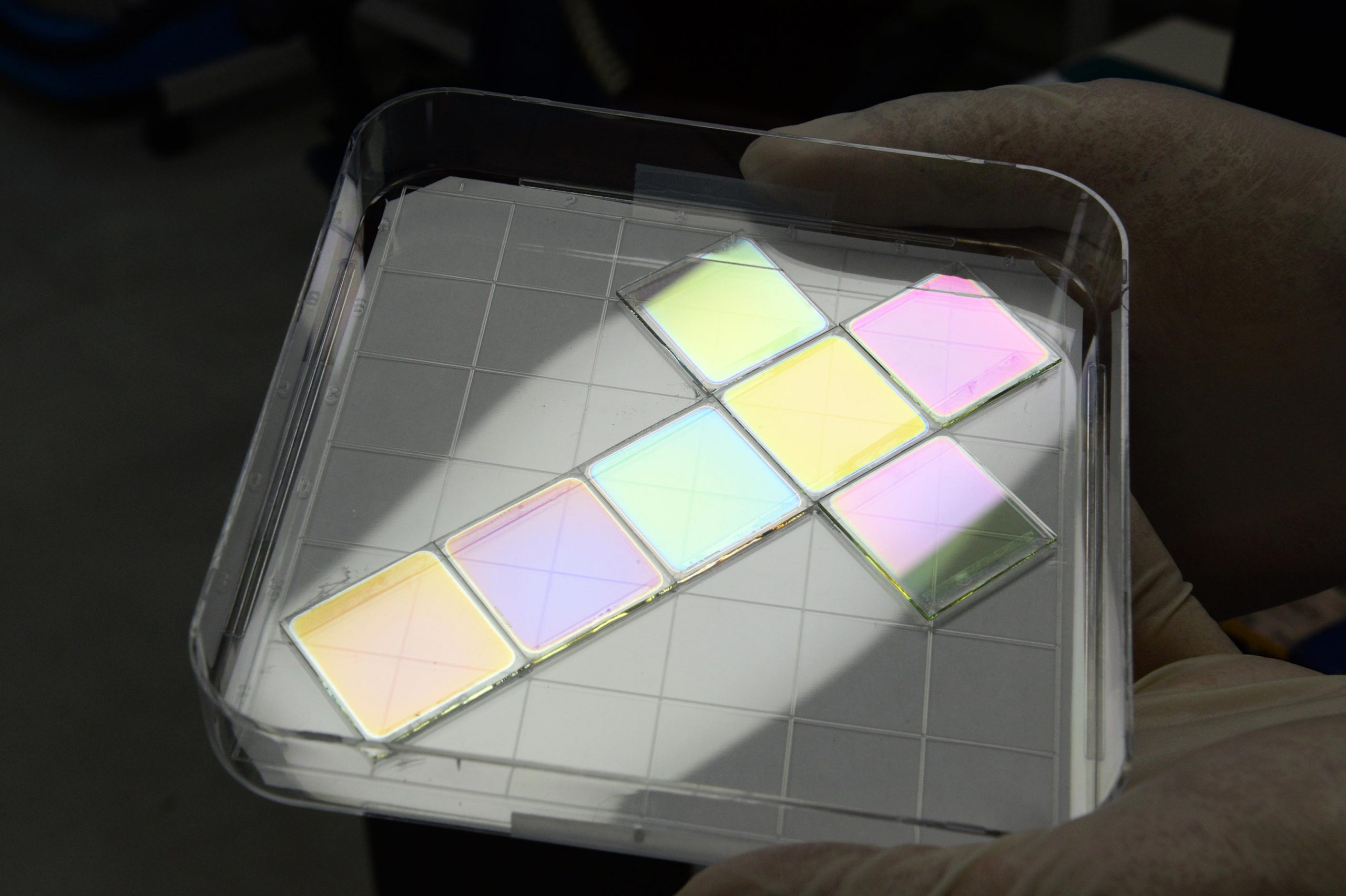
    The eco-friendly color CIGS thin film solar cells developed by ETRI researchers. Credit: Electronics and Telecommunications Research Institute (ETRI)

    Research on solar cells to secure renewable energy sources are ongoing around the world. The Electronics and Telecommunications Research Institute (ETRI) in South Korea succeeded in developing eco-friendly color Cu(In,Ga)Se2 (CIGS) thin-film solar cells.

    CIGS thin-film solar cells are used to convert sunlight into electrical energy and are made by coating multiple thin films on a glass substrate. They have a relatively higher absorption coefficient among non-silicon based cells, resulting in high conversion efficiency and long stability. Also, they require less raw materials compared to silicon-based cells; hence less process and material costs.

    One downside has been the difficulty in commercialization as they use the buffer layer which contains toxic heavy metal, cadmium. Thus, the ETRI team replaced the cadmium sulfide (CdS) buffer layer with zinc (Zn) based materials — which is not harmful — and managed to achieve approximately 18% conversion efficiency; thus eliminating the obstacle to commercialization.

    Likewise, the availability of more than 7 colors including purple, green, and blue — without the need for additional process or cost — means one step closer to full-on commercialization. Moreover, the researchers succeeded in identifying a new analysis method using photo-pumping terahertz spectroscopy and a mechanism for improving the conversion efficiency of solar cells with Zn-based buffer layers.

    The solar cells are only 3? thick and can be coated on a flexible substrate as well as a glass substrate. This means that they could be bent or folded, expanding applications as a next-generation eco-friendly energy source.

    “This technology will contribute to the solar power system development through the production of high value-added color photovoltaic modules,” said Yong-Duck Chung, the ETRI principal researcher.

    The excellence of the research was proven by its publication in ‘Nano Energy’ and ‘Progress in Photovoltaics: Research and Applications’ as the cover article, globally esteemed international journals in the energy sector.

    Reference: “Ultrafast wavelength-dependent carrier dynamics related to metastable defects in Cu(In,Ga)Se2 solar cells with chemically deposited Zn(O,S) buffer layer” by Woo-Jung Lee, Dae-Hyung Cho, Jung Min Bae, Myeong Eon Kim, Jaehun Park and Yong-Duck Chung, 13 May 2020, Nano Energy.
    DOI: 10.1016/j.nanoen.2020.104855

    ETRI is a non-profit government-funded research institute. Since its foundation in 1976, ETRI, a global ICT research institute, has been making its immense effort to provide Korea a remarkable growth in the field of ICT industry. ETRI delivers Korea as one of the top ICT nations in the World, by unceasingly developing world’s first and best technologies.

    Never miss a breakthrough: Join the SciTechDaily newsletter.
    Follow us on Google and Google News.

    Energy ETRI Nanotechnology Solar Cells
    Share. Facebook Twitter Pinterest LinkedIn Email Reddit

    Related Articles

    New Transparent Electrode Developed That Boosts Solar Cell Efficiency

    New Perovskite Fabrication Method for Solar Cells Paves Way to Low-Cost, Large-Scale Production

    Researchers Extract More Energy From Sunlight – Could Boost the Efficiency of Solar Panels by 50%

    Highly Efficient Eco-Friendly Perovskite Solar Cells With Enhanced Stability

    Chalcogenide Perovskite Energy Transport Mechanism Mapped for Solar Energy Use

    All-Carbon Photovoltaic Cell to Harness Infrared Light

    Textured Surface Maintains Efficiency and Reduces Thickness of Silicon Solar Cells

    Nanowires Covered in Nanoparticles Boost Performance

    Researchers Study the Use of Photosystem-I as Photovoltaic Panels

    3 Comments

    1. Spirituality Awakening on October 3, 2020 5:38 am

      It is the great improvement in Solar Energy… <3

      Reply
    2. Nanachilan on October 3, 2020 8:20 pm

      Some traditional 7 color motifs and portraiture are being made now. Kind of hoping not all shades of purple and orange, but can’t complain.

      Reply
    3. Mujeeb on October 4, 2020 8:49 am

      Very good step ahead in solar technology v r waiting ven it comes in market

      Reply
    Leave A Reply Cancel Reply

    • Facebook
    • Twitter
    • Pinterest
    • YouTube

    Don't Miss a Discovery

    Subscribe for the Latest in Science & Tech!

    Trending News

    Artificial Sweeteners May Harm Future Generations, Study Suggests

    Splashdown! NASA Artemis II Returns From Record-Breaking Moon Mission

    What If Consciousness Exists Beyond Your Brain

    Scientists Finally Crack the 100-Million-Year Evolutionary Mystery of Squid and Cuttlefish

    Beyond “Safe Levels”: Study Challenges What We Know About Pesticides and Cancer

    Researchers Have Found a Dietary Compound That Increases Longevity

    Scientists Baffled by Bizarre “Living Fossil” From 275 Million Years Ago

    Your IQ at 23 Could Predict Your Wealth at 27, Study Finds

    Follow SciTechDaily
    • Facebook
    • Twitter
    • YouTube
    • Pinterest
    • Newsletter
    • RSS
    SciTech News
    • Biology News
    • Chemistry News
    • Earth News
    • Health News
    • Physics News
    • Science News
    • Space News
    • Technology News
    Recent Posts
    • What if Dark Matter Has Two Forms? Bold New Hypothesis Could Explain a Cosmic Mystery
    • Researchers Expose Hidden Chemistry of “Ore-Forming” Elements in Biology
    • Geologists Reveal the Americas Collided Earlier Than We Thought
    • 20x Difference: Study Reveals True Source of Airborne Microplastics
    • Scientists Uncover Hidden Force Powering Yellowstone’s Supervolcano
    Copyright © 1998 - 2026 SciTechDaily. All Rights Reserved.
    • Science News
    • About
    • Contact
    • Editorial Board
    • Privacy Policy
    • Terms of Use

    Type above and press Enter to search. Press Esc to cancel.