
Close Menu
    Facebook X (Twitter) Instagram
    SciTechDaily
    • Biology
    • Chemistry
    • Earth
    • Health
    • Physics
    • Science
    • Space
    • Technology
    Facebook X (Twitter) Pinterest YouTube RSS
    SciTechDaily
    Home»Technology»Researchers Extract More Energy From Sunlight – Could Boost the Efficiency of Solar Panels by 50%
    Technology

    Researchers Extract More Energy From Sunlight – Could Boost the Efficiency of Solar Panels by 50%

    By University of Illinois at Urbana-ChampaignOctober 13, 2020No Comments4 Mins Read
    Facebook Twitter Pinterest Telegram LinkedIn WhatsApp Email Reddit
    Share
    Facebook Twitter LinkedIn Pinterest Telegram Email Reddit
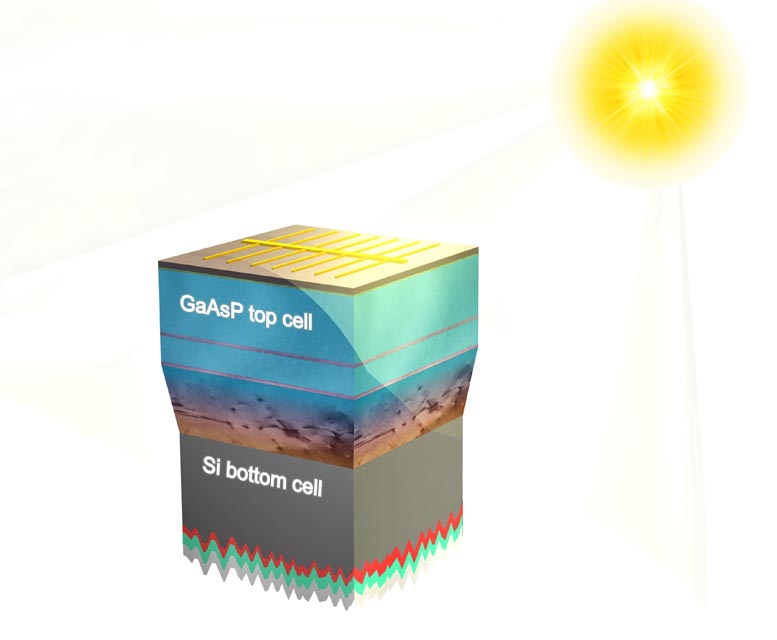
    Tandem Solar Panel Layered Structure
    A schematic showing the layered structure of a tandem solar panel. Credit: Graphic courtesy Minjing Kim

    Researchers working to maximize solar panel efficiency said layering advanced materials atop traditional silicon is a promising path to eke more energy out of sunlight. A new study shows that by using a precisely controlled fabrication process, researchers can produce multilayered solar panels with the potential to be 1.5 times more efficient than traditional silicon panels.

    The results of the study led by University of Illinois Urbana-Champaign engineer Minjoo Larry Lee are published in the journal Cell Reports Physical Sciences.

    “Silicon solar panels are prevalent because they are affordable and can convert a little over 20% of the sun’s light into usable electricity,” said Lee, a professor of electrical and computer engineering and Holonyak Micro and Nanotechnology Lab affiliate. “However, just like silicon computer chips, silicon solar cells are reaching the limit of their abilities, so finding a way to increase efficiency is attractive to energy providers and consumers.”

    Larry Lee
    Silicon solar panels are reaching their technological limit, but researchers are experimenting by combining silicon with other materials to squeeze more energy out of sunlight. Electrical and computer engineering professor Larry Lee led a new study that could boost the efficiency of consumer solar panels by 50%. Credit: Photo by L. Brian Stauffer

    Lee’s team has been working to layer the semiconductor material gallium arsenide phosphide onto silicon because the two materials complement each other. Both materials absorb visible light strongly, but gallium arsenide phosphide does so while generating less waste heat. In contrast, silicon excels at converting energy from the infrared part of the solar spectrum just beyond what our eyes can see, Lee said.

    “It is like a sports team. You are going to have some fast people, some who are strong and some with great defensive skills,” he said. “In a similar way, tandem solar cells work as a team and take advantage of the best properties of both materials to make a single, more efficient device.”

    Shizhao Fan
    Shizhao Fan is the lead author of a new study that could boost the efficiency of consumer solar panels by 50%. Credit: Photo courtesy Grainger College of Engineering at University of Illinois

    While gallium arsenide phosphide and other semiconductor materials like it are efficient and stable, they are expensive, so making panels composed entirely from them is not reasonable for mass production at this time. Hence, Lee’s team uses low-cost silicon as a starting point for its research.

    During fabrication, material defects find their way into the layers, particularly at interfaces between the silicon and gallium arsenide phosphide, Lee said. Tiny imperfections form whenever materials with different atomic structure are layered onto silicon, compromising both performance and reliability.  

    “Anytime you switch from one material to another, there is always a risk of creating some disorder in the transition,” Lee said. “Shizhao Fan, the lead author of the study, developed a process for forming pristine interfaces in the gallium arsenide phosphide cell, which led to a vast improvement over our earlier work in this area.”

    “Eventually, a utility company could use this technology to get 1.5 times more energy out of the same amount of land on its solar farms, or a consumer could use 1.5 times less space for rooftop panels,” he said.

    Lee said obstacles remain on the path to commercialization, but he is hopeful that energy providers and consumers will see the value in using stable materials to achieve a performance boost. 

    References: “Current-Matched III–V/Si Epitaxial Tandem Solar Cells with 25.0% Efficiency” by Shizhao Fan, Zhengshan J. Yu, Ryan D. Hool, Pankul Dhingra, WilliamWeigand, Mijung Kim, Erik D. Ratta, Brian D. Li, Yukun Sun, Zachary C. Holman and Minjoo L. Lee, 23 September 2020, Cell Reports Physical Sciences.
    DOI: 10.1016/j.xcrp.2020.100208

    U. of I. researchers Fan, Ryan D. Hool, Pankul Dhingra, Mijung Kim, Erik D. Ratta, Brian D. Li and Yukun Sun; and Arizona State University researchers William Weigand, Zhengshan J. Yu, and Zachary C. Holman contributed to this study.

    The National Science Foundation and NASA supported this study.

    Never miss a breakthrough: Join the SciTechDaily newsletter.
    Follow us on Google and Google News.

    Electrical Engineering Energy Nanotechnology Popular Solar Cells University of Illinois at Urbana-Champaign
    Share. Facebook Twitter Pinterest LinkedIn Email Reddit

    Related Articles

    New Transparent Electrode Developed That Boosts Solar Cell Efficiency

    A Ghostly Solution: Strange Property of the Quantum Realm Enables Efficient Energy Harvesting in Tiny Device

    Transparent Nanolayers for More Solar Power: Silicon Solar Cells With More Than 26% Efficiency

    New Perovskite Fabrication Method for Solar Cells Paves Way to Low-Cost, Large-Scale Production

    Invisible Solar Panels: How Tomorrow’s Windows Will Generate Electricity

    Supercapacitors Challenge Batteries: Powerful Graphene Hybrid Material for Highly Efficient Energy Storage

    Good Vibrations for New Energy: Nanogenerator “Scavenges” Power From Surroundings

    Transparent Solar Panels for Windows Hit New Efficiency Record – Could Help Enable Skyscrapers to Serve As Power Sources

    Crystal Structure Discovered Almost 200 Years Ago May Revolutionize Solar Cells

    Leave A Reply Cancel Reply

    • Facebook
    • Twitter
    • Pinterest
    • YouTube

    Don't Miss a Discovery

    Subscribe for the Latest in Science & Tech!

    Trending News

    Scientists Discover How Coffee Impacts Memory, Mood, and Gut Health

    Why Did the Neanderthals Disappear? Scientists Reveal Humans Had a Hidden Advantage

    Physicists Propose Strange Experiment Where Time Goes Quantum

    Magnesium Magic: New Drug Melts Fat Even on a High-Fat, High-Sugar Diet

    Weight-Loss Drugs Like Ozempic May Come With an Unexpected Cost

    Mezcal “Worm” in a Bottle Mystery: DNA Testing Reveals a Surprise

    New Research Reveals That Your Morning Coffee Activates an Ancient Longevity Switch

    This Is What Makes You Irresistible to Mosquitoes

    Follow SciTechDaily
    • Facebook
    • Twitter
    • YouTube
    • Pinterest
    • Newsletter
    • RSS
    SciTech News
    • Biology News
    • Chemistry News
    • Earth News
    • Health News
    • Physics News
    • Science News
    • Space News
    • Technology News
    Recent Posts
    • Harvard Scientists Reveal Secret Structure Behind How You Smell
    • Scientists Just Discovered the Hidden Trick That Keeps Your Cells Alive
    • This Simple Movement Could Be Secretly Cleaning Your Brain
    • Male Birth Control Breakthrough: Scientists Find Way To Turn Sperm Production Off and Back On
    • A Common Vitamin Could Hold the Key to Treating Fatty Liver Disease
    Copyright © 1998 - 2026 SciTechDaily. All Rights Reserved.
    • Science News
    • About
    • Contact
    • Editorial Board
    • Privacy Policy
    • Terms of Use

    Type above and press Enter to search. Press Esc to cancel.