
The ability to enhance night vision capabilities could have implications in improving what can be seen in space, in chemical and biological disaster areas, and on the battlefield.
Much like some snakes use infrared to “see” at night, University of Central Florida researchers are working to create similar viper vision to improve the sensitivity of night-vision cameras.
The ability to enhance night vision capabilities could have implications in improving what can be seen in space, in chemical and biological disaster areas, and on the battlefield.
A study detailing the UCF researchers’ night-vision work appeared recently in the journal Nature Communications.
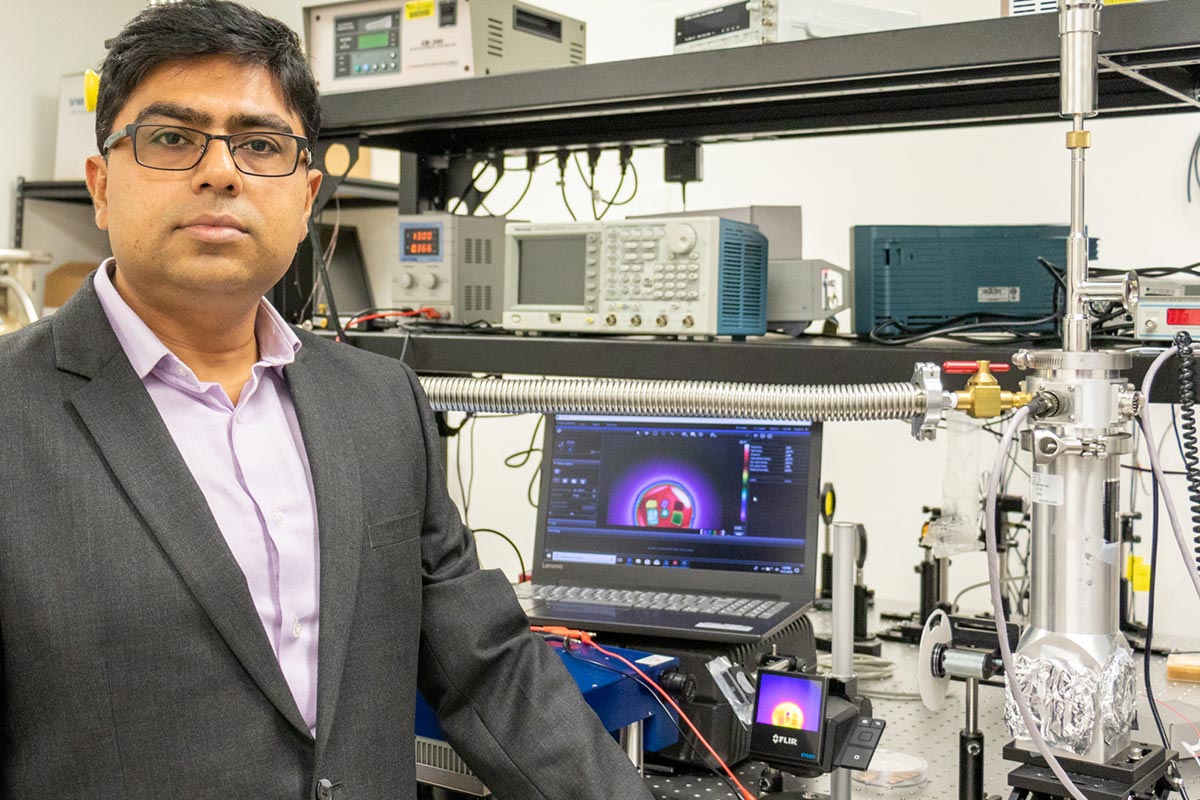
“With the infrared detector we’ve developed, you can extract more information from the object you’re looking at in the dark,” said Debashis Chanda, an associate professor in UCF’s NanoScience Technology Center and the study’s principal investigator.
“Say, you’re looking at somebody at night through night-vision goggles. You’re looking at his infrared signature, which is coming all over his body. He may have a hidden weapon that emits a different wavelength of infrared light, but you cannot see that even with a presently available, expensive, cryogenically cooled camera.”
The infrared detector developed by Chanda and his team, however, doesn’t need liquid nitrogen cooling it down to an extreme -321 degrees to be sensitive enough to detect different wavelengths of infrared light. It also operates much faster than existing night-vision cameras that don’t require cooling, but are slow to process images.
Humans see light in the electromagnetic spectrum that has wavelengths that are from about 400 to 700 nanometers long, which is known as the visible light spectrum.
In this research, Chanda and his team were working with much longer wavelengths that extend to about 16,000 nanometers.
That allows the UCF detector to discern the different wavelengths in the invisible infrared domain. It does this by picking out different objects emitting different wavelengths.
Current night-vision cameras can’t isolate the different objects based on their distinct infrared wavelengths and instead integrate or lump the wavelengths all together so that what may be several separate objects are only seen as one through the infrared lens.
“This is one of the first demonstrations of actually dynamically tuning of the spectral response of the detector or, in other words, selecting what infrared ‘color’ you want to see,” Chanda said.
With the new technology, additional infrared “colors” could be assigned to represent items that reflect different wavelengths of infrared light, in addition to the standard colors of either green, orange or black seen in night vision, Chanda said.
For astronomers, this means the potential to have new telescopes that see information that was previously invisible in the infrared domain. For chemical- and biological-disaster areas, or even monitoring pollution, it means taking a picture to receive a spectral analysis of the gasses present in an area, such as carbon monoxide or carbon dioxide, based on how infrared light reacts with chemical molecules.
The trick in developing the new highly sensitive, but uncooled infrared detector was engineering the two-dimensional nanomaterial graphene into a material that can carry an electric current.
The researchers achieved this by designing the material to be asymmetric so that the temperature difference created from absorbed light hitting the different parts of material caused electrons to flow from one side to another, thus creating a voltage.
The process was also verified using a model developed by study co-author Michael N. Leuenberger, a professor in UCF’s NanoScience Technology Center with joint appointments in the Department of Physics and the College of Optics and Photonics.
The detector’s ability to capture an image was tested one pixel at a time.
The device is not commercially available but could one day be integrated into cameras and telescopes.
Reference: “Dirac plasmon-assisted asymmetric hot carrier generation for room-temperature infrared detection” by Alireza Safaei, Sayan Chandra, Muhammad Waqas Shabbir, Michael N. Leuenberger and Debashis Chanda, 2 August 2019, Nature Communications.
DOI: 10.1038/s41467-019-11458-5
The work was supported with funding from the U.S. Department of Defense’s Defense Advanced Research Projects Agency.
Co-authors of the study also included Alireza Safaei, a graduate of UCF’s Department of Physics doctoral program; Sayan Chandra, a postdoctoral researcher in UCF’s NanoScience Technology Center; and Muhammad Waqas Shabbir, a doctoral student in UCF’s Department of Physics.
Chanda has joint appointments in UCF’s NanoScience Technology Center, Department of Physics and College of Optics and Photonics. He received his doctorate in photonics from the University of Toronto and worked as a postdoctoral fellow at the University of Illinois at Urbana-Champaign. Chanda joined UCF in 2012.
Never miss a breakthrough: Join the SciTechDaily newsletter.
Follow us on Google and Google News.