

Close Menu
    Facebook X (Twitter) Instagram
    SciTechDaily
    • Biology
    • Chemistry
    • Earth
    • Health
    • Physics
    • Science
    • Space
    • Technology
    Facebook X (Twitter) Pinterest YouTube RSS
    SciTechDaily
    Home»Science»Scientists Measure Mouse Personality and Map Traits to Their Genetics
    Science

    Scientists Measure Mouse Personality and Map Traits to Their Genetics

    By Max Planck InstituteNovember 9, 2019No Comments3 Mins Read
    Facebook Twitter Pinterest Telegram LinkedIn WhatsApp Email Reddit
    Share
    Facebook Twitter LinkedIn Pinterest Telegram Email Reddit

    Harvest Mouse

    Scientists at the Max Planck Institute of Psychiatry in Munich, Germany, together with colleagues at the Weizmann Institute of Sciencein Israel have developed a computational method to objectively measure the personality of mice living in a semi-natural, group environment.

    Just like humans, every mouse is different. Some are quick to explore a new environment while others prefer to stay within the comfort of their nest. Some prefer to stay close to their cage mates, while others prefer to be alone. These unique characteristics of an individual remain fairly stable throughout life and define their personality. In humans, personality can be measured using multiple-choice questionnaires to derive personality scores but how can one measure personality in animals?

    Oren Forkosh and Stoyo Karamihalev, together with other colleagues collected huge amounts of data by analyzing video footage taken of groups of mice. To do this, they dyed the fur of each mouse a different color allowing them to track the groups of mice behaving undisturbed. Each video was analyzed for a repertoire of 60 behaviors, such as how close a mouse stays to other mice, if they chase one another or run away, or the time spent in the nest or eating.
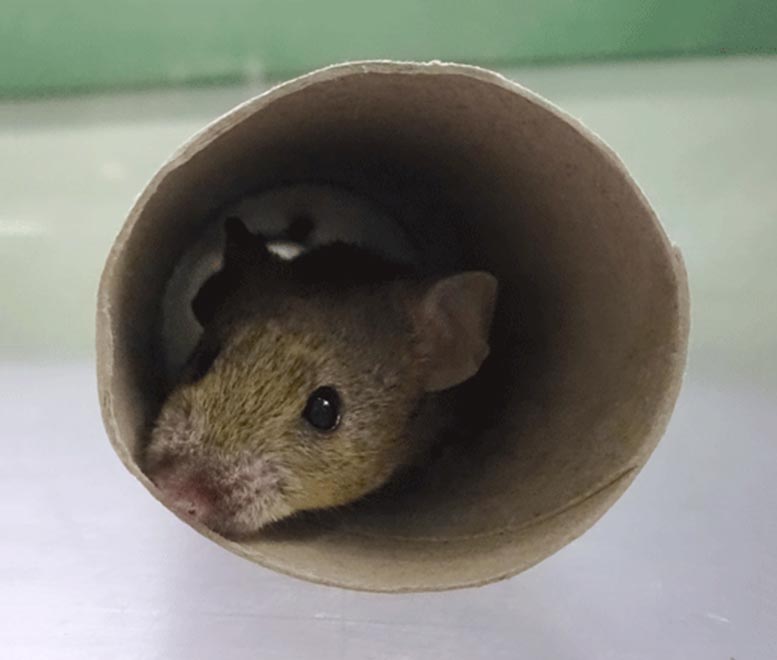
    Mouse Personality
    Some mice are curious and explore every new hiding place. Others are more anxious and prefer to stay in their nest. Credit: © MPI f. Molecular Genetics

    Stable personalities

    The scientists developed a mathematical algorithm that sought stable traits that were able to discriminate individuals based on differences in behavior. This method works somewhat in the same way as personality tests in humans in which people are often assessed on five dimensions, however, it specifically searches for traits that are consistent over time. In mice, the algorithm identified four trait-like dimensions that could capture and describe the behavior of mice. To test that these traits were stable, the researchers mixed up the groups and found that while some of the behaviors had changed, the personalities of the mice were still stable. Using advanced RNA-sequencing tools and genetically modified mouse strains, the researchers were also able to show that individual differences captured in these traits corresponded to a variety of differences in gene expression in the mouse brain and could identify mice with different genetic makeup.

    “This method has the potential to greatly advance our knowledge beyond what is possible using the current simplified methods for assessing behavior and toward stable and consistent differences in personality. It opens up the possibility to study how personality is affected by genes, drugs, aging, etc., how it is represented and maintained by the brain, and how it contributes to mental health and disease,” explains Karamihalev, together with Oren Forkosh one of the first authors of the study published in Nature Neuroscience. “This is a good first step in the direction of better pre-clinical methods for assessing individual differences in behavior and physiology,” says Alon Chen, the principal investigator for this study. “Our hope is that such approaches will aid in the effort toward a more personalized psychiatry.”

    Reference: “Identity domains capture individual differences from across the behavioral repertoire” by Oren Forkosh, Stoyo Karamihalev, Simone Roeh, Uri Alon, Sergey Anpilov, Chadi Touma, Markus Nussbaumer, Cornelia Flachskamm, Paul M. Kaplick, Yair Shemesh and Alon Chen, 4 November 2019, Nature Neuroscience.
    DOI: 10.1038/s41593-019-0516-y

    Never miss a breakthrough: Join the SciTechDaily newsletter.
    Follow us on Google and Google News.

    Genetics Max Planck Institute Mice Personality Psychology
    Share. Facebook Twitter Pinterest LinkedIn Email Reddit

    Related Articles

    Ancient Genetics Trace the Origin and Decline of the Legendary Scythians

    On the Origin of Our Species: Untangling Ancestry in the Evolution of Homo sapiens

    DNA of Bones Found in Cave Reveals Major Cultural Transition in Europe Took Place Earlier Than Thought

    The Origin of Feces: Using AI & DNA to Reliably Predict Sources of Ancient Poop

    Method for Measuring Animal Personality Developed to Explore Connections Between Genes and Behavior

    Scientists Reveal the Complex Story Behind the Beaker Phenomenon

    Researchers Shed Light on the Nature of Risk Preferences

    Genome Data Shows Ancient Egyptian Mummies Closely Related to Ancient Populations from the Near East

    Mice Can Sense Oxygen Levels in the Environment Using Specialized Neurons

    Leave A Reply Cancel Reply

    • Facebook
    • Twitter
    • Pinterest
    • YouTube

    Don't Miss a Discovery

    Subscribe for the Latest in Science & Tech!

    Trending News

    Breakthrough Bowel Cancer Trial Leaves Patients Cancer-Free for Nearly 3 Years

    Natural Compound Shows Powerful Potential Against Rheumatoid Arthritis

    100,000-Year-Old Neanderthal Fossils in Poland Reveal Unexpected Genetic Connections

    Simple “Gut Reset” May Prevent Weight Gain After Ozempic or Wegovy

    2.8 Days to Disaster: Scientists Warn Low Earth Orbit Could Suddenly Collapse

    Common Food Compound Shows Surprising Power Against Superbugs

    5 Simple Ways To Remember More and Forget Less

    The Atomic Gap That Could Cost the Semiconductor Industry Billions

    Follow SciTechDaily
    • Facebook
    • Twitter
    • YouTube
    • Pinterest
    • Newsletter
    • RSS
    SciTech News
    • Biology News
    • Chemistry News
    • Earth News
    • Health News
    • Physics News
    • Science News
    • Space News
    • Technology News
    Recent Posts
    • After 37 Years, the World’s Longest-Running Soil Warming Experiment Uncovers a Startling Climate Secret
    • NASA Satellite Captures First-Ever High-Res View of Massive Pacific Tsunami
    • ADHD Isn’t Just a Deficit: Study Reveals Powerful Hidden Strengths
    • Scientists Uncover “Astonishing” Hidden Property of Light
    • Scientists Discover Stem Cells That Could Regrow Teeth and Bone
    Copyright © 1998 - 2026 SciTechDaily. All Rights Reserved.
    • Science News
    • About
    • Contact
    • Editorial Board
    • Privacy Policy
    • Terms of Use

    Type above and press Enter to search. Press Esc to cancel.