
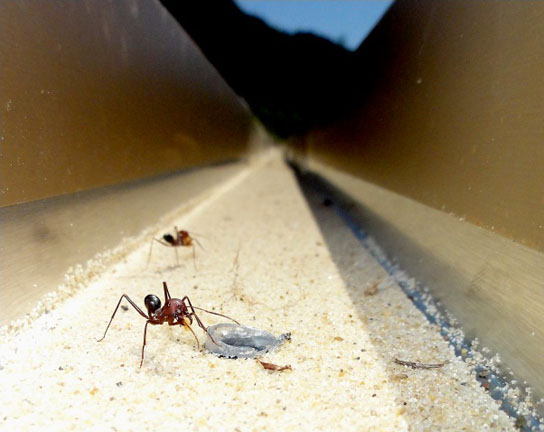
While studying desert ants, researchers at the Max Planck Institute for Chemical Ecology discovered that ants were able to use magnetism and vibrational signals in the absence of other landmarks to find their nest. Cataglyphis fortis also use polarized sunlight as a compass, count their steps and sense carbon dioxide produced by their nestmates’ breathing.
Desert ants have adapted to life in a barren environment which only provides very few landmarks for orientation. Apart from visual cues and odors the ants use the polarized sunlight as a compass and count their steps in order to return safely to their home after searching for food. In experiments with ants of the genus Cataglyphis in their natural habitats in Tunisia and Turkey, behavioral scientists of the Max Planck Institute for Chemical Ecology in Jena, Germany, have now discovered that ants can also use magnetic and vibrational landmarks in order to find their way back to their nest − a small hole in the desert ground. In addition, carbon dioxide produced by their nestmates’ breathing also helps homing ants to pinpoint their nest entrance. Hence, the ants’ navigational skills prove enormously adaptable to their inhospitable environment.
Path integration is a fascinating mechanism that ants use for orientation. It combines counting the steps after leaving the nest with determining the direction by using polarized sunlight. This method, which helps the insects to return to their nest, is an important survival formula in the barren environments of deserts. However, the path integrator is error-prone. Therefore ants also use landmarks in order to find home quickly and unerringly: Visual as well as olfactory landmarks serve as important cues. For ants, it is a question of life and death to find the right nest because they may be killed or at least attacked by resident ants if they enter the wrong nest accidentally.
It is known from leaf-cutting ants that they use vibrational signals for communication. That ants − like birds − also sense the earth’s magnetic field, becomes more and more likely. Therefore, the researchers in Markus Knaden’s lab, behavioral scientists in the Department of Bill Hansson at the Max Planck Institute for Chemical Ecology, wanted to find out whether desert ants − adapted to landscapes providing a minimum of cues − are able to use magnetism and vibrational signals in the absence of other landmarks.
“We were very surprised that this is actually the case,” says PhD student Cornelia Buehlmann, who performed the experiments.
Trained ants of the species Cataglyphis noda pinpointed their nest without any problem if a battery-powered vibrational device was buried next to the nest entrance so that the ants could localize their nest by using the vibrational landmark. To exclude electromagnetic effects of the device, experiments were performed using the vibrational device without contact to the ground. The result: The ants behaved like their untrained conspecifics. They wandered around aimlessly. If two strong neodymium magnets generating a magnetic field of about 21 millitesla (the earth’s magnetic field was, for comparison, only 0.041 millitesla) were placed above ground next to the nest, trained ants again found their home without any problems.
The experiments demonstrated the desert ants’ highly sensitive reaction to vibrational signals. However, it is unknown which sense is involved in the orientation using the artificial magnetic field around the nest. “This doesn’t mean that ants have a kind of sensory organ for the detection of magnetic fields. Their behavior could also be caused by abnormal neural electrical signals due to the strong magnetic field which were memorized by the ants,” says Knaden. Anyhow, neither vibrations nor strong magnetic fields are likely present in the natural vicinity of nest entrances. Therefore it is really astonishing that ants “remember” vibrations or a changing magnetic field as nest landmarks. Ants which have adapted to extremely inhospitable habitats seem to be remarkably flexible in terms of using all senses for navigation.
Carbon dioxide produced by the ants’ breathing is an olfactory signal that is constantly present at the nest entrances. That desert ants of the species Cataglyphis fortis use the CO2 plume in order to return to their home could now be shown by experiments performed in Tunisia. The ants ran upwind along the nest plume when the CO2 concentration was not too high and corresponded with the typical plume concentration in the nest vicinity.
However, CO2 is released by all the nests and therefore all nests smell the same. Therefore the question is: How can ants recognize their own nest when all smell like home?
“We could show in a series of experiments that ants primarily rely on path integration,” explains Cornelia Buehlmann.
If ants were released in the close vicinity of their own nest by hand after they had walked to a feeding place, they avoided following the original nest plume of their own nest: The olfactory signal and the number of footsteps did not coincide. In order not to lose their lives in a foreign nest, ants trust path integration more than the chemical signal CO2. They only follow the nest plume when path integration tells them that they are close to home.
Never miss a breakthrough: Join the SciTechDaily newsletter.
Follow us on Google and Google News.
1 Comment
Hey, if ants communicate through vibrations,can’t we mimic the vibrations to communicate w them,at least control them, tell them what to do.i wonder how long it will before we are using AI to communicate
W animals,and control insects.