
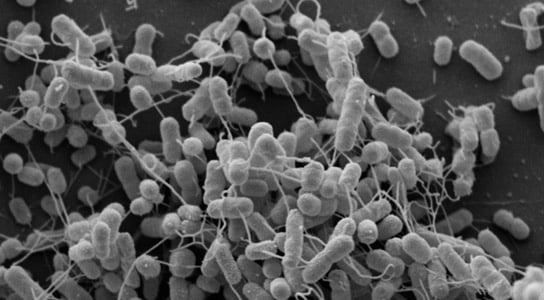
New research from the Max Planck Institute shows that some bacteria can form nanotubular structures between single cells that enable a direct exchange of nutrients.
It is well-known that bacteria can support each other’s growth and exchange nutrients. Scientists at the Max Planck Institute for Chemical Ecology in Jena, Germany, and their colleagues at the universities of Jena, Kaiserslautern, and Heidelberg, however, have now discovered a new way of how bacteria can achieve this nutritional exchange. They found that some bacteria can form nanotubular structures between single cells that enable a direct exchange of nutrients.
Bacteria usually live in species-rich communities and frequently exchange nutrients and other metabolites. Until now, it was unclear whether microorganisms exchange metabolites exclusively by releasing them into the surrounding environment or whether they also use direct connections between cells for this purpose. Scientists from the Research Group Experimental Ecology and Evolution at the Max Planck Institute for Chemical Ecology in Jena, Germany addressed this question using the soil bacterium Acinetobacter baylyi and the gut microbe Escherichia coli. By experimentally deleting bacterial genes from the genome of both species, the scientists generated mutants that were no longer able to produce certain amino acids, yet produced increased amounts of others.
In co-culture, both bacterial strains were able to cross-feed each other, thereby compensating the experimentally induced deficiencies. However, separating the two bacterial strains with a filter that allowed free passage of amino acids, yet prevented direct contact between cells, abolished growth of both strains. “This experiment showed that a direct contact between cells was required for the nutrient exchange to occur,” explains Samay Pande, who recently obtained his Ph.D. at the Max Planck Institute in Jena on this research project and now started a postdoc at the ETH Zürich.
Observing the co-culture under the electron microscope revealed structures that formed between bacterial strains, which functioned as nanotubes and enabled the exchange of nutrients between cells. Especially remarkable, however, was the fact that only the gut microbe Escherichia coli was capable of forming these structures and connecting to Acinetobacter baylyi or other E. coli cells. “The major difference between both species is certainly that E. coli is able to actively move in liquid media, whereas A. baylyi is immotile. It may thus be possible that swimming is required for E. coli to find suitable partners and connect to them via nanotubes,” explains Christian Kost, head of the Research Group Experimental Ecology and Evolution, which is funded by the Volkswagen Foundation.
“A lack of amino acids triggered the formation of nanotubes. Deleting a gene, which is involved in the production of a certain amino acid, caused the resulting bacteria to connect to other bacterial cells and − in this way − compensate their nutritional deficiency. However, nanotubes did not form when the required amino acids were supplemented to the growth medium, indicating that the formation of these structures obviously depends on how ‘hungry’ a cell is,” the scientist summarizes the results.
Cells that specialize on particular biochemical processes and thereby divide their labor can be advantageous for bacterial communities: Resources can be used more economically, thus enhancing growth and efficiency. Whether the formation of nanotubes exclusively serves the mutual exchange of nutrients or whether some bacterial species also parasitize other bacterial cells in this way will be subject to further investigation. Moreover, it remains unclear whether bacteria can actively choose the cells to which they attach. After all, such tubular connections also pose a potential risk, because the partner on the other side of the tube could also provide harmful substances.
“To me, the most exciting question that remains to be answered is whether bacteria are in fact unicellular and relatively simply structured organisms or whether we are actually looking at some other type of multicellularity, in which bacteria increase their complexity by attaching to each other and combining their biochemical abilities,” Christian Kost summarizes. His research focuses mainly on the question why organisms cooperate with each other. Using bacterial communities as experimentally tractable model systems will help to explain why so many organisms have developed a cooperative lifestyle in the course of their evolution.
Reference: Samay Pande, et al., “Metabolic cross-feeding via intercellular nanotubes among bacteria” by Samay Pande, Shraddha Shitut, Lisa Freund, Martin Westermann, Felix Bertels, Claudia Colesie, Ilka B. Bischofs and Christian Kost, 23 February 2015, Nature Communications.
DOI:10.1038/ncomms7238
Never miss a breakthrough: Join the SciTechDaily newsletter.
Follow us on Google and Google News.