
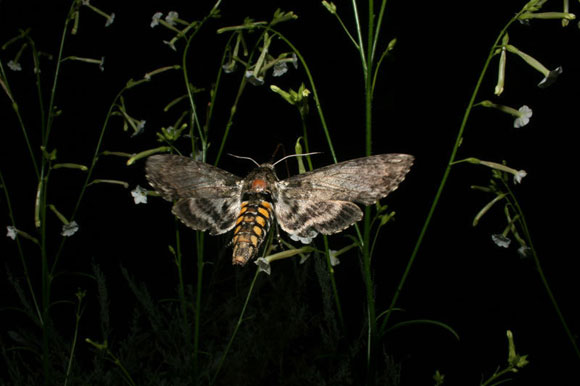
Scientists from the Max Planck Institute for Chemical Ecology reveal how flowers use scent and nectar to manipulate pollinators and herbivores.
Some pollinators not only provide fertilization services for flowering plants, they also lay their eggs on the plants’ leaves after they have visited the flowers. Voracious caterpillars hatch from these eggs and their enormous appetite can easily kill the plants. So when plants advertise for pollinators they frequently also attract herbivores. Scientists from the Max Planck Institute for Chemical Ecology in Jena, Germany, demonstrated in field trials that the flowers of the coyote tobacco Nicotiana attenuata are able to solve this dilemma. The researchers showed that when flowers produce both scent and nectar and are visited by three different pollinators, their outcrossing increases, which is important for the gene flow between plants. Moreover, both floral traits influenced oviposition by the hawkmoth Manduca sexta, with the amount of nectar being even more influential than floral scent on the decision of female hawkmoths to lay eggs. Natural variations of scent biosynthesis and nectar secretion in wild tobacco populations, including plants whose flowers do not produce any nectar at all, may therefore ensure that the reproductive success is optimized while herbivores are kept at bay. For the first time, scientists examined these two floral traits, scent, and nectar, and their influence on pollen vectors and herbivores simultaneously.
Flowering plants emit odors in order to attract pollinators. Pollinators are rewarded with sweet nectar for their reproductive assistance. However, this interaction is not always based on the “one hand washes the other” principle alone. Some female moths pollinate the flowers and lay their eggs on the leaves of the same plant afterward. From these eggs, voracious larvae hatch and threaten the survival of the plant. One example of a ”mutualist turned into antagonist” is the tobacco hornworm Manduca sexta, a moth that visits the flowers of Nicotiana attenuata, a wild tobacco species in North and Middle America. Its larvae, however, can cause devastating feeding damage.
As scientists led by Ian T. Baldwin found out, the concentrations and amounts of floral scent and nectar vary in natural populations of Nicotiana attenuata. There are even individual plants that do not secrete any nectar at all. These plants cheat floral visitors by attracting them in the first place, but denying a reward for pollination services. In order to uncouple the influence of floral scent and nectar and to study both traits simultaneously, the scientists used plants that had been genetically altered to not produce benzylacetone, the main component of the floral scent, or nectar. A third group of plants could neither synthesize benzylacetone nor nectar. These plants were modified by using an RNA-interference-based transformation technique (RNAi). Both floral traits were studied simultaneously and independently for the first time.
The researchers examined the influence of these floral traits on outcrossing rates after pollinations by three different pollinators: the tobacco hawkmoth Manduca sexta, the hummingbird moth Hyles lineata, and the hummingbird Archilochus alexandri. A high outcrossing rate is achieved when pollen, and thereby the genetic information of a plant, is transferred from one plant to another. This increases genetic diversity in plant populations.
While nectar is a sweet reward that makes pollinators fly from flower to flower, floral scent is an attractant that advertises the presence of this reward. The assessment of the experimental data revealed that both scent and nectar make sure that flowers are visited by pollinators more often than plants that lack these traits. Interestingly, scent and nectar had different effects on the pollen transfer service by the three tested pollinators. On the other hand, scent as well as nectar directly influenced oviposition by female Manduca sexta moths. The amount of nectar more than scent affected the decision of female moths to lay their eggs and therefore more Manduca eggs were found on plants that produced large amounts of nectar.
The scientists were surprised that nectar secretion had a larger impact on the egg-laying behavior in female Manduca sexta moths than did floral scent. They hypothesize that hawkmoths use nectar as an indicator to evaluate plant size or health traits which give their offspring a better chance of survival. “Some plants, on the other hand, are cheaters and only feign the presence of a reward. They benefit from nectar-producing neighbors and cheated pollinators, thereby substantially reducing herbivory,” Danny Kessler, the first author of the study, explains.
Flowers face many challenges. They have to provide for outcrossing and reproductive success and depend on different pollinating species, all of which have different preferences and behaviors. At the same time, flowers must also make sure that moths won’t lay too many eggs on the plant’s leaves. “Both herbivores and pollinators contributed to the evolution of floral traits. Therefore it makes little sense to study these traits, scent, and nectar, as if they only mediate pollination services,” Ian T. Baldwin, the head of the Department of Molecular Ecology, summarizes. His lab developed a comprehensive molecular toolbox for the coyote tobacco Nicotiana attenuata.
The combination of these floral traits, scent biosynthesis, and nectar production, requires a certain fine-tuning to maximize the fitness of a plant. Large moths, such as Manduca sexta, are probably able to transfer pollen over larger distances in comparison to hummingbirds which are usually found in the vicinity of their nests. Because wild tobacco populations are often found isolated in nature, the transfer of pollen over larger distances is important to ensure outcrossing between these populations.
Reference: “How scent and nectar influence floral antagonists and mutualists” by Danny Kessler Is a corresponding author, Mario Kallenbach, Celia Diezel, Eva Rothe, Mark Murdock and Ian T Baldwin, 1 July 2015, eLife.
DOI: 10.7554/eLife.07641
Never miss a breakthrough: Join the SciTechDaily newsletter.
Follow us on Google and Google News.