
New research from the Max Planck Institute for Developmental Biology and the University of Wyoming details how changes in temperature variability across the globe are altering the environment.
If more of the world’s climate becomes like that in tropical zones, it could potentially affect crops, insects, malaria transmission, and even confuse migration patterns of birds and mammals worldwide. George Wang, a postdoctoral fellow at the Max Planck Institute for Developmental Biology in Tübingen, Germany, is part of a research tandem that has found that the daily and nightly differences in temperatures worldwide are fast approaching yearly differences between summer and winter temperatures.
Only recently, the UN Climate Summit came together in New York to further address the necessary measures to protect the Earth from a dramatic climate change. It has long been recognized that an increase of the average temperature will cause rising oceans and thus flooded landscapes. Particularly, regions close to the coasts are endangered. While it is well known that climate change has increased average temperatures, it is less clear how temperature variability has altered with climate change.
Postdoctoral fellow George Wang, from Detlef Weigel’s Department for Molecular Biology at the Max Planck Institute for Developmental Biology, has now examined this issue in more depth.
He realized that existing climate measures did not provide enough information to predict the life history responses, such as hatching, hibernation, or flowering of organisms. Together with his partner Michael Dillon, an Assistant Professor in the Department of Zoology and Physiology, University of Wyoming, USA, he started to analyze climate conditions since records began to be kept.
“We describe, for the first time, changes in temperature variability across the globe. We’ve had a long discussion about changes in the mean temperature. It has been ongoing for over 30 years,” says George Wang. “It’s very clear mean temperatures have shifted across the globe. It’s less clear if the variation in temperature has changed.”
For example, the variability in temperature could potentially mean bugs survive for a longer period in non-tropical regions. The result could be increased crop damage from pest insects or spread of diseases, such as malaria transmitted by mosquitoes.
In addition, plants in temperate regions are adapted to use temperature to tell the season. This is how they know when to produce flowers and fruits. As daily temperature cycles become more extreme, it becomes harder for plants to behave appropriately to the season. Therefore, plants might produce flowers too early or too late, and so there might be some years when certain fruits never appear.
Wang is the first author of a paper, titled “Recent Geographic Convergence in Diurnal and Annual Temperature Cycling Flattens Global Thermal Profiles,” that was published in the online edition of Nature Climate Change. Dillon is the paper’s co-writer. The monthly journal is dedicated to publishing the most significant and cutting-edge research on the science of climate change, its impacts, and wider implications for the economy, society, and policy.
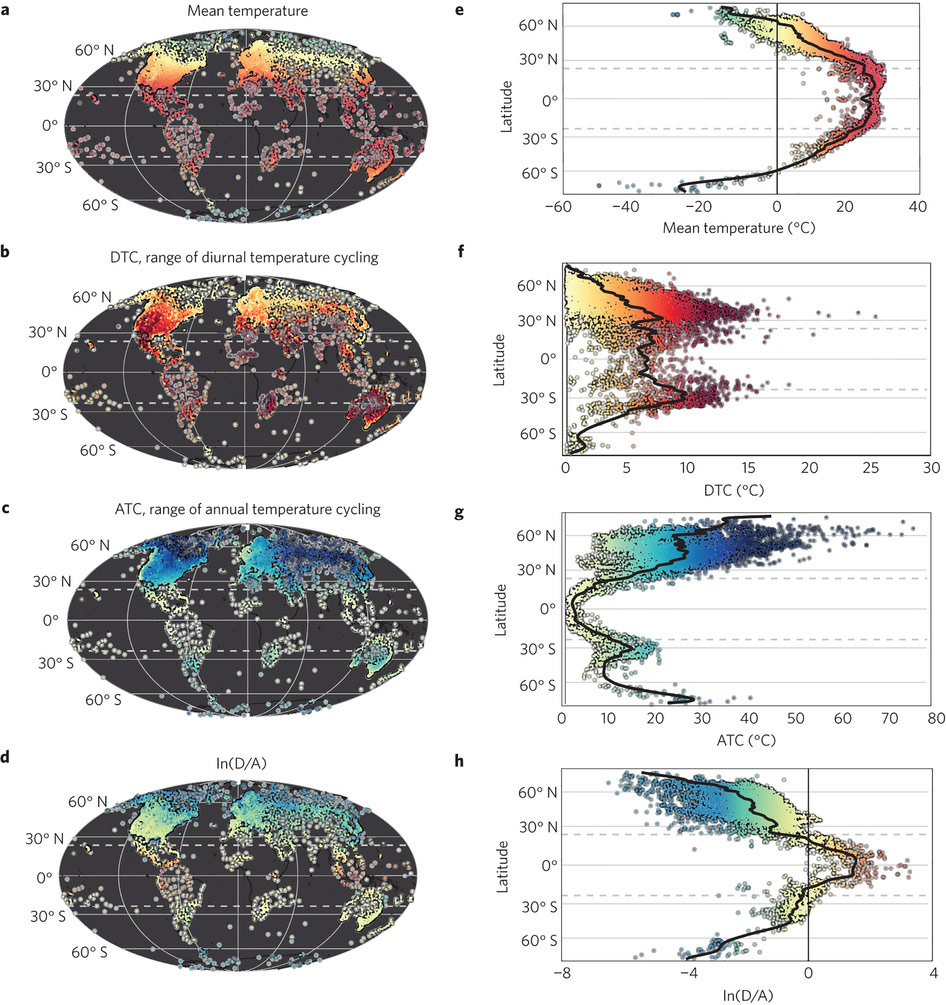
Wang and Dillon first estimated global spatial variation in the mean temperature and in temperature cycling by analyzing more than 1 billion temperature measurements from 7,906 weather stations that sampled from the period of January 1, 1926, through December 31, 2009. Analysis of monthly and yearly averages of daily temperature extremes reveals that daily and annual minimum and maximum temperatures have increased across the world since 1950. The scientists then estimated global changes in the magnitudes of diurnal and annual temperature cycles from 1975-2013.
The research was “very computationally intensive”, as Michael Dillon points out. The researchers had to use computer clusters on two continents, with the majority of the work performed on the cluster at the MPI for Developmental Biology. They also used a new mathematical technique to describe how temperature changes from day to night, and winter to summer, thus characterizing the variability of temperature over the globe.
According to this, the changes have been most dramatic for places closest to the poles and far from oceans. “In these places, warmer winters — decreasing the difference between summer and winter — and hotter days — increasing the difference between day and night — mean that the range of temperatures, which organisms experience over a few days, is closer to the range of temperatures they experience over an entire year. These patterns are strongest in Canada and Russia, but occur even in Germany,” explains Wang. “For example, in Wiesbaden, in 1992, the average difference between day and night was 1.2 degrees, while the average difference between summer and winter was 24.8 degrees. In 2012, the day/night cycle was 5.2 degrees, while the summer/winter cycle was 18.9, so the daily temperature variability is now much more similar to the yearly variability. Compare this to Las Palmas in the Canary Islands, where the day/night difference is about 4.3 degrees and the summer/winter difference is about 6.7 — it has not changed very much.”
The range of diurnal temperature cycling (DTC), meaning the change in temperature from the daytime high to nighttime low, was lowest at the poles, intermediate at the tropics, and was relatively small close to large bodies of water and at lower elevations, according to the study. The range of annual temperature cycling (ATC), meaning temperatures for any given location will go through a regular cycle on an annual basis, was lowest at the tropics and increased toward the poles.
“For these temperature zones that we historically think of as having lower daily variations relative to the annual variations in temperatures, what we found in these zones is that the ATC has not changed much in the last 30 to 40 years,” Michael Dillon explains. “But, the DTC has gone up considerably. If the annual is constant and daily temperatures increase, areas outside the tropics will become more tropical. This idea of convergence could be a really important thing.”
The findings show that no place is safe from climate change. “Most people are rightly concerned about sea level rise, but feel that this will not affect them if they don’t live next to the ocean. We find that places far from the oceans will have the biggest changes in daily and seasonal temperature variability because they are far away from the buffering effects of oceans”, says Wang. Therefore, there would be no places immune from the effects of climate change, and this would have consequences on crops, parasites, and disease.
Reference: “Recent geographic convergence in diurnal and annual temperature cycling flattens global thermal profiles” by George Wang and Michael E. Dillon, 28 September 2014, Nature Climate Change.
DOI: 10.1038/nclimate2378
Never miss a breakthrough: Join the SciTechDaily newsletter.
Follow us on Google and Google News.