
Close Menu
    Facebook X (Twitter) Instagram
    SciTechDaily
    • Biology
    • Chemistry
    • Earth
    • Health
    • Physics
    • Science
    • Space
    • Technology
    Facebook X (Twitter) Pinterest YouTube RSS
    SciTechDaily
    Home»Biology»Sunken Wood Can Develop Into Habitats for Microorganisms and Invertebrates
    Biology

    Sunken Wood Can Develop Into Habitats for Microorganisms and Invertebrates

    By Max Planck InstituteJanuary 22, 2013No Comments3 Mins Read
    Facebook Twitter Pinterest Telegram LinkedIn WhatsApp Email Reddit
    Share
    Facebook Twitter LinkedIn Pinterest Telegram Email Reddit
    wood-can-develop-into-oases-for-deep-sea-life
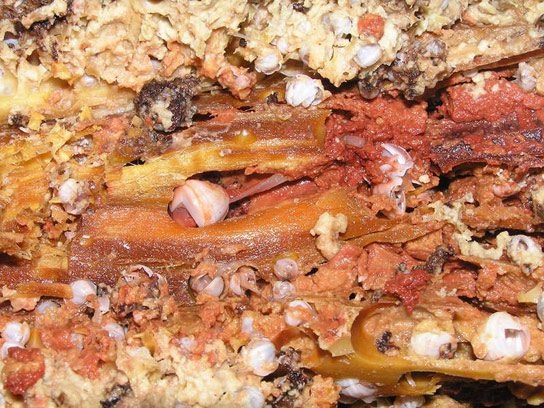
    One of the wood experiments after one year at the seafloor. Wood-boring bivalves of the genus Xylophaga had populated the wood. Credit: Christina Bienhold, MPI for Marine Microbiology

    Scientists from the Max Planck Institute have shown how sunken wood can develop into attractive habitats for a variety of microorganisms and invertebrates due to the activity of bacteria, which produce hydrogen sulfide during wood degradation.

    Trees do not grow in the deep sea, nevertheless, sunken pieces of wood can develop into oases for deep-sea life – at least temporarily until the wood is fully degraded. A team of Max Planck researchers from Germany now showed how sunken wood can develop into attractive habitats for a variety of microorganisms and invertebrates. By using underwater robot technology, they confirmed their hypothesis that animals from hot and cold seeps would be attracted to the wood due to the activity of bacteria, which produce hydrogen sulfide during wood degradation.

    Many of the animals thriving at hydrothermal vents and cold seeps require special forms of energy such as methane and hydrogen sulfide emerging from the ocean floor. They carry bacterial symbionts in their body, which convert the energy from these compounds into food. The vents and seeps are often separated by hundreds of kilometers of deep-sea desert, with no connection between them.

    For a long time, it was an unsolved mystery how animals can disperse between those rare oases of energy in the deep sea. One hypothesis was that sunken whale carcasses, large dead algae, and also sunken woods could serve as food source and temporary habitat for deep-sea animals, but only if bacteria were able to produce methane and sulfur compounds from it.

    To tackle this question, the team deposited wood logs on the Eastern Mediterranean seafloor at depths of 1700 meters and returned after one year to study the fauna, bacteria, and chemical microgradients.
    Colonization-of-wood-in-the-deep-sea
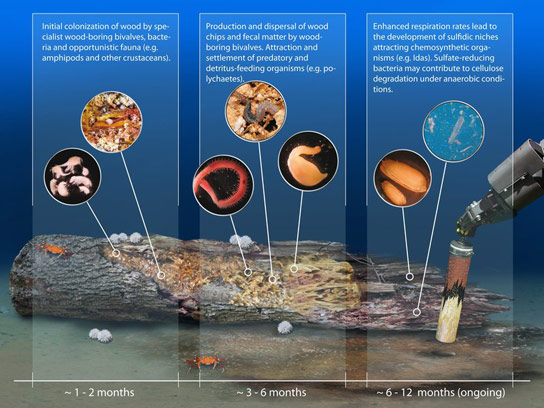
    Colonization of wood in the deep sea. Credit: Bienhold et al., PLoS ONE 8(1): e53590).

    “We were surprised how many animals had populated the wood already after one year. The main colonizers were wood-boring bivalves of the genus Xylophaga, also named “shipworms” after their shallow-water counterparts. The wood-boring Xylophaga essentially constitute the vanguard and prepare the habitat for other followers,” Bienhold said. „But they also need assistance from bacteria, namely to make use of the cellulose from the wood, which is difficult to digest.”

    The team of researchers observed that the wood-boring bivalves had cut large parts of the wood into smaller chips, which were further degraded by many other organisms. This activity led to the consumption of oxygen, enabling the production of hydrogen sulfide by sulfate-reducing microorganisms. And indeed, the researchers also found a mussel, which is typically only found at cold seeps or similar environments where it uses sulfur compounds as an energy source. “It is amazing to see how deep-sea bacteria can transform foreign substances such as wood to provide energy for cold-seep mussels on their journey through the deep ocean”, said Antje Boetius, chief scientist of the expedition. Furthermore, the researchers discovered unknown species of deep-sea worms, which have been described by taxonomic experts in Germany and the USA. Thus, sunken woods do not only promote the dispersal of rare deep-sea animals, but also form hotspots of biodiversity at the deep seafloor.

    Reference: “How Deep-Sea Wood Falls Sustain Chemosynthetic Life” by Christina Bienhold, Petra Pop Ristova, Frank Wenzhöfer, Thorsten Dittmar and Antje Boetius, 2 January 2013, PLoS ONE.
    DOI: 10.1371/journal.pone.0053590

    Never miss a breakthrough: Join the SciTechDaily newsletter.
    Follow us on Google and Google News.

    Ecology Max Planck Institute Microbiology
    Share. Facebook Twitter Pinterest LinkedIn Email Reddit

    Related Articles

    This Fungus Turns Bark Beetles’ Defenses Against Them

    Scientists Discover Mussels and Sponges Thrive on Oil with the Help of Symbiont Bacteria

    The Effects of Ice Retreat and Biodiversity in the Arctic Deep Sea

    Plants Choose and Make Use of the Bacteria They Allow into Their Roots

    Hybridization Leads to New Pathogen Species

    Insight on the Evolution of Cocaine Biosynthesis

    Oxygen Depletion and Acidification Accelerate Coral Death

    Marine Worm Thrives on Steady Diet of Deadly Poisons

    Desert Ants Need Very Few Landmarks for Orientation

    Leave A Reply Cancel Reply

    • Facebook
    • Twitter
    • Pinterest
    • YouTube

    Don't Miss a Discovery

    Subscribe for the Latest in Science & Tech!

    Trending News

    One of the Universe’s Largest Stars May Be Getting Ready To Explode

    Scientists Discover Enzyme That Could Supercharge Ozempic-Like Weight Loss Drugs

    Popular Sweetener Linked to DNA Damage – “It’s Something You Should Not Be Eating”

    Ancient “Rock” Microbes May Reveal How Complex Life Began

    Researchers Capture Quantum Interference in One of Nature’s Rarest Atoms

    “A Plague Is Upon Us”: The Mass Death That Changed an Ancient City Forever

    Scientists Discover Game-Changing New Way To Treat High Cholesterol

    This Small Change to Your Exercise Routine Could Be the Secret to Living Longer

    Follow SciTechDaily
    • Facebook
    • Twitter
    • YouTube
    • Pinterest
    • Newsletter
    • RSS
    SciTech News
    • Biology News
    • Chemistry News
    • Earth News
    • Health News
    • Physics News
    • Science News
    • Space News
    • Technology News
    Recent Posts
    • Scientists Prove There Are Just Six Degrees of Separation in a Social Network
    • Bee Bacteria Could Fix a Major Flaw in Plant-Based Milk
    • Scientists Discover a Surprising Way To Make Bread Healthier and More Nutritious
    • Natural Compounds Boost Bone Implant Success While Killing Bacteria and Cancer Cells
    • After 60 Years, Scientists Uncover Unexpected Brain Effects of Popular Diabetes Drug Metformin
    Copyright © 1998 - 2026 SciTechDaily. All Rights Reserved.
    • Science News
    • About
    • Contact
    • Editorial Board
    • Privacy Policy
    • Terms of Use

    Type above and press Enter to search. Press Esc to cancel.