
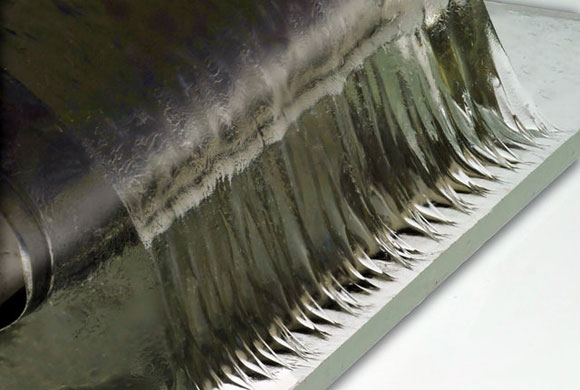
Engineers from MIT have developed a method to make synthetic, sticky hydrogel that is more than 90 percent water. The hydrogel, which is a transparent, rubber-like material, can adhere to surfaces with a toughness comparable to the bond between tendon and cartilage on bone.
Nature has developed innovative ways to solve a sticky challenge: Mussels and barnacles stubbornly glue themselves to cliff faces, ship hulls, and even the skin of whales. Likewise, tendons and cartilage stick to bone with incredible robustness, giving animals flexibility and agility.
The natural adhesive in all these cases is hydrogel — a sticky mix of water and gummy material that creates a tough and durable bond.
Now engineers at MIT have developed a method to make synthetic, sticky hydrogel that is more than 90 percent water. The hydrogel, which is a transparent, rubber-like material, can adhere to surfaces such as glass, silicon, ceramics, aluminum, and titanium with a toughness comparable to the bond between tendon and cartilage on bone.
In experiments to demonstrate its robustness, the researchers applied a small square of their hydrogel between two plates of glass, from which they then suspended a 55-pound weight. They also glued the hydrogel to a silicon wafer, which they then smashed with a hammer. While the silicon shattered, its pieces remained stuck in place.
Such durability makes the hydrogel an ideal candidate for protective coatings on underwater surfaces such as boats and submarines. As the hydrogel is biocompatible, it may also be suitable for a range of health-related applications, such as biomedical coatings for catheters and sensors implanted in the body.
“You can imagine new applications with this very robust, adhesive, yet soft material,” says Xuanhe Zhao, the Robert N. Noyce Career Development Associate Professor in MIT’s Department of Mechanical Engineering. For example, Zhao’s group is currently exploring uses for the hydrogel in soft robotics, where the material may serve as synthetic tendon and cartilage, or in flexible joints.
“It’s a pretty tough and adhesive gel that’s mostly water,” Hyunwoo Yuk, a graduate student in mechanical engineering and the lead author of a paper on the work, says. “Basically, it’s tough, bonding water.”
Zhao and his students will publish their results in the journal Nature Materials.
Learn how MIT engineers developed a synthetic, sticky hydrogel that’s more than 90 percent water. Video: Melanie Gonick/MIT (demo clips courtesy of Hyunwook Yuk)
A stretchy anchor
A tough, flexible hydrogel that bonds strongly requires two characteristics, Zhao found: energy dissipation and chemical anchorage. A hydrogel that dissipates energy is essentially able to stretch significantly without retaining all the energy used to stretch it. A chemically anchored hydrogel adheres to a surface by covalently bonding its polymer network to that surface.
“Chemical anchorage plus bulk dissipation leads to tough bonding,” Zhao says. “Tendons and cartilage harness these, so we’re really learning this principle from nature.”
In developing the hydrogel, Yuk mixed a solution of water with a dissipative ingredient to create a stretchy, rubbery material. He then placed the hydrogel atop various surfaces, such as aluminum, ceramic, glass, and titanium, each modified with functional silanes — molecules that created chemical links between each surface and its hydrogel.
The researchers then tested the hydrogel’s bond using a standard peeling test, in which they measured the force required to peel the hydrogel from a surface. On average, they found the hydrogel’s bond was as tough as 1,000 joules per square meter — about the same level as tendon and cartilage on bone.
Zhao group compared these results with existing hydrogels, as well as elastomers, tissue adhesives, and nanoparticle gels, and found that the new hydrogel adhesive has both higher water content and a much stronger bonding ability.
“We basically broke a world record in bonding toughness of hydrogels, and it was inspired by nature,” Yuk says.
Sticky robotics
In addition to testing the hydrogel’s toughness with a hammer and a weight, Zhao and his colleagues explored its use in robotic joints, using small spheres of hydrogel to connect short pipes to simulate robotic limbs.
“Hydrogels can act as actuators,” Zhao says. “Instead of using conventional hinges, you can use this soft material with strong bonding to rigid materials, and it can give a robot many more degrees of freedom.”
The researchers also looked into its application as an electrical conductor. Yuk and other students added salts to a hydrogel sample, and attached the hydrogel to two metal plates connected via electrodes to an LED light. They found that the hydrogel enabled the flow of salt ions within the electrical loop, ultimately lighting up the LED.
“We create extremely robust interfaces for hydrogel-metal hybrid conductors,” Yuk adds.
Zhao’s group is currently most interested in exploring the hydrogel’s use in soft robotics, as well as in bioelectronics.
“Since the hydrogel contains over 90 percent water, the bonding may be regarded as a water adhesive, which is tougher than natural glues, such as in barnacles and mussels, and bio-inspired underwater glues,” Zhao says. “The work has significant implications in understanding bio-adhesion, as well as practical applications such as in hydrogel coatings, biomedical devices, tissue engineering, water treatment, and underwater glues.”
This research was supported in part by the Office of Naval Research and the National Science Foundation.
Publication: In press
Never miss a breakthrough: Join the SciTechDaily newsletter.
Follow us on Google and Google News.
1 Comment
How would someone go about making the hydrogel