

Scientists using data from the European Space Agency’s Gaia mission have made a groundbreaking discovery: a massive exoplanet and a brown dwarf.
This marks the first time a planet has been identified solely through Gaia’s ability to detect the tiny gravitational “wobble” it causes in its host star. What makes this finding even more intriguing is that both objects orbit low-mass stars—an arrangement considered extremely rare. These unexpected discoveries are challenging our understanding of how planets and brown dwarfs form and evolve.
Gaia Reveals Two New Mysterious Celestial Objects
New research published on February 4 confirms the existence of two mysterious celestial objects using data from ESA’s Gaia spacecraft. The first, Gaia-4b, is a massive “Super-Jupiter” exoplanet, while the second, Gaia-5b, is a brown dwarf. Surprisingly, both of these giant objects orbit low-mass stars, challenging current models of planetary formation.

Gaia-4b orbits the previously unremarkable star Gaia-4, located about 244 light-years from Earth. Meanwhile, Gaia-5b circles Gaia-5, a star roughly 134 light-years away. These discoveries place them relatively close to us in cosmic terms, right within our galactic neighborhood. Their unexpected nature raises new questions about how such massive objects form around smaller stars. Gaia’s ongoing mission will provide critical data to help scientists better understand these puzzling systems.
“Gaia-4b is about twelve times more massive than Jupiter. With an orbital period of 570 days, it is a relatively cold gas giant planet,” explains first author Guðmundur Stefánsson of the University of Amsterdam, the Netherlands, and first author of the new study.
“With a mass of around 21 Jupiters, Gaia-5b is a brown dwarf, more massive than a planet but too light to sustain nuclear fusion to be a star,” Guðmundur adds.

From Wobbles to New Worlds
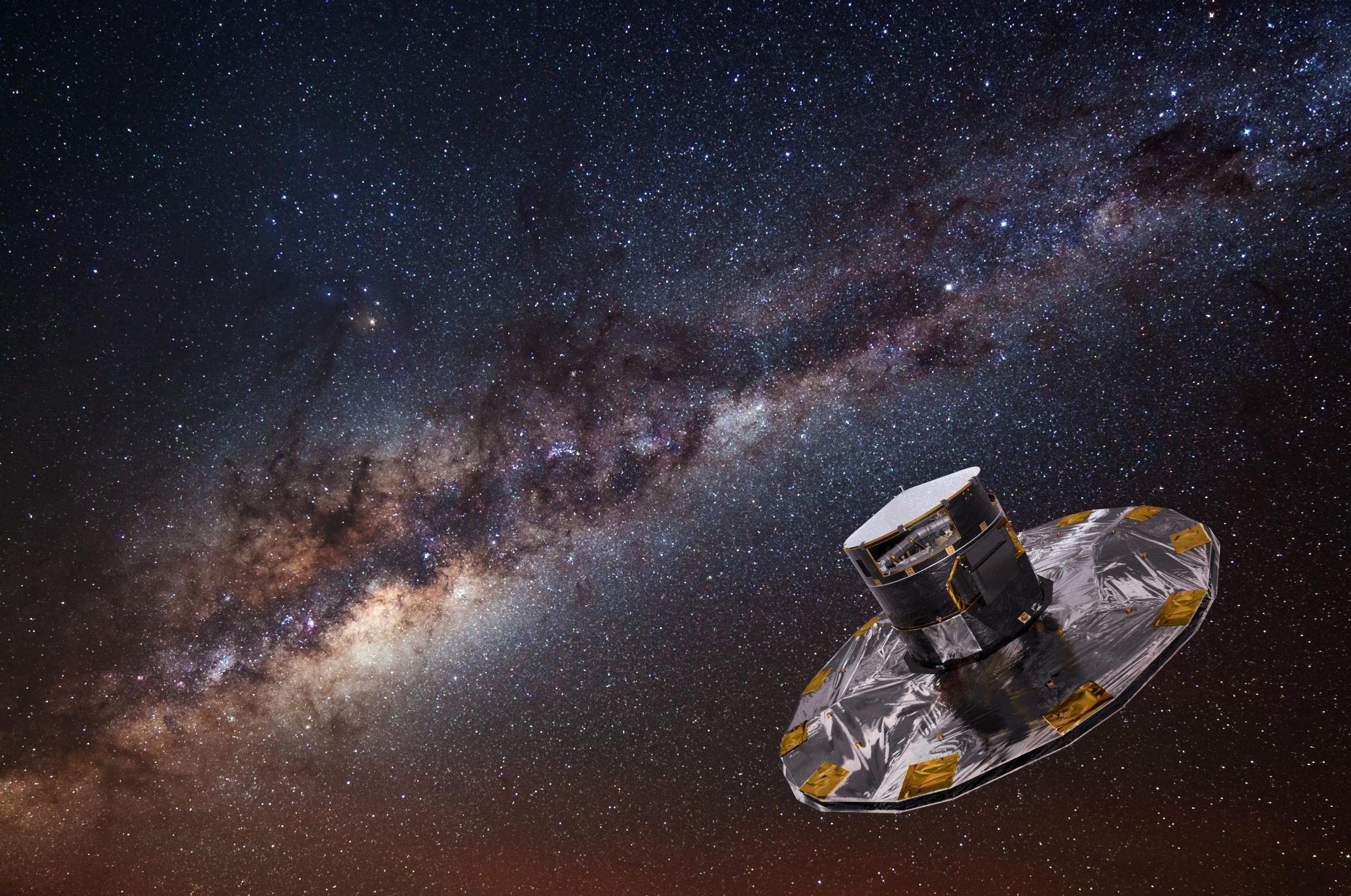
Since its launch in 2013, ESA’s Gaia spacecraft has been building the largest, most precise three-dimensional map of our galaxy. Spinning slowly, it scanned the sky with two optical telescopes, repeatedly pinpointing the positions of two billion objects with unprecedented precision, until its end of science observations on January 15, 2025. Because Gaia precisely tracked the motion of stars – a technique known as astrometry – thousands of new objects are expected to be discovered in its data.
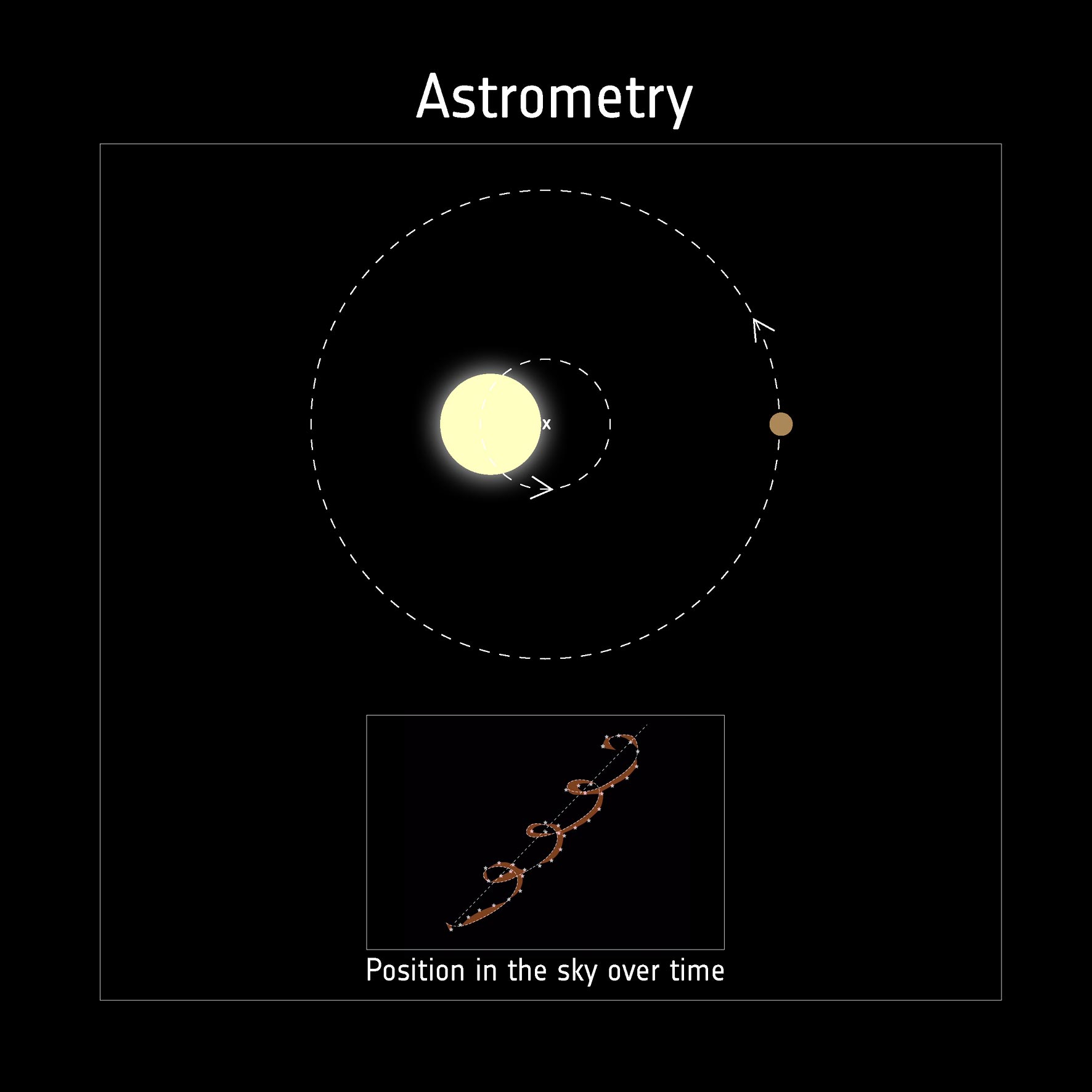
A planet in orbit around a star creates a tiny gravitational ‘tug’ that makes the star ‘wobble’ around its center of mass and travel in a corkscrew-like motion across the sky. The easiest objects to discover using astrometry are massive and in distant orbits around their parent star. Previously, a few massive brown dwarfs were confirmed to exist by other telescopes that observed their faint glow next to bright stars for which Gaia had detected such a wobble.
That’s in contrast to the transit method, which detects planets as they pass in front of their star and is most likely to find planets in a close orbit. And although detecting a wobble suggests a star might have a planet, there are other potential causes (such as binary star systems), so astrometric discoveries must be confirmed using other methods.
Mapping the Secrets of Low-Mass Stars
“Gaia was repeatedly scanning these stars, building up an increasingly detailed picture over time,” Guðmundur says. “In 2022, Gaia Data Release 3 included a list of stars that appear to be moving as though pulled by an exoplanet. Using ground-based spectroscopic data and the radial velocity technique to investigate these stars, we confirmed our first planet and our first brown dwarf.”
Combining astrometric and radial velocity data allows astronomers to find all the orbital details and the mass of the orbiting object, offering a unique opportunity to create three-dimensional visualizations.
“About 75% of the stars in the Milky Way are low-mass stars, with masses between about 10% and 60-65% of the mass of the Sun. Because they’re so numerous, they’re also our nearest neighbor stars,” explains Guðmundur. “Massive planets around low-mass stars are known to be relatively rare, but when they occur, they cause a larger wobble, and therefore a stronger astrometric signature that is easier to detect.”
Treasure Trove for Planet Hunters
Whereas a previous exoplanet was found by the Gaia and Hipparcos missions in tandem, the presence of Gaia-4b was revealed by Gaia data alone.
When the next batch of Gaia data is released in 2026, it will contain 5.5 years of mission data that could uncover hundreds – if not thousands – of planets and brown dwarfs around nearby stars. That will give us new insights into how these different objects form, and Gaia is paving the way for a new era of astrometric discovery, leading to a deeper understanding of the diverse planetary systems that populate our galaxy.
Breaking New Ground in Exoplanet Research
ESA Research Fellow Matthew Standing is an exoplanet expert. “This discovery is an exciting tip-of-the-iceberg for the exoplanet discoveries we can expect from Gaia in the future,” he explains. “The discovery of Gaia-4b is an important breakthrough in the use of Gaia astrometry for exoplanet detection, complimenting the other exoplanet detection methods used by ESA’s Cheops and the upcoming Plato mission.”
“Gaia has seen the telltale signs of known exoplanets before, but this time Gaia revealed an entirely new extrasolar world,” says Johannes Sahlmann, Gaia Project Scientist at ESA. “The discovery of Gaia-4b shows how Gaia’s detailed measurements complement established exoplanet discovery techniques and offer new opportunities for exoplanet research. The upcoming fourth Gaia data release will be a treasure trove for planet hunters.”
Reference: “Gaia-4b and 5b: Radial Velocity Confirmation of Gaia Astrometric Orbital Solutions Reveal a Massive Planet and a Brown Dwarf Orbiting Low-mass Stars” by Gudmundur Stefánsson, Suvrath Mahadevan, Joshua N. Winn, Marcus L. Marcussen, Shubham Kanodia, Simon Albrecht, Evan Fitzmaurice, Onė Mikulskytė, Caleb I. Cañas, Juan I. Espinoza-Retamal, Yiri Zwart, Daniel M. Krolikowski, Andrew Hotnisky, Paul Robertson, Jaime A. Alvarado-Montes, Chad F. Bender, Cullen H. Blake, J. R. Callingham, William D. Cochran, Megan Delamer, Scott A. Diddams, Jiayin Dong, Rachel B. Fernandes, Mark R. Giovinazzi, Samuel Halverson, Jessica Libby-Roberts, Sarah E. Logsdon, Michael W. McElwain, Joe P. Ninan, Jayadev Rajagopal, Varghese Reji, Arpita Roy, Christian Schwab and Jason T. Wright, 4 February 2025, The Astronomical Journal.
DOI: 10.3847/1538-3881/ada9e1
Never miss a breakthrough: Join the SciTechDaily newsletter.
Follow us on Google and Google News.
10 Comments
What an adventurous line of work the astronomy must be. You get stunned all the time.
They don’t even know what is in our Oceans, let alone all these planets we spend Billions of Dollars on For what?? INFORMATION!!!!???? READ your Bible, Give you better insight to the Rock we Live on.
I don’t find anything in the Bible that gives me better insight “to” the Rock we Live on, or the rock you live under.
If we can’t explain something, which was every at some point, we study it to learn about it. That’s how we gain knowledge, studying and researching. The first sentence is inherently true but really makes no sense to state. As does the last. But again makes no sense to state. Add the middle one and we are sacrifices goats to make it rain still…..
Missing books of the old testament…..plate tectonics and the one where the Roman’s killed off the dinosaurs
Agree
Well, since the Bible didn’t predict the asteroid heading our way in seven years, clearly it isn’t going to hit us. Didn’t predict the one in Russia ten years ago, either.
God’s gift to the literary world is a wonderful thing, but nowhere in it does it tell us to stop using the grey matter between our ears to solve potential problems. The information you decry may well end up saving us from an ELE.
Everything in the universe that exists is supposed to exist. The fact we humans can’t explain something simply means we’re not as intelligent as we think we are. Not everything can be explained with our current limited knowledge of the universe.
Including those three sentences? I suppose.
But they still leave me woefully unsatisfied.
Missing books of the old testament…..plate tectonics and the one where the Roman’s killed off the dinosaurs