
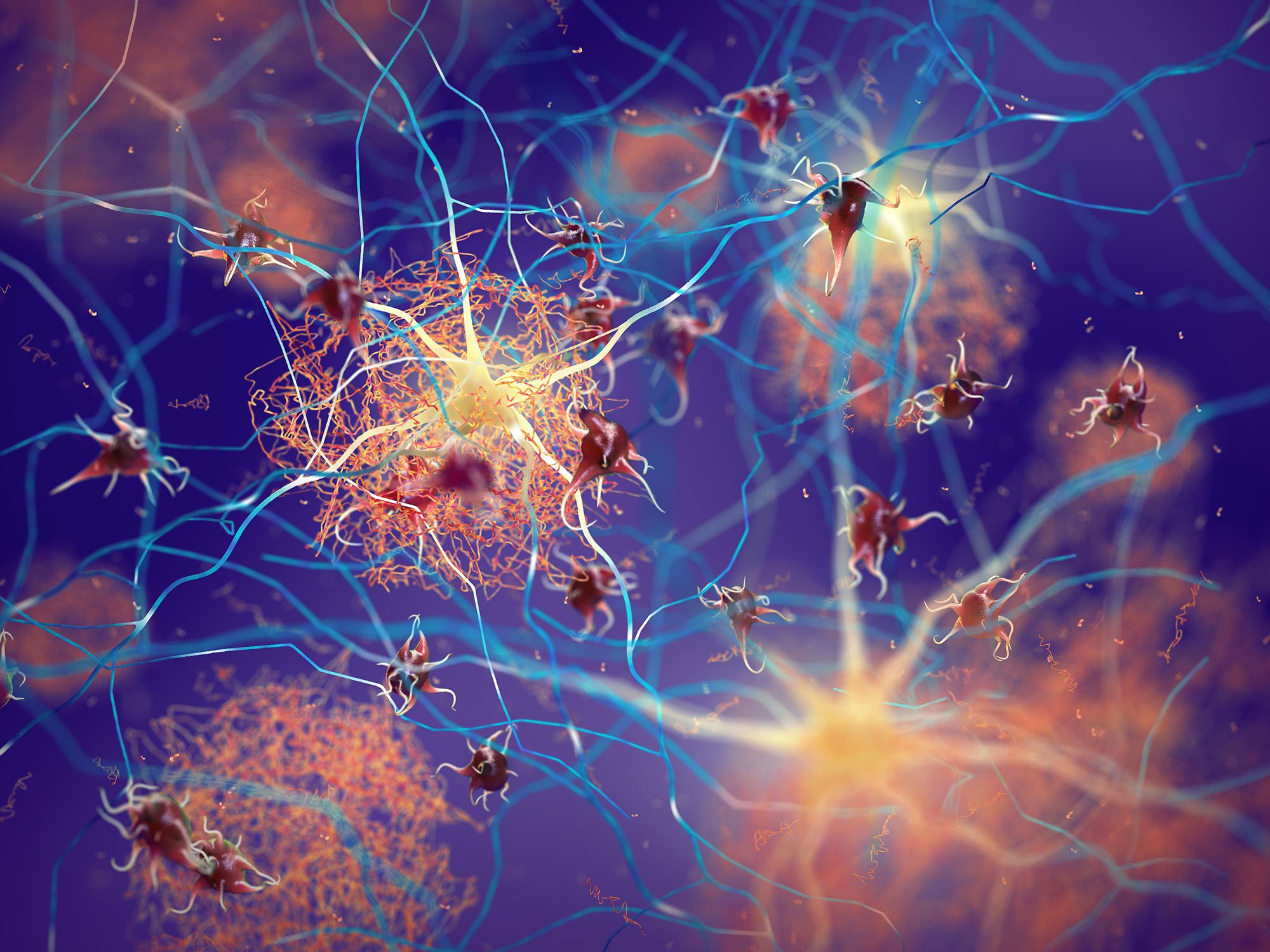
L-arginine helps protein droplets stay stable and prevents fibril formation linked to Alzheimer’s. This process occurs at droplet surfaces, offering a potential therapeutic target.
Inside living cells, tiny liquid-like droplets quietly keep essential processes running. But in disorders like Alzheimer’s, these dynamic structures can take a dangerous turn, hardening into fiber-like fibrils that disrupt the inner workings of neurons.
This transformation undermines critical functions, including the stabilization of microtubules that ferry vital cargo through cells. The challenge has been finding a way to stop this harmful shift without shutting down the droplets’ normal activity.
Biophysicists at the University at Buffalo report a potential solution involving a naturally occurring small molecule already found in cells. In a study published in Nature Communications, they found that the metabolite L-arginine improves the stability of protein droplets. It helps prevent their conversion into fibrils while preserving their ability to stabilize and build microtubules.
L-Arginine Stabilizes Droplets and Prevents Fibrils
The findings offer a proof of principle for identifying small molecules that can block fibril formation without impairing droplet function.
“These findings show that protein droplet formation and fibril formation are two separable processes, and that one can be prevented without interfering with the other,” says the study’s corresponding author, Priya Banerjee, PhD, professor in the UB Department of Physics.
Banerjee studies droplets made of proteins, RNA, and DNA. These structures, known as biomolecular condensates, are vital for normal cellular activity but can behave abnormally in many neurodegenerative diseases and cancers.
One protein, Tau, forms droplets that can slowly transform into fibrils called amyloids. These Tau fibrils are a hallmark of Alzheimer’s disease. Unlike amyloid-beta plaques, which build up outside neurons, Tau fibrils accumulate inside them.
Tau Protein and Surface-Level Fibril Growth
In this study, Banerjee’s team used a bottom-up bioengineering method with an engineered form of Tau to replicate how these liquid droplets form and gradually turn into fibrils.
Their model showed that fibrils begin forming at the surface of droplets rather than throughout the entire structure.
“This means that the inside of the droplet remains liquid-like and functional during fibril formation, so it’s possible to keep the droplet intact while simply blocking fibril formation at the surface,” says first author, Tharun Selvam Mahendran, a PhD student in Banerjee’s lab.
Potential Pathways for Alzheimer’s Therapies
The researchers then introduced L-arginine, which is known to reduce protein clumping, into their system. The droplets remained liquid-like for longer, fibril formation dropped, and the droplets continued to assemble microtubules.
“Healthy cells might already be using small molecules like this L-arginine to stabilize the droplets and prevent them from being something toxic,” Banerjee says. “So molecules like L-arginine could help guide efforts to develop therapies that target fibril formation in Alzheimer’s.”
Reference: “Decoupling phase separation and fibrillization preserves activity of biomolecular condensates” by Tharun Selvam Mahendran, Anurag Singh, Sukanya Srinivasan, Christian M. Jennings, Christian Neureuter, Bhargavi H. Gindra, Sapun H. Parekh and Priya R. Banerjee, 16 February 2026, Nature Communications.
DOI: 10.1038/s41467-026-69244-z
The work was supported by the National Institutes of Health, the National Science Foundation, St. Jude Children’s Research Hospital, the Welch Foundation, and the Chan Zuckerberg Initiative.
Never miss a breakthrough: Join the SciTechDaily newsletter.
Follow us on Google and Google News.
5 Comments
Thank y’all 🙏 God bless each of you ❤️
Thank you for the info
L arginine metabolizes into nitric oxide which is a potent vasodilator. This increases blood circulation which is beneficial. It also helps maintain elections and little and increases quantity of ejaculation. According to an Italian study from the early 2000’s.
Yep. Does a lot more than that!
How can I get Larginine
For Alzheimer’s