
Glowing Bipolar Bubble From Dying Star Expands Into Space
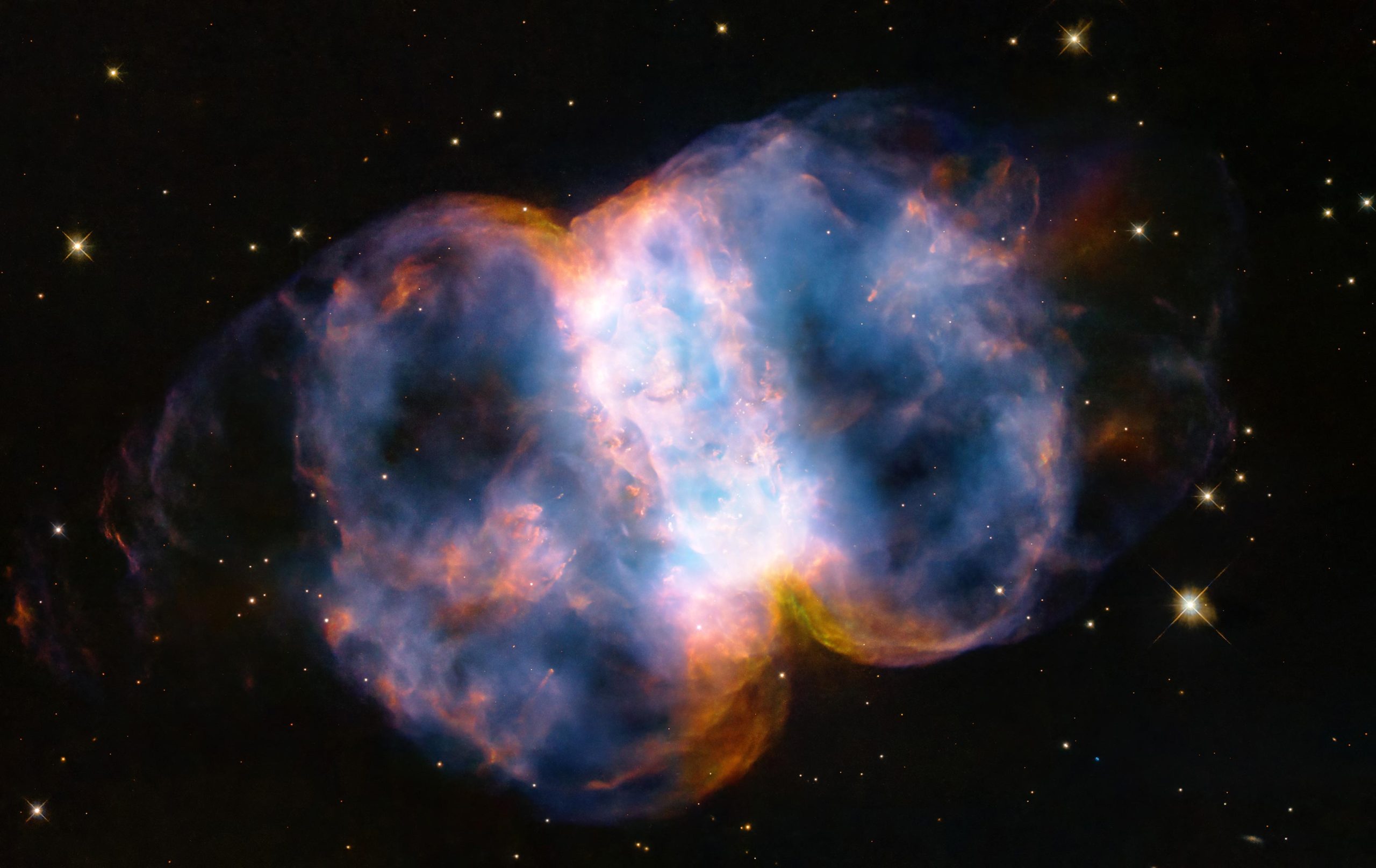
In celebration of the 34th anniversary of the launch of NASA’s legendary Hubble Space Telescope on April 24, 1990, astronomers took a snapshot of the Little Dumbbell Nebula. Also known as Messier 76, M76, or NGC 650/651, it is composed of a ring, seen edge-on as the central bar structure, and two lobes on either opening of the ring.
Before a red giant star burned out, it ejected a ring of gas and dust. The ring was probably sculpted by the effects of a binary companion star. This sloughed-off material created a thick disk of dust and gas along the plane of the companion’s orbit. The hypothetical companion star isn’t seen in the Hubble image, and so it could have been later swallowed by the central star. The disk would be forensic evidence for that stellar cannibalism.
The photogenic nebula is a favorite target of amateur astronomers. Professional astronomers first took a spectrum in 1891, which indicated it was a nebula instead of a galaxy or a star cluster. They suggested that M76 might be similar to the donut-shaped Ring Nebula (M57), as seen instead from a side view.
For more than three decades the NASA/ESA Hubble Space Telescope has revolutionized modern astronomy, not only for astronomers but also by taking the public on a wondrous journey of exploration and discovery. Each year Hubble dedicates a small portion of its precious observing time to taking a special anniversary image, showcasing particularly beautiful and meaningful objects. Hubble’s 34th launch anniversary is celebrated with a snapshot of the Little Dumbbell Nebula. Credit: NASA, ESA, STScI, A. Pagan (STScI), N. Bartmann (ESA/Hubble)
Hubble Celebrates 34th Anniversary With a Look at the Little Dumbbell Nebula
In celebration of the 34th anniversary of the launch of the legendary NASA/ESA Hubble Space Telescope on 24 April, astronomers took a snapshot of the Little Dumbbell Nebula (also known as Messier 76, M76, or NGC 650/651) located 3400 light-years away in the northern circumpolar constellation Perseus. The photogenic nebula is a favorite target of amateur astronomers.
M76 is classified as a planetary nebula, an expanding shell of glowing gases that were ejected from a dying red giant star. The star eventually collapses to an ultra-dense and hot white dwarf. A planetary nebula is unrelated to planets, but has that name because astronomers in the 1700s using low-power telescopes thought this type of object resembled a planet.
M76 is composed of a ring, seen edge-on as the central bar structure, and two lobes on either opening of the ring. Before the star burned out, it ejected the ring of gas and dust. The ring was probably sculpted by the effects of the star that once had a binary companion star. This sloughed-off material created a thick disc of dust and gas along the plane of the companion’s orbit. The hypothetical companion star isn’t seen in the Hubble image, and so it could have been later swallowed by the central star. The disc would be forensic evidence for that stellar cannibalism.
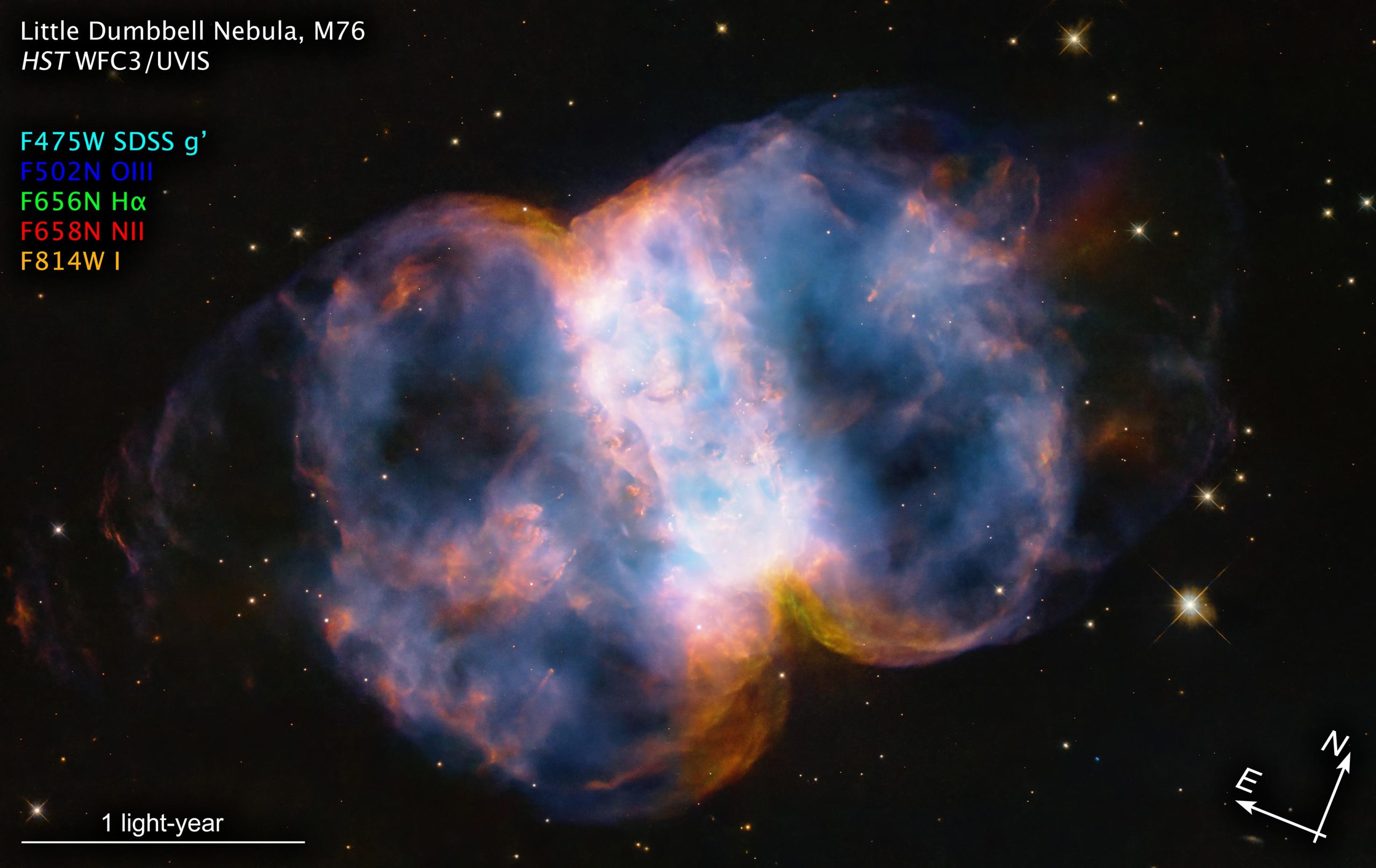
The primary star is collapsing to form a white dwarf. It is one of the hottest stellar remnants known, at a scorching 120,000 degrees Celsius, 24 times our Sun’s surface temperature. The sizzling white dwarf can be seen as a pinpoint in the center of the nebula. A star visible in projection beneath it is not part of the nebula.
Pinched off by the disc, two lobes of hot gas are escaping from the top and bottom of the ‘belt’ along the star’s rotation axis that is perpendicular to the disc. They are being propelled by the hurricane-like outflow of material from the dying star, tearing across space at two million miles per hour. That’s fast enough to travel from Earth to the Moon in a little over seven minutes! This torrential ‘stellar wind’ is plowing into cooler, slower-moving gas that was ejected at an earlier stage in the star’s life, when it was a red giant. Ferocious ultraviolet radiation from the super-hot star is causing the gases to glow. The red color is from nitrogen, and the blue is from oxygen.
Given that our solar system is 4.6 billion years old, the entire nebula is a flash in the pan by cosmological timekeeping. It will vanish in about 15,000 years.
Hubble’s Record-Breaking Science Output
Since its launch in 1990 Hubble has made 1.6 million observations of over 53,000 astronomical objects. To date, the Mikulski Archive for Space Telescopes at the Space Telescope Science Institute in Baltimore, Maryland holds 184 terabytes of processed data that are science-ready for use by astronomers around the world to use for research and analysis. A European mirror of the public data is hosted at ESA’s European Space Astronomy Centre (ESAC), in the European Hubble Space Telescope (eHST) Science Archive.
Since 1990, 44,000 science papers have been published from Hubble observations. This includes a record 1056 papers published in 2023, of which 409 were led by authors in the ESA Member States. The demand for using Hubble is so high it is currently oversubscribed by a factor of six.
Throughout its past year of science operations, new discoveries made using Hubble include finding water in the atmosphere of the smallest exoplanet to date, spotting a bizarre cosmic explosion far from any host galaxy, following spokes on the rings of Saturn, and finding the unexpected home of the most distant and powerful fast radio burst yet seen. Hubble’s studies of the asteroid Dimorphos, the target of a deliberate NASA spacecraft collision in September 2022 to alter its trajectory, continued with the detection of boulders released by the impact.
This video takes the viewer on a journey to the 34th-anniversary image of the launch of the legendary NASA/ESA Hubble Space Telescope: the Little Dumbbell Nebula (also known as Messier 76, M76, or NGC 650/651). The object is located 3400 light-years away in the northern circumpolar constellation Perseus. The photogenic nebula is a favorite target of amateur astronomers. Credit: NASA, ESA, STScI, A. Pagan (STScI), Acknowledgment: D. Crowson, A. Fujii, Digitized Sky Survey
Hubble has also continued to provide spectacular images of celestial targets including spiral galaxies, globular clusters, and star-forming nebulae. A newly forming star was the source of a cosmic light show. Hubble imagery was also combined with infrared observations from the NASA/ESA/CSA James Webb Space Telescope to create one of the most comprehensive views of the Universe ever, an image of galaxy cluster MACS 0416.
Most of Hubble’s discoveries were not anticipated before launch, such as supermassive black holes, the atmospheres of exoplanets, gravitational lensing by dark matter, the presence of dark energy, and the abundance of planet formation among stars. Hubble will continue research in those domains, as well as capitalizing on its unique ultraviolet-light capability to examine such things as Solar System phenomena, supernova outbursts, the composition of exoplanet atmospheres, and dynamic emission from galaxies. And Hubble investigations continue to benefit from its long baseline of observations of Solar System objects, variable stellar phenomena and other exotic astrophysics of the cosmos.
The performance characteristics of the James Webb Space Telescope were designed to be uniquely complementary to Hubble, and not a substitute. Future Hubble research also will take advantage of the opportunity for synergies with Webb, which observes the Universe in infrared light. Combined together, the complementary wavelength coverage of the two space telescopes expands on groundbreaking research in such areas as protostellar discs, exoplanet composition, unusual supernovae, cores of galaxies and chemistry of the distant Universe.
The Hubble Space Telescope has been operating for over three decades and continues to make ground-breaking discoveries that shape our fundamental understanding of the Universe.
Hubble is a project of international cooperation between NASA and ESA (European Space Agency). NASA’s Goddard Space Flight Center in Greenbelt, Maryland, manages the telescope and mission operations. Lockheed Martin Space, based in Denver, Colorado, also supports mission operations at Goddard. The Space Telescope Science Institute in Baltimore, Maryland, which is operated by the Association of Universities for Research in Astronomy, conducts Hubble science operations for NASA.
Never miss a breakthrough: Join the SciTechDaily newsletter.
Follow us on Google and Google News.
1 Comment
My first thought is about Carl Hubble an amazing pitcher whose brother lived across the street. My second thought is of the gillions given to Perkin-Elmer the company that screwed up the mirror. My third thought is about the Challenger disaster and Morton Thiakol the company that disciplined an employee for pointing out problems with the seals and then pushed for launch.
Lastly, I think about the engineers who will guarantee the safety of “newly designed” nuclear reactors.