
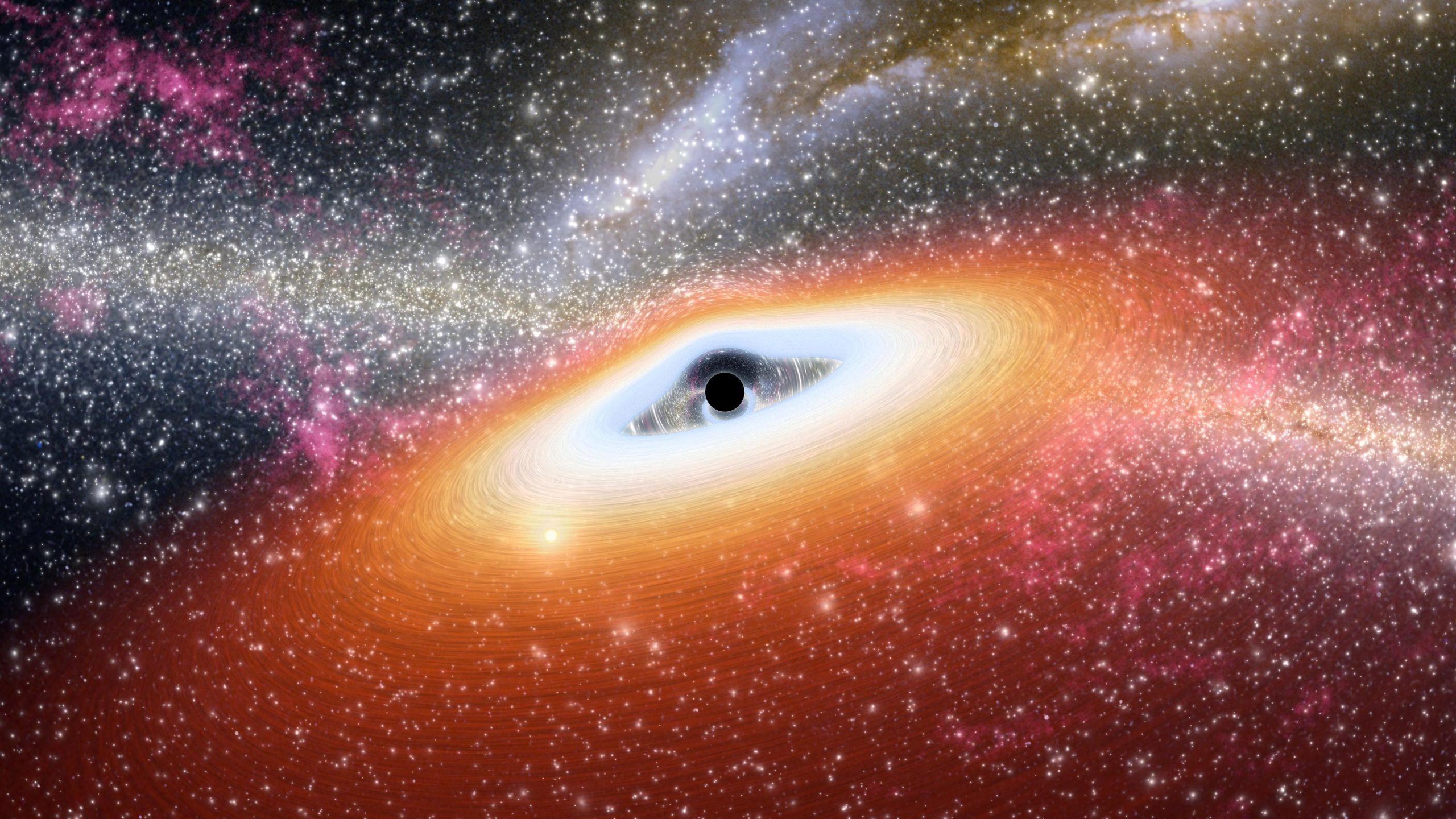
These space giants would not have had the time to develop in the young Universe. Yet, observations say they were already present; a new study proposes a response to the mystery.
They are billions of times larger than our Sun: how is it possible that, as recently observed, supermassive black holes were already present when the Universe, now 14 billion years old, was “just” 800 million years old? For astrophysicists, the formation of these cosmic monsters in such a short time is a real scientific headache, which raises important questions on the current knowledge of the development of these celestial bodies. A recent article published in The Astrophysical Journal, by the SISSA Ph.D. student Lumen Boco and his supervisor Andrea Lapi, offers a possible explanation to the thorny issue. Thanks to an original model theorized by the scientists from Trieste, the study proposes a very fast formation process in the initial phases of the development of the supermassive black holes, those up to now considered slower. Proving, mathematically, that their existence was possible in the young Universe, the results of the research reconcile the timing required for their growth with the limits imposed by the age of the Cosmos. The validity of the theory can be fully validated thanks to future gravitational wave detectors namely Einstein Telescope and LISA, but tested in several basic aspects also with the current Advanced LIGO/Virgo system.
The cosmic monster that grows at the center of galaxies
The scientists started their study with a piece of well-known observational evidence: the growth of supermassive black holes occurs in the central regions of galaxies, progenitors of the current elliptical galaxies, which had a very high gas content and in which the stellar formation was extremely intense. “The biggest stars live a short time and very quickly evolve into stellar black holes, as large as several scores of solar masses; they are small, but many form in these galaxies.” The dense gas that surrounds them, explain Boco and Lapi, has a very powerful definitive effect of dynamic friction and causes them to migrate very quickly to the center of the galaxy. The majority of the numerous black holes that reach the central regions merge, creating the supermassive black hole seed. Boco and Lapi continue: “According to classical theories, a supermassive black hole grows at the center of a galaxy capturing the surrounding matter, principally gas, “growing it” on itself and finally devouring it at a rhythm which is proportional to its mass. For this reason, during the initial phases of its development, when the mass of the black hole is small, the growth is very slow. To the extent that, according to the calculations, to reach the mass observed, billions of times that of the Sun, a very long time would be required, even greater than the age of the young Universe.” Their study, however, showed that things could go much faster than that.
The crazy dash of black holes: what the scientists have discovered
“Our numerical calculations show that the process of dynamic migration and fusion of stellar black holes can make the supermassive black hole seed reach a mass of between 10,000 and 100,000 times that of the Sun in just 50-100 million years.” At this point, the researchers say, “the growth of the central black hole according to the aforementioned direct accretion of gas, envisaged by the standard theory, will become very fast, because the quantity of gas it will succeed in attracting and absorbing will become immense, and predominant on the process we propose. Nevertheless, precisely the fact of starting from such a big seed as envisaged by our mechanism speeds up the global growth of the supermassive black hole and allows its formation, also in the Young Universe. In short, in light of this theory, we can state that 800 million years after the Big Bang the supermassive black holes could already populate the Cosmos.”
“Looking” at the supermassive black hole seeds grow
The article, besides illustrating the model and demonstrating its efficacy, also proposes a method for testing it: “The fusion of numerous stellar black holes with the seed of the supermassive black hole at the center will produce gravitational waves which we expect to see and study with current and future detectors”, explain the researchers. In particular, the gravitational waves emitted in the initial phases, when the central black hole seed is still small, will be identifiable by the current detectors like Advanced LIGO/Virgo and fully characterizable by the future Einstein Telescope. The subsequent development phases of the supermassive black hole could be investigated thanks to the future detector LISA, which will be launched in space around 2034. In this way, explain Boco and Lapi, “the process we propose can be validated in its different phases, in a complementary way, by future gravitational wave detectors.
“This research” concludes Andrea Lapi, coordinator of the Astrophysics and Cosmology group of SISSA, “shows how the students and researchers of our group are fully approaching the new frontier of gravitational waves and multi-messenger astronomy. In particular, our main goal will be to develop theoretical models, like that devised in this case, which serve to capitalize on the information originating from the experiments of current and future gravitational waves, thereby hopefully providing solutions for unresolved issues connected with astrophysics, cosmology, and fundamental physics.”
Reference: “Growth of Supermassive Black Hole Seeds in ETG Star-forming Progenitors: Multiple Merging of Stellar Compact Remnants via Gaseous Dynamical Friction and Gravitational-wave Emission” by L. Boco, A. Lapi and L. Danese, 9 March 2020, The Astrophysical Journal.
DOI: 10.3847/1538-4357/ab7446
Never miss a breakthrough: Join the SciTechDaily newsletter.
Follow us on Google and Google News.
1 Comment
And a long existing explanation advanced by the astronomers Burbidge is the we live in an EXPANDING/COLLAPSING UNIVERSE.