
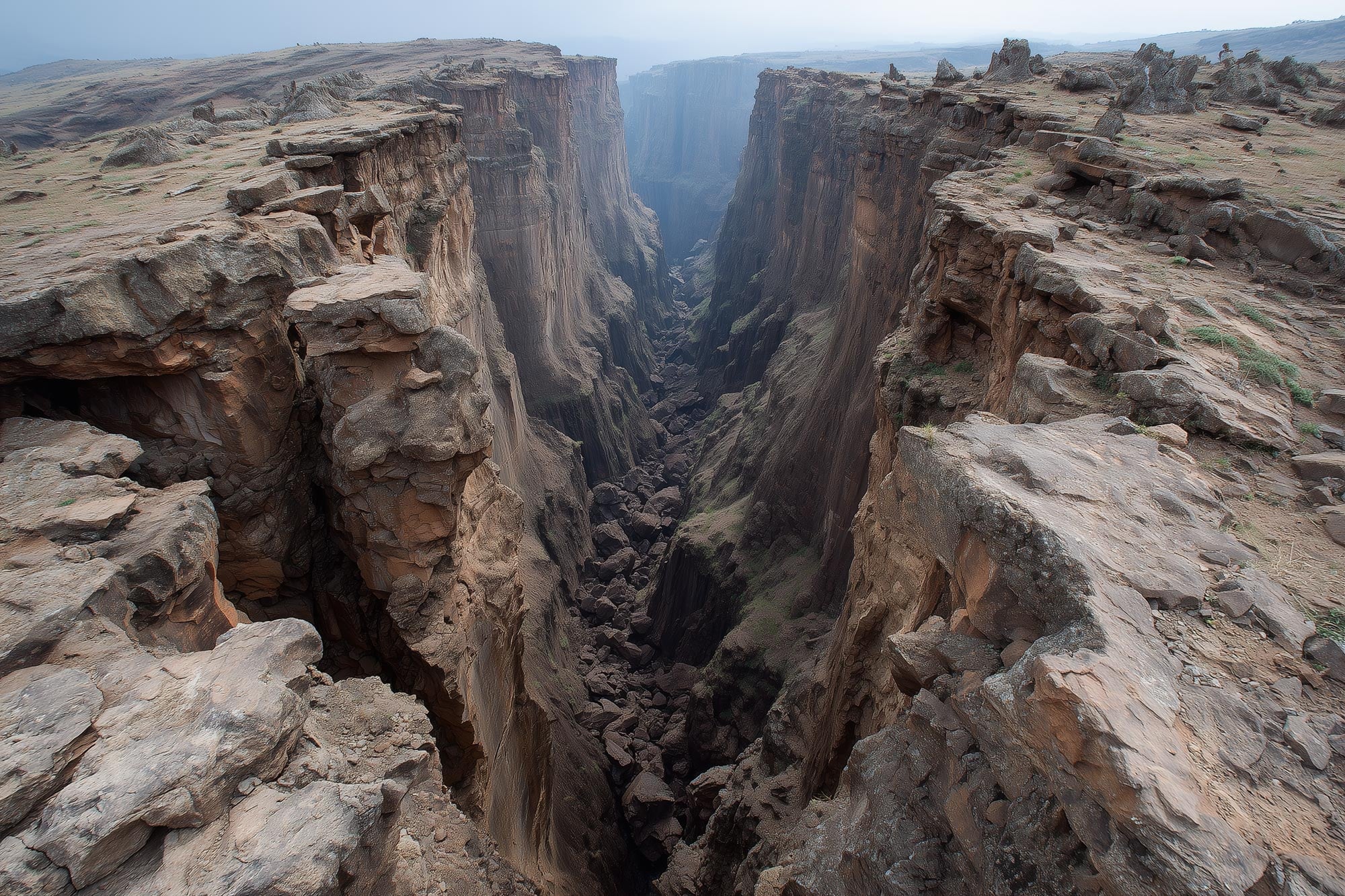
Africa may be slowly breaking apart—and that same process could explain our fossil record.
Eastern Africa’s Turkana Rift is known both for its rich collection of early human fossils and its intense volcanic activity driven by shifting tectonic plates. Now scientists report that the crust beneath this region has thinned far more than previously recognized, pointing toward the long-term breakup of the African continent—and offering a new explanation for why this area preserves such an extraordinary record of human evolution.
The findings were published in Nature Communications.
A Massive Rift Shaped by Tectonic Forces
The Turkana Rift spans about 500 kilometers across Kenya and Ethiopia and forms part of the broader East African Rift System. This system stretches from the Afar Depression in northeastern Ethiopia down to Mozambique, separating the African tectonic plate from the Arabian and Somali plates. In the Turkana region, the African and Somali plates are slowly moving apart at roughly 4.7 millimeters per year.
This gradual separation, known as rifting, pulls the crust sideways. As it stretches, the ground buckles and fractures, allowing magma from deep within Earth to rise toward the surface.
While some rifts stall before splitting a continent, the Turkana Rift appears to be progressing toward that outcome.
Thinning Crust Signals Advanced Rifting
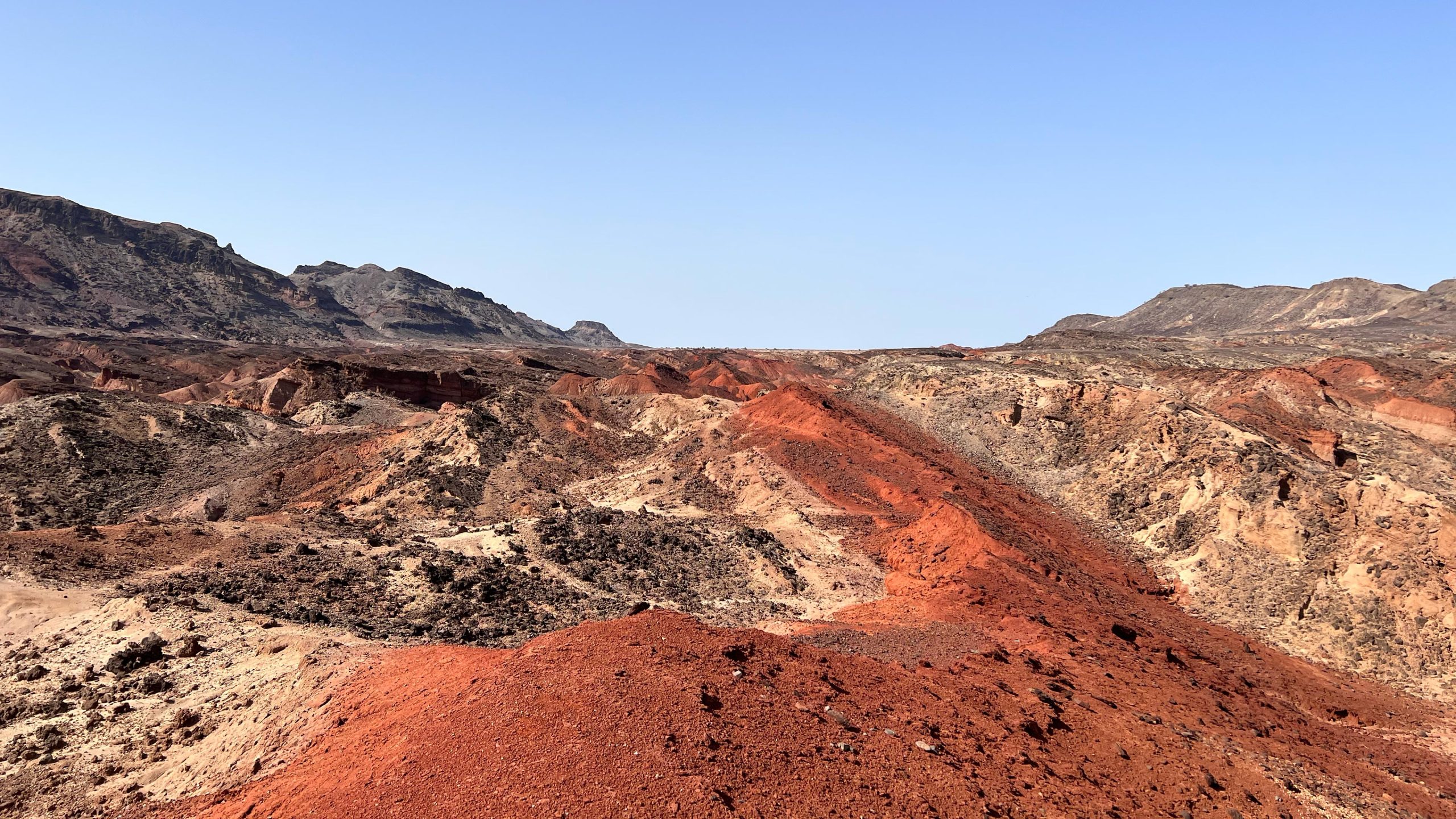
“We found that rifting in this zone is more advanced, and the crust is thinner, than anyone had recognized,” says study lead author Christian Rowan, a Ph.D. student at Columbia University’s Lamont-Doherty Earth Observatory, which is part of the Columbia Climate School. “Eastern Africa has progressed further in the rifting process than previously thought.”
To investigate, Rowan and his team analyzed a high-quality set of seismic data gathered with industry partners and in collaboration with the Turkana Basin Institute, founded by the late paleoanthropologist Richard Leakey. By tracking how sound waves moved through underground layers and combining those results with other subsurface imaging, the researchers mapped sediment structures and determined the depth of the crust beneath the rift.
At the center of the rift, the crust is about 13 kilometers thick. Away from the rift, it exceeds 35 kilometers. This sharp contrast is a clear sign of a process known as “necking.”
“Necking” Marks a Critical Stage of Breakup
The term “necking” refers to how the crust narrows as it stretches, similar to the thin middle section that forms when a piece of saltwater taffy is pulled from both ends. As the crust becomes thinner, it also weakens, which makes continued rifting more likely.
“The thinner the crust gets, the weaker it becomes, which helps promote continued rifting,” Rowan says. Eventually, the crust can split completely.
“We’ve reached that critical threshold” of crustal breakdown, says Anne Bécel, a geophysicist at Lamont and co-author of the study. “We think this is why it is more prone to separate.”
Even so, these changes unfold over vast timescales. The Turkana Rift began opening around 45 million years ago, and researchers estimate that necking began after widespread volcanic eruptions about 4 million years ago. It could take several million more years before the next stage, called oceanization, begins. During that phase, magma will rise through fractures to create new seafloor, and water from the Indian Ocean to the north may eventually flood into the region.
Evidence of Earlier Failed Rifting
The study also uncovered signs of an earlier rifting episode that did not result in a full continental split. Instead, it left the crust thinner and weaker, helping drive the current phase of activity.
“It challenges some of the more traditional ideas of how continents break apart,” says Rowan.
Because the Turkana Rift is the first known active continental rift currently undergoing necking, it provides a rare opportunity to observe this crucial stage of tectonic evolution.
“In essence, we now have a front row seat to observe a critical rifting phase that has fundamentally shaped all rifted margins across the world,” says co-author Folarin Kolawole, who is also with Lamont. These processes are linked to other Earth systems, helping scientists reconstruct past environments, vegetation, and climate. “Then we can use that knowledge to understand what’s going to happen in our future, even on shorter time scales,” says Bécel.
Rethinking the Fossil Record of Human Evolution
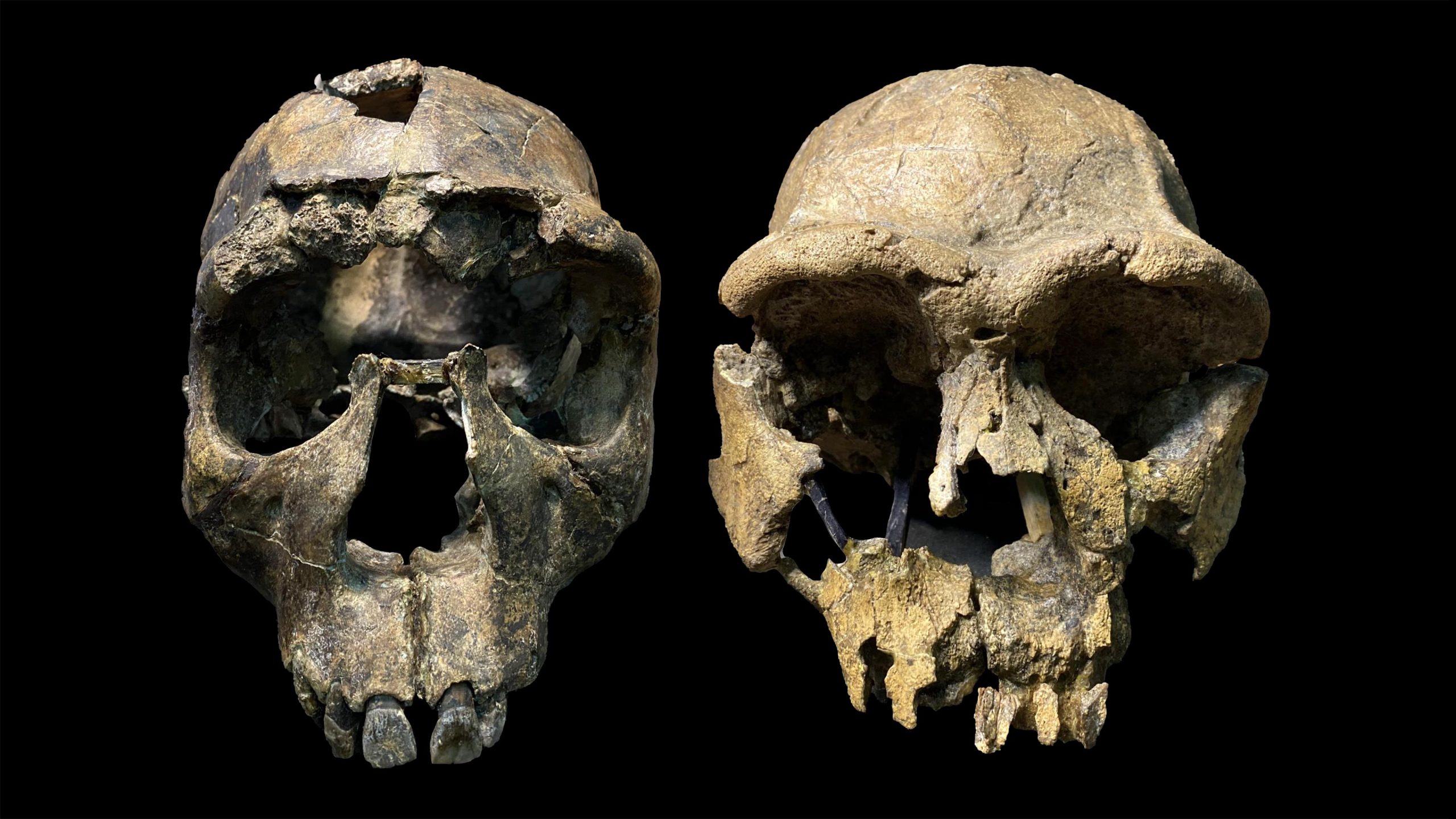
The findings also have important implications for understanding human evolution. The Turkana Rift has produced more than 1,200 hominin fossils from the past 4 million years, representing about one-third of all such discoveries in Africa. Many researchers have considered this region a key center of early human evolution.
Rowan and his colleagues suggest a different interpretation.
After widespread volcanic activity around 4 million years ago, the onset of necking caused the land in the rift to sink. This subsidence led to the rapid buildup of fine-grained sediments, which are especially good at preserving fossils.
“The conditions were right to preserve a continuous fossil record,” says Rowan.
This raises the possibility that the Turkana Rift was not uniquely important as a location where human ancestors evolved, but rather a place where geological conditions made it easier to preserve their remains.
That idea remains a hypothesis. “But other researchers can now use our results to explore those ideas,” says Rowan. “In addition, our results can be fed into tectonic models that are coupled with climate to really explore how shifting tectonics and climates influenced our evolution.”
Reference: “Necking of the active Turkana Rift Zone and the priming of eastern Africa for continental breakup” by Christian M. Rowan, Folarin Kolawole, Anne Bécel, Paul Betka and John Rowan, 23 April 2026, Nature Communications.
DOI: 10.1038/s41467-026-71663-x
The research team also includes Paul Betka from Western Washington University and John Rowan from the University of Cambridge.
Never miss a breakthrough: Join the SciTechDaily newsletter.
Follow us on Google and Google News.
5 Comments
Perhaps all that rifting might be the result of a world wide flood that cause tectonic shifting only about 5,000 years ago, providing rich sedimentary fossil layers.
Or not.
Why is it so difficult to accept that geologic processes have been happening for 100s of millions of years before the first animal the significantly resembles modern humans ever existed.
Is this the mindset that so desperately wants the Hebrew myths to be true?
Oh, right…. Making cognitive space for such vast time frames opens the door to that concept that terrifies religionists of all stripes: Evolution. And the mere possibility that each and every human is a (relatively) hairless, great ape — an animal — made of bone, sinew, skin, and blood, like all other mammals. And maybe, ~just maybe~ the Cosmic Magician didn’t whip up a batch of human from scratch a few thousand years ago. Maybe, ~just maybe~ we live and we die, and that’s it… just like a squirrel, a dear, a cat, or any other animal.
That’s the scary ~possibility~, the primal fear, that the Hebrew myths and subsequent appendices serve to insulate your mind and emotions from.
I don’t claim to possess absolute and incontrovertible knowledge as to whether religionists’ stories are true or just wishful thinking. I am, however, intellectually honest enough to acknowledge that humans have a near infinite capacity to contrive and embrace comforting stories, irrespective of what the historical facts might be.
Yes, scientists create stories to explain what the data suggests, and often need to refine or revise those stories as new data becomes available. But they do so without invoking a deux ex machina when confronted with a mystery.
The myth isn’t a Hebrew one; Hebrews borrowed it. It’s a myth that also exists in other places, and the the Mesopotamian variant is simply the first one we have a written record of, as perhaps the literal first written story we ever found. But calling it “Hebrew” is LITERALLY un-scientific as we have a dated record of it existing prior to Hebrew record. And 1971 dating of a 60cm alluvial layer (from a flood) pegged it at (are you ready?) 2900 BCE.
NONE of which is likely to have ANYTHING to do with this article.
Always someone saying creationist this or that. When new scientific evidence comes to play and it disagrees with old neanderthal science used for the past couple hundred years. Science isn’t fact it is based on theories although heavily investigated they are and remain just theories until proven to be fact. But then it really isn’t science anymore is it. People need to open their minds that just because some really intelligent people came up with long long dating ideas doesn’t make them absolute. It really is impossible to say something is even 100,000 years and yet even harder to prove something is hundreds of millions of years when there is no real proof. You can say they use isotopes and run your mouth on and on but there are no documents nor any real proof how well any of that holds up when we have no idea what has or has not occur on the earth for even the last 100000 years. How many large solar flares, how much rain, flooding, wind, earth movement has effect what areas. Science allows for errors and science has a way of evolving over time from the way light moves, to the possibility of soft tissue last millions of years (which I highly doubt), to all sorts of other things which science is disputing science. So it bothers me when someone whom enjoys science and if you come up with a theory that disputes something you automatically are a creationist or made to look delusional. Especially when it come to time discrepancies. Maybe the mass has been fooled to thinking carbon dating and nuclear dating are perfect but that just isn’t true. They are far from it with errors occurring frequently, do your homework. Find out the truth on how they know that something is millions of years old and don’t stop until you understand the very basic idea that means to the breaking down of how they knows how long the crystal and isotopes last and how they are created. This seems to end before they can explain just like the big bang. Nothing exists until two things from nowhere that weren’t there collided. How does that make since. Be a detective things are not what we are always told. Science is cool but not absolute.
“Several million more years before the next stage”, I don’t think I’m going to worry about this too much.