
Close Menu
    Facebook X (Twitter) Instagram
    SciTechDaily
    • Biology
    • Chemistry
    • Earth
    • Health
    • Physics
    • Science
    • Space
    • Technology
    Facebook X (Twitter) Pinterest YouTube RSS
    SciTechDaily
    Home»Earth»Newly Discovered Greenland Hot Rock Mantle Plume Drives Thermal Activities in the Arctic
    Earth

    Newly Discovered Greenland Hot Rock Mantle Plume Drives Thermal Activities in the Arctic

    By Tohoku UniversityDecember 24, 20205 Comments4 Mins Read
    Facebook Twitter Pinterest Telegram LinkedIn WhatsApp Email Reddit
    Share
    Facebook Twitter LinkedIn Pinterest Telegram Email Reddit
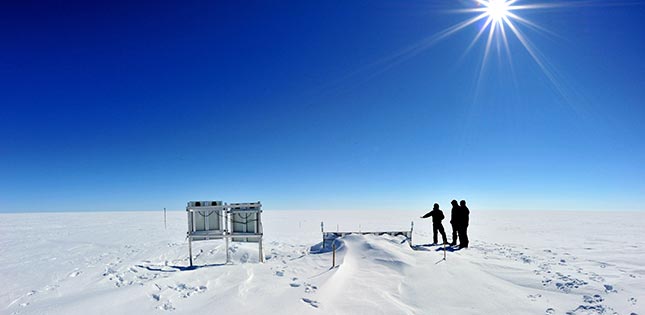
    Greenland Ice Sheet Seismic Station
    A seismic station on the Greenland Ice Sheet installed by authors. Snow accumulation in one year is ~1.5 m (5 ft), and the solar panels are buried in the snow. Snow removal and maintenance are done manually by several people. Credit: Genti Toyokuni

    A team of researchers understands more about the melting of the Greenland ice sheet. They discovered a flow of hot rocks, known as a mantle plume, rising from the core-mantle boundary beneath central Greenland that melts the ice from below.

    The results of their two-part study were published in the Journal of Geophysical Research.

    “Knowledge about the Greenland plume will bolster our understanding of volcanic activities in these regions and the problematic issue of global sea-level rising caused by the melting of the Greenland ice sheet,” said Dr. Genti Toyokuni, co-author of the studies.

    The North Atlantic region is awash with geothermal activity. Iceland and Jan Mayen contain active volcanoes with their own distinct mantle plumes, whilst Svalbard — a Norwegian archipelago in the Arctic Ocean — is a geothermal area. However, the origin of these activities and their interconnectedness has largely been unexplored.

    The research team discovered that the Greenland plume rose from the core-mantle boundary to the mantle transition zone beneath Greenland. The plume also has two branches in the lower mantle that feed into other plumes in the region, supplying heat to active regions in Iceland and Jan Mayen and the geothermal area in Svalbard.
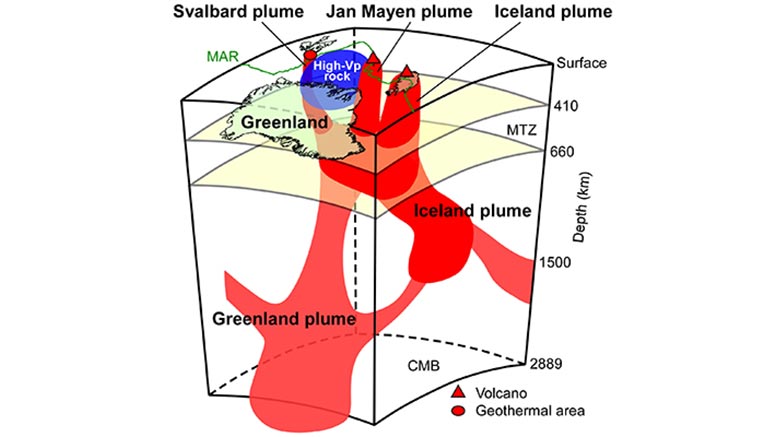
    Main Tectonic Features and Mantle Plumes Beneath Greenland
    A schematic diagram showing the main tectonic features and mantle plumes beneath Greenland and the surrounding regions. Vp = P wave velocity; MAR = the Mid-Atlantic Ridge; MTZ = the mantle transition zone (410-660 km or 255-410 mi depths); CMB = the core-mantle boundary at 2,889 km (1,795 mi) depth. Credit: Tohoku University

    Their findings were based on measurements of the 3-D seismic velocity structure of the crust and whole mantle beneath these regions. To obtain the measurements, they used seismic topography. Numerous seismic wave arrival times were inverted to obtain 3-D images of the underground structure. The method works similarly to a CT scan of the human body.

    Toyokuni was able to utilize seismographs he installed on the Greenland ice sheet as part of the Greenland Ice Sheet Monitoring Network. Set up in 2009, the project sees the collaboration of researchers from 11 countries. The US-Japan joint team is primarily responsible for the construction and maintenance of the three seismic stations on the ice sheet.
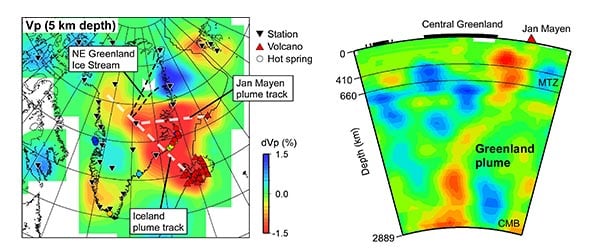
    Greenland Velocity Tomography Map
    A map view of P wave velocity tomography at 5 km (3.1 mi) depth beneath Greenland and surrounding regions (left). Blue and red colors denote high and low-velocity perturbations, respectively, whose scale (in %) is shown beside the map. The white dotted lines are the thermal tracks of Iceland and Jan Mayen plumes that are affected by the Greenland plume. The area surrounded by the black dotted lines is where the flow, caused by melting at the bottom of the ice sheets, exists (Northeast Greenland Ice Stream); its water source is located at the intersection of the two heat tracks. A vertical cross-section of whole-mantle tomography passing through central Greenland and Jan Mayen (right). We can see that the Greenland plume is the heat source for the Jan Mayen volcano. Credit: Tohoku University

    Looking ahead, Toyokuni hopes to explore the thermal process in more detail. “This study revealed the larger picture, so examining the plumes at a more localized level will reveal more information.”

    References:

    “P Wave Tomography Beneath Greenland and Surrounding Regions: 1. Crust and Upper Mantle” by Genti Toyokuni, Takaya Matsuno and Dapeng Zhao, 31 October 2020, Journal of Geophysical Research – Solid Earth.
    DOI: 10.1029/2020JB019837

    “P Wave Tomography Beneath Greenland and Surrounding Regions: 2. Lower Mantle” by Genti Toyokuni, Takaya Matsuno and Dapeng Zhao, 30 October 2020, Journal of Geophysical Research – Solid Earth.
    DOI: 10.1029/2020JB019837

    Never miss a breakthrough: Join the SciTechDaily newsletter.
    Follow us on Google and Google News.

    Geophysics Greenland Popular Seismology Tectonic Plates Tohoku University
    Share. Facebook Twitter Pinterest LinkedIn Email Reddit

    Related Articles

    Earth’s Crust Is Tearing Open in Africa, and It Could Form a New Ocean

    Scientists Solve 50-Year Mystery of Strange Zone Deep Inside Earth

    A Lost World Beneath the Pacific Ocean? Mysterious Structures Discovered Deep Within Earth’s Mantle

    Rethinking Earth’s Surface: Geoscientists Discover Hidden Faults of the Pacific Plate

    Quake-Ception – Groundbreaking Earthquake Discovery: Risk Models Overlook an Important Element

    Possible Chemical Leftovers From Early Earth Sit Near the Planet’s Core

    Unexpected Widespread Structures Detected Near Earth’s Core – “A Totally New Perspective”

    Earthquakes Deform Gravity – New Algorithm Could Enable Early Warning Systems

    Unusual Indian Ocean Earthquakes May Signal Tectonic Breakup

    5 Comments

    1. Clyde Spencer on December 24, 2020 8:08 am

      “…, they used seismic topography.”

      That should be “tomography,” NOT topography!

      Reply
    2. Clyde Spencer on December 24, 2020 8:10 am

      “This study revealed the larger picture, so examining the plumes at a more localized level will reveal more information.”

      It goes a long way towards explaining why Eastern Greenland has experienced greater retreat of its glaciers than Western Greenland!

      Reply
    3. Mary Ellerd on December 24, 2020 2:36 pm

      I wonder how much global warming is coming from the melting icecap. I’m certainly not disputing climate change from human effects, but wonder how much this is contributing. It will surely not explain melting in the Antarctic. It will be interesting to see how the effects of this plume will affect future models.

      Reply
    4. gepay on December 29, 2020 6:56 pm

      Mary there is an active volcanp beneath the West Antarctic ice shelf. Nobody knows for sure how many active volcanos there are on Earth. Nobody really has concrete notions how the Earth’s magnetic fields work. Nobody can tell you why the Earth’s magnetic northpole is moving towards Russia at an increasing pace. Everybody assumes that the present assemblage of the Solar system is the way it has always been but just because of how they are now is no proof of what they may have been in the past. Imagine how that would have effected the Earth’s climate as the Earth orbits the center of gravitly of the Solar systen and not the center of gravity of the Sun. So the Earth’s orbit is not an ellipse but a rosette as the Sun is moving also. It is also an assumption that the Sun’s output that has only been accurately measured for less than a hundred years is what it has always been. A person like me thinks it is absurd to believe that man made CO2 is acting like the control knob of the climate. All the ice cores say the temperature changes and then the CO2 level changes.It is certainly not settled as to why the Ice ages start and end. Or why they changed to to have somewhat 100,000 year cycles from the previous somewhat 40,000 cycles. Or why there was the younger dryas when global temperatures plummented and then rose 10C in a decade but hey the climate science is settled

      Reply
      • Joe F on June 14, 2025 8:32 am

        Brilliant Summary in a very kind letter to Mary,

        Reply
    Leave A Reply Cancel Reply

    • Facebook
    • Twitter
    • Pinterest
    • YouTube

    Don't Miss a Discovery

    Subscribe for the Latest in Science & Tech!

    Trending News

    New Research Shows Vitamin B12 May Hold the Key to Healthy Aging

    These Simple Daily Habits Can Quickly Improve Blood Pressure and Heart Risk Factors

    A Common Nutrient May Play a Surprising Role in Anxiety

    Doing This After 9 p.m. Could Double Your Risk of Gut Issues

    Scientists Discover How Coffee Impacts Memory, Mood, and Gut Health

    Why Did the Neanderthals Disappear? Scientists Reveal Humans Had a Hidden Advantage

    Physicists Propose Strange Experiment Where Time Goes Quantum

    Magnesium Magic: New Drug Melts Fat Even on a High-Fat, High-Sugar Diet

    Follow SciTechDaily
    • Facebook
    • Twitter
    • YouTube
    • Pinterest
    • Newsletter
    • RSS
    SciTech News
    • Biology News
    • Chemistry News
    • Earth News
    • Health News
    • Physics News
    • Science News
    • Space News
    • Technology News
    Recent Posts
    • This New Memory Technology Could Make Devices Last Months on One Charge
    • Scientists Turn Cancer’s Own Bacteria Against It in Breakthrough Therapy
    • Cannabis Can Make You Remember Things That Never Happened
    • Doctors Are Surprised by What This Vaccine Is Doing to the Heart
    • Quantum Breakthrough Turns Simple Forces Into Powerful New Interactions
    Copyright © 1998 - 2026 SciTechDaily. All Rights Reserved.
    • Science News
    • About
    • Contact
    • Editorial Board
    • Privacy Policy
    • Terms of Use

    Type above and press Enter to search. Press Esc to cancel.