
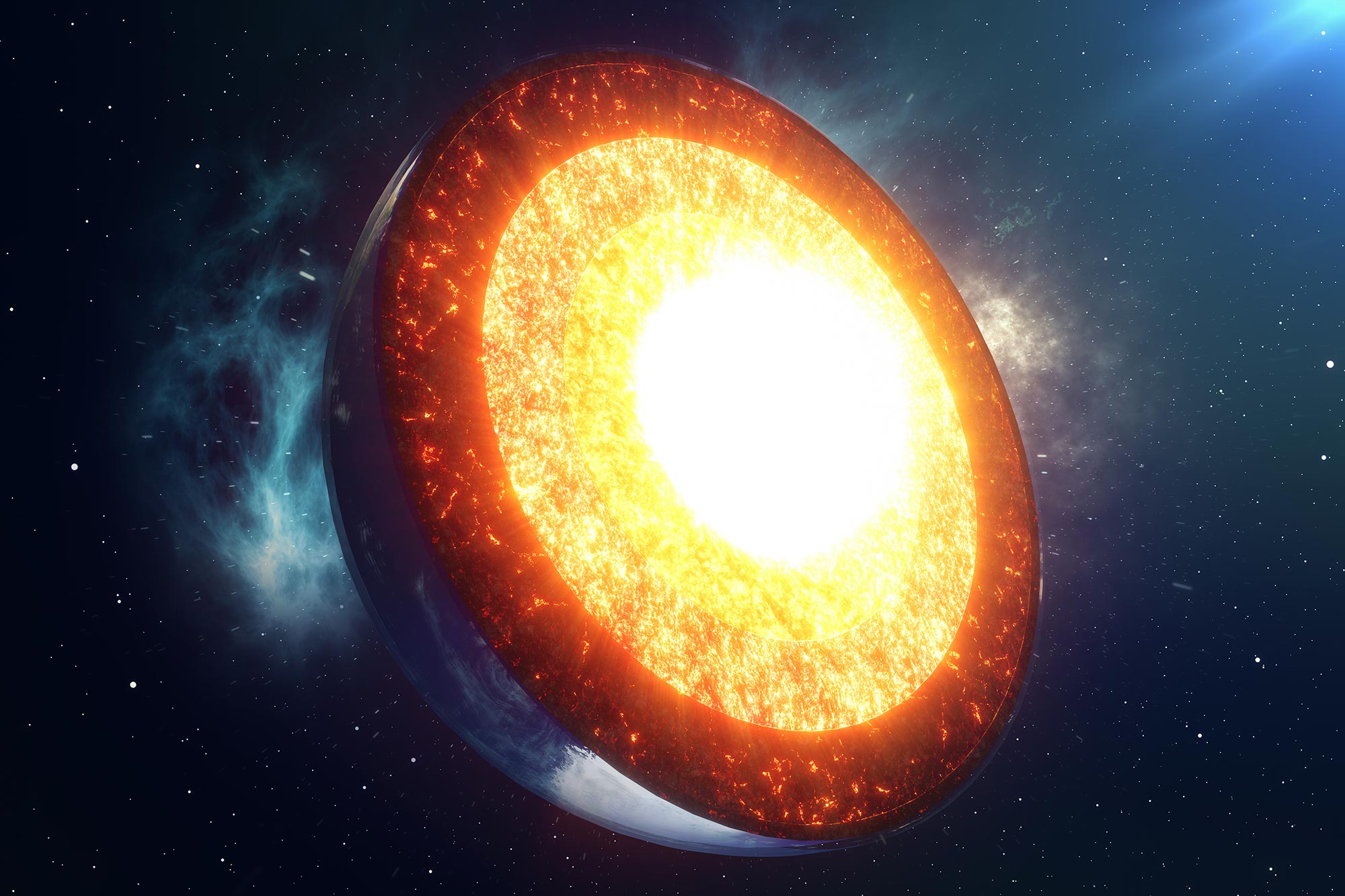
ETH Zurich scientists confirmed that solid rock flows deep inside Earth, solving a decades-old mystery about seismic waves.
Earthquakes, volcanic eruptions, and drifting continents all remind us that Earth is not a static ball of rock, but a dynamic, living planet. Now, scientists have uncovered something even more astonishing deep beneath the surface: nearly 3,000 kilometers down, solid rock is actually flowing—not like molten lava, but as a solid mass moving slowly over time.
This discovery comes from a new study led by Professor Motohiko Murakami, an expert in experimental mineral physics at ETH Zurich. The findings, published in Communications Earth & Environment, shine new light on one of Earth’s greatest geological mysteries.
Half a century of guesswork
For over five decades, scientists have been puzzled by a strange region near the boundary between Earth’s mantle and core, known as the D” layer. Located about 2,700 kilometers below our feet, this zone has long defied explanation. Seismic waves, those triggered by earthquakes, suddenly speed up when they pass through it, as if encountering a completely different kind of material. Until now, no one could explain why.
In 2004, Murakami, who has been a professor at ETH Zurich since 2017, discovered that perovskite, the main mineral of the Earth’s lower mantle, transforms into a new mineral near the D” layer under extreme pressure and very high temperatures – so-called “post-perovskite.”
The researchers assumed that this change explained the strange acceleration of the seismic waves. But that was not the full story. In 2007, Murakami and colleagues found new evidence that the phase change of perovskite alone is not enough to accelerate earthquake waves.
Using a sophisticated computer model, they finally discovered something important: depending on the direction in which the post-perovskite crystals point, the hardness of the mineral changes. Only when all the crystals of the mineral point in the same direction in the model are the seismic waves accelerated – as can be observed in the D” layer at a depth of 2700 kilometers.
In an unusual laboratory experiment at ETH Zurich, Murakami has now proven that post-perovskite crystals align themselves in the identical direction under enormous pressure and extreme temperatures. To do this, the researchers measured the speed of seismic waves in their experiment and were also able to reproduce the jump that occurs at the D” layer in the laboratory. “We have finally found the last piece of the puzzle,” says Murakami.
Mantle flow aligns crystals
The big question is: what makes these crystals line up? The answer is that solid mantle rock that flows horizontally along the lower edge of the Earth’s mantle. Researchers have long suspected that this movement – a kind of convection like boiling water – must exist but have never been able to prove it directly.
A new chapter in Earth research begins
Murakami and his colleagues have now also demonstrated experimentally that mantle convection of solid rock is present at the boundary between the core and the Earth’s mantle, i.e. that solid – not liquid – rock flows slowly but steadily at this depth. “This discovery not only solves the mystery of the D” layer but also opens a window into the dynamics in the depths of the Earth,” Murakami explains.
It is not only a milestone, but also a turning point. The assumption that solid rock flows has been transformed from a theory into a certainty. “Our discovery shows that the Earth is not only active on the surface, but is also in motion deep inside,” says the ETH professor.
With this knowledge, researchers can now begin to map the currents in the Earth’s deepest interior and thus visualize the invisible motor that drives volcanoes, tectonic plates, and perhaps even the Earth’s magnetic field.
Reference: “The texture of the post-perovskite phase controls the characteristics of the D” seismic discontinuity” by Motohiko Murakami, Shin-ichiro Kobayashi, Naohisa Hirao and Tomofumi Kawadai, 23 May 2025, Communications Earth & Environment.
DOI: 10.1038/s43247-025-02383-1
Never miss a breakthrough: Join the SciTechDaily newsletter.
Follow us on Google and Google News.
1 Comment
so that’s why people need to stop trying to control their environment