
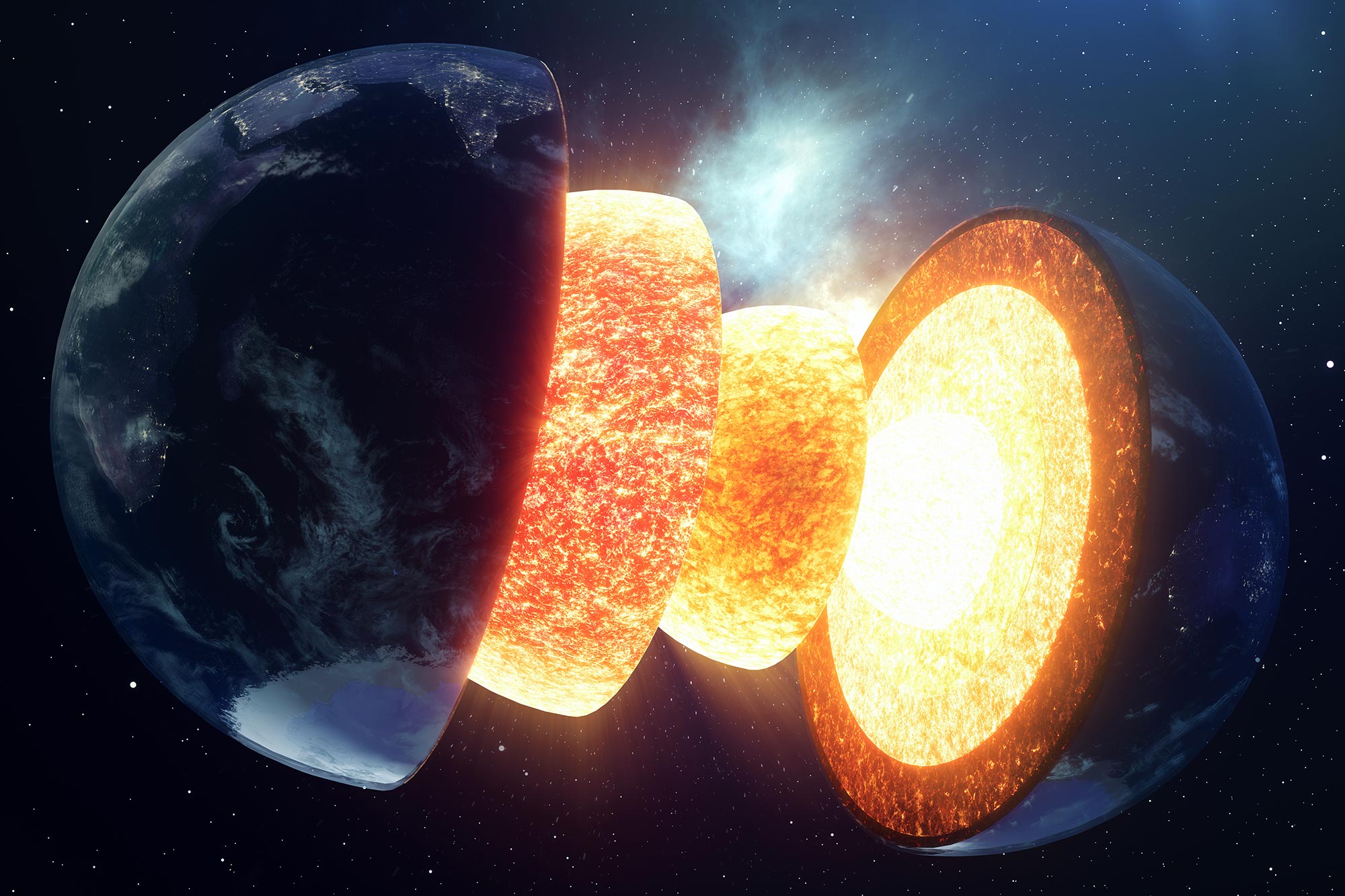
New research suggests the mysterious D” layer at Earth’s core-mantle boundary might have formed from remnants of an early colossal impact, with iron-rich peroxide playing a key role in its unique and enduring features.
Deep within Earth, there lies a mysterious layer called the D” layer. Located roughly 3,000 kilometers down, this zone sits just above the boundary between the planet’s molten outer core and its solid mantle. Unlike a perfect sphere, the D” layer is surprisingly patchy. Its thickness varies greatly from place to place, with some regions even lacking a D” layer altogether – much like continents rise above the Earth’s oceans. These intriguing variations have captured the attention of geophysicists, who describe the D” layer as a heterogeneous, or non-uniform, region.
A new study led by Dr. Qingyang Hu (Center for High Pressure Science and Technology Advanced Research) and Dr. Jie Deng (Princeton University) suggests the D” layer might be originated from Earth’s earliest days. Their theory hinges on the Giant Impact hypothesis, which proposes a Mars-sized object slammed into the proto-Earth, creating a planet-wide magma ocean in the aftermath. They believe the D” layer may be a unique composition leftover from this colossal impact, potentially holding clues to Earth’s formation.
Water in the Magma Ocean
Dr. Jie Deng highlights the presence of a substantial amount of water within this global magma ocean. The exact origin of this water remains a topic of debate, with various theories have been proposed including its formation through reactions between nebula gas and the magma, or direct delivery by comets. “The prevailing view,” Dr. Deng continues, “suggests that water would have concentrated towards the bottom of the magma ocean as it cooled. By the final stages, the magma closest to the core could have contained water volumes comparable to Earth’s present-day oceans.”
The extreme pressure and temperature conditions within the bottom magma ocean would have created a unique chemical environment, fostering unexpected reactions between water and minerals. Dr. Qingyang Hu explains, “Our research suggests this hydrous magma ocean favored the formation of an iron-rich phase called iron-magnesium peroxide.” This peroxide, with the formula (Fe, Mg)O2, has an even stronger preference for iron compared to other major components expected in the lower mantle. “According to our calculation, its affinity to iron could have led to the accumulation of iron-dominant peroxide in layers ranging from several to tens of kilometers thick.

The presence of this iron-rich peroxide phase would alter the mineral composition of the D” layer, deviating from our current understanding. According to the new model, minerals in D” would be dominated by a new assemblage: the iron-poor silicate, iron-rich (Fe, Mg) peroxide, and iron-poor (Fe, Mg) oxide. This iron-dominant peroxide also possesses low seismic velocities and high electrical conductivity, making it a potential candidate to explain the D” layer’s unique geophysical features. These features include ultra-low velocity zones and layers of high conductance, both contributing to the D” layer’s well-known compositional heterogeneity.
“Our findings suggest that iron-rich peroxide, formed from the ancient water within the magma ocean, has played a crucial role in shaping the D” layer’s heterogeneous structures,” said Qingyang. This peroxide’s strong affinity for iron creates a stark density contrast between these iron-rich patches and the surrounding mantle. Essentially, it acts as an insulator, preventing them from mixing and potentially explaining the long-lasting heterogeneity observed at the base of the lower mantle. Jie added, “This model aligns well with recent numerical modeling results, suggesting the lowermost mantle’s heterogeneity may be a long-lived feature.”
Reference: “Earth’s core-mantle boundary shaped by crystalizing a hydrous terrestrial magma ocean” by Qingyang Hu, Jie Deng, Yukai Zhuang, Zhenzhong Yang and Rong Huang, 13 May 2024, National Science Review.
DOI: 10.1093/nsr/nwae169
Never miss a breakthrough: Join the SciTechDaily newsletter.
Follow us on Google and Google News.