
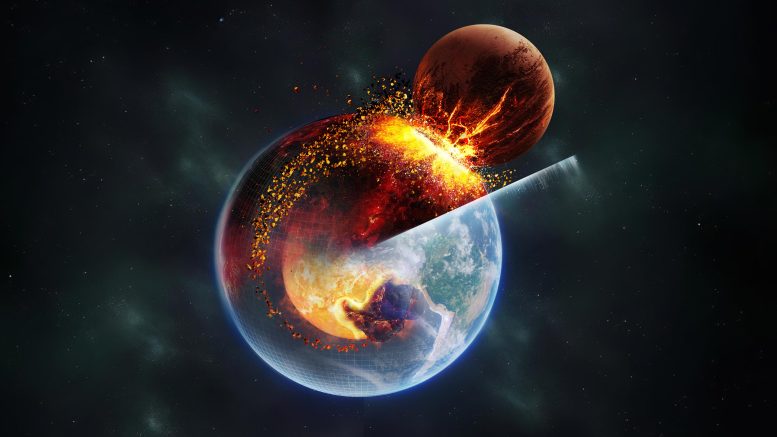
A Caltech-led study suggests that two massive, iron-rich structures deep within Earth’s mantle are the remains of Theia, an ancient planet that collided with Earth, also creating the Moon. This discovery answers long-standing questions about the Moon’s origin and Theia’s fate.
In the 1980s, geophysicists made a startling discovery: two continent-sized blobs of unusual material were found deep near the center of the Earth, one beneath the African continent and one beneath the Pacific Ocean. Each blob is twice the size of the Moon and likely composed of different proportions of elements than the mantle surrounding it.
Origins of the Large Low-Velocity Provinces
Where did these strange blobs—formally known as large low-velocity provinces (LLVPs)—come from? A new study led by Caltech researchers suggests that they are remnants of an ancient planet that violently collided with Earth billions of years ago in the same giant impact that created our Moon.
The study, published in the journal Nature on November 1, also proposes an answer to another planetary science mystery. Researchers have long hypothesized that the Moon was created in the aftermath of a giant impact between Earth and a smaller planet dubbed Theia, but no trace of Theia has ever been found in the asteroid belt or in meteorites. This new study suggests that most of Theia was absorbed into the young Earth, forming the LLVPs, while residual debris from the impact coalesced into the Moon.
Visualization of the Earth with large “blobs” of dense material near Earth’s core. These blobs were discovered in the 1980s. Now, researchers propose that they are actually the remnants of an ancient planet, Theia, that collided with Earth to form the Moon. Credit: Edward Garnero
Research Methodology and Findings
The research was led by Qian Yuan, O.K. Earl Postdoctoral Scholar Research Associate in the laboratories of both Paul Asimow (MS ’93, PhD ’97), the Eleanor and John R. McMillan Professor of Geology and Geochemistry; and Michael Gurnis, the John E. And Hazel S. Smits Professor of Geophysics and Clarence R. Allen Leadership Chair, director of Caltech’s Seismological Laboratory, and director of the Schmidt Academy for Software Engineering at Caltech.
Scientists first discovered the LLVPs by measuring seismic waves traveling through the earth. Seismic waves travel at different speeds through different materials, and in the 1980s, the first hints emerged of large-scale three-dimensional variations deep within the structure of Earth. In the deepest mantle, the seismic wave pattern is dominated by the signatures of two large structures near the Earth’s core that researchers believe possess an unusually high level of iron. This high iron content means the regions are denser than their surroundings, causing seismic waves passing through them to slow down and leading to the name “large low velocity provinces.”
Yuan, a geophysicist by training, was attending a seminar about planet formation given by Mikhail Zolotov, a professor at Arizona State University, in 2019. Zolotov presented the giant-impact hypothesis, while Qian noted that the Moon is relatively rich in iron. Zolotov added that no trace had been found of the impactor that must have collided with the Earth.
“Right after Mikhail had said that no one knows where the impactor is now, I had a ‘eureka moment’ and realized that the iron-rich impactor could have transformed into mantle blobs,” says Yuan.
A detailed simulation of Theia crashing into Earth. While the collision was violent, it was not energetic enough to melt the Earth’s lower mantle — meaning that remnants of Theia could be preserved, rather than mixed homogenously in with the Earth’s material. Credit: Hongping Deng
Yuan worked with multidisciplinary collaborators to model different scenarios for Theia’s chemical composition and its impact with Earth. The simulations confirmed that the physics of the collision could have led to the formation of both the LLVPs and the Moon. Some of Theia’s mantle could have become incorporated into the Earth’s own, where it ultimately clumped and crystallized together to form the two distinct blobs detectable today at Earth’s core–mantle boundary today; other debris from the collision mixed together to form the Moon.
Implications and Future Research
Given such a violent impact, why did Theia’s material clump into the two distinct blobs instead of mixing together with the rest of the forming planet? The researchers’ simulations showed that much of the energy delivered by Theia’s impact remained in the upper half of the mantle, leaving Earth’s lower mantle cooler than estimated by earlier, lower-resolution impact models. Because the lower mantle was not totally melted by the impact, the blobs of iron-rich material from Theia stayed largely intact as they sifted down to the base of the mantle, like the colored masses of paraffin wax in a turned-off lava lamp. Had the lower mantle been hotter (that is, if it had received more energy from the impact), it would have mixed more thoroughly with the iron-rich material, like the colors in a stirred pot of paints.
The next steps are to examine how the early presence of Theia’s heterogeneous material deep within the earth might have influenced our planet’s interior processes, such as plate tectonics.
“A logical consequence of the idea that the LLVPs are remnants of Theia is that they are very ancient,” Asimow says. “It makes sense, therefore, to investigate next what consequences they had for Earth’s earliest evolution, such as the onset of subduction before conditions were suitable for modern-style plate tectonics, the formation of the first continents, and the origin of the very oldest surviving terrestrial minerals.”
New research answers two longstanding mysteries of planetary science: What are the giant mysterious “blobs” of material near the Earth’s core, and what happened to the planet that smashed into the Earth to create the Moon? A new study from Caltech suggests that the remains of that ancient planet still lie within the Earth, explaining the origins of the “blobs” near the core-mantle boundary.
Reference: “Moon-forming impactor as a source of Earth’s basal mantle anomalies” by Qian Yuan, Mingming Li, Steven J. Desch, Byeongkwan Ko, Hongping Deng, Edward J. Garnero, Travis S. J. Gabriel, Jacob A. Kegerreis, Yoshinori Miyazaki, Vincent Eke and Paul D. Asimow, 1 November 2023, Nature.
DOI: 10.1038/s41586-023-06589-1
Qian Yuan is the first author. In addition to Yuan and Asimow, the additional Caltech coauthor is Yoshinori Miyazaki, Stanback Postdoctoral Scholar Research Associate in Comparative Planetary Evolution. Additional coauthors are Mingming Li, Steven Desch, and Edward Garnero (PhD ’94) of Arizona State University (ASU); Byeongkwan Ko of ASU and Michigan State University; Hongping Deng of the Chinese Academy of Sciences; Travis Gabriel of the U.S. Geological Survey; Jacob Kegerreis of NASA’s Ames Research Center; and Vincent Eke of Durham University. Funding was provided by the National Science Foundation, the O.K. Earl Postdoctoral Fellowship at Caltech, the U.S. Geological Survey, NASA, and the Caltech Center for Comparative Planetary Evolution.
Never miss a breakthrough: Join the SciTechDaily newsletter.
Follow us on Google and Google News.
4 Comments
That’s pretty cool. I was taught that in this impact scenario, the mantle was entirely liquified. Maybe not.
The study authors proposed this back in March 2021, with “Giant impact origin for the large low shear velocity provinces”. For some time, the Moon has been speculated by other authors to have originated in a giant impact hypothesis. Did the new study by these authors propose some change?
Just noting, there’s many proposed origin stories for Moon.
I wonder what effect this revelation has on the earth’s magnetic field.and if it can be detected.
I wonder what effect this revelation has on the earth’s magnetic field.and if it can be detected.
Nature 32 October. On Planet Theia?