

Close Menu
    Facebook X (Twitter) Instagram
    SciTechDaily
    • Biology
    • Chemistry
    • Earth
    • Health
    • Physics
    • Science
    • Space
    • Technology
    Facebook X (Twitter) Pinterest YouTube RSS
    SciTechDaily
    Home»Physics»Revolutionizing Technology: Superconductors Master Spin Waves on Chips
    Physics

    Revolutionizing Technology: Superconductors Master Spin Waves on Chips

    By Delft University of TechnologyNovember 1, 20231 Comment4 Mins Read
    Facebook Twitter Pinterest Telegram LinkedIn WhatsApp Email Reddit
    Share
    Facebook Twitter LinkedIn Pinterest Telegram Email Reddit
    Superconductor Magnet Wave Chip Concept Art
    Researchers at Delft University of Technology have successfully controlled spin waves on a chip using superconductors, a potential game-changer for energy-efficient technology and quantum computing.

    Physicists use superconductors to control spin waves on a chip, paving the way for energy-efficient tech and quantum computer advancements.

    Quantum physicists at Delft University of Technology have shown that it’s possible to control and manipulate spin waves on a chip using superconductors for the first time. These tiny waves in magnets may offer an alternative to electronics in the future, interesting for energy-efficient information technology or connecting pieces in a quantum computer, for example. The breakthrough, published in Science, primarily gives physicists new insight into the interaction between magnets and superconductors.

    Energy-Efficient Substitute

    “Spin waves are waves in a magnetic material that we can use to transmit information,” explains Michael Borst, who led the experiment. “Because spin waves can be a promising building block for an energy-efficient replacement for electronics, scientists have been searching for an efficient way to control and manipulate spin waves for years.”

    Theory predicts that metal electrodes give control over spin waves, but physicists have barely seen such effects in experiments until now. “The breakthrough of our research team is that we show that we can indeed control spin waves properly if we use a superconducting electrode,” says Toeno van der Sar, Associate Professor in the Department of Quantum Nanoscience.

    Superconducting Mirror

    It works as follows: a spin wave generates a magnetic field that in turn generates a supercurrent in the superconductor. That supercurrent acts as a mirror for the spin wave: the superconducting electrode reflects the magnetic field back to the spin wave. The superconducting mirror causes spin waves to move up and down more slowly, and that makes the waves easily controllable. Borst: “When spin waves pass under the superconducting electrode, it turns out that their wavelength changes completely! And by varying the temperature of the electrode slightly, we can tune the magnitude of the change very accurately.”
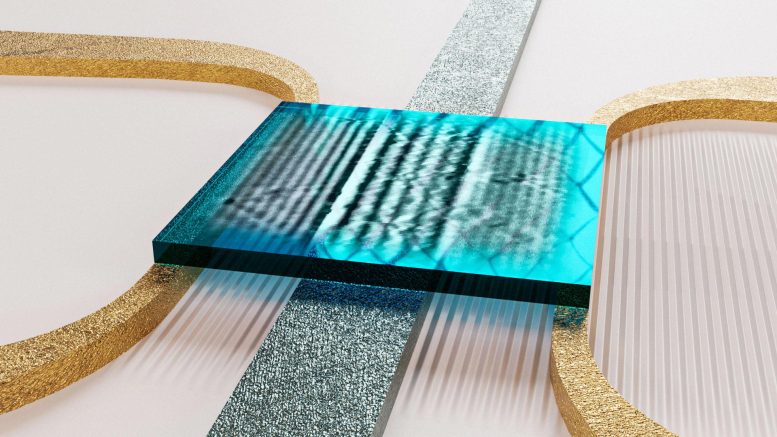
    Controlling Waves in Magnets With Superconductors
    An illustration of the experiment. The illustration shows two gold electrodes on top of a thin magnetic layer. In the middle lies a superconducting electrode. With the left gold electrode, the researchers generate spin waves in the magnetic material, which travel to the right. On top of the electrodes is a square diamond membrane, which allows the researchers to see right through the superconducting electrode. Credit: Michael Borst, TU Delft

    “We started with a thin magnetic layer of yttrium iron garnet (YIG), known as the best magnet on Earth. On top of that we laid a superconducting electrode and another electrode to induce the spin waves. By cooling to -268 degrees, we got the electrode into a superconducting state,” Van der Sar says. “It was amazing to see that the spin waves got slower and slower as it got colder. That gives us a unique handle to manipulate the spin waves; we can deflect them, reflect them, make them resonate and more. But it also gives us tremendous new insights into the properties of superconductors.”

    Unique Sensor

    The researchers imaged the spin waves by measuring their magnetic field with a unique sensor, something that was essential to the experiment. Van der Sar: “We use electrons in diamond as sensors for the magnetic fields of the spin waves. Our lab is pioneering that technique. The cool thing about it is that we can look through the opaque superconductor at the spin waves underneath, just like an MRI scanner can look through the skin into someone’s body.”

    New Circuits

    “Spin wave technology is still in its infancy,” Borst says. “For example, to make energy-efficient computers with this technology, we first have to start building small circuits to perform calculations. Our discovery opens a door: superconducting electrodes allow countless new and energy-efficient spin-wave circuits.”

    “We can now design devices based on spin waves and superconductors that produce little heat and sound waves,” Van der Sar adds. “Think of the spintronics version of frequency filters or resonators, components that can be found in electronic circuits of cell phones, for example. Or circuits that can serve as transistors or connectors between qubits in a quantum computer.”

    Reference: “Observation and control of hybrid spin-wave–Meissner-current transport modes” by M. Borst, P. H. Vree, A. Lowther, A. Teepe, S. Kurdi, I. Bertelli, B. G. Simon, Y. M. Blanter and T. van der Sar, 26 October 2023, Science.
    DOI: 10.1126/science.adj7576

    Never miss a breakthrough: Join the SciTechDaily newsletter.
    Follow us on Google and Google News.

    Delft University of Technology Magnets Quantum Computing Quantum Mechanics Superconductivity
    Share. Facebook Twitter Pinterest LinkedIn Email Reddit

    Related Articles

    DNA Origami Nanoturbine: Pioneering the Nanomotor Revolution

    Quantum Entanglement Shatters Einstein’s Local Causality: The Future of Computing and Cryptography

    Mysterious Class of “Strange Metals” Yields Quantum Secrets

    New Platform for Quantum Computing? Artificial Material Mimics Quantum Entangled Rare Earth Compounds

    Scientists Overhear Two Atoms Chatting: Magnetic Quantum Interactions

    Physicists Use a Switch to Manipulate Light on Superconducting Chips

    New System Converts Laser Beam Into Controlled Stream of Single Photons

    Quantum Bits Store Data for Nearly Two Seconds Using Laboratory Grown Diamonds

    Evidence of Elusive Majorana Fermions Raises Possibilities for Quantum Computing

    1 Comment

    1. ELKBIR SAIF on November 3, 2023 5:28 pm

      When the darkness looked away
      And the stars don’t frown on me

      Reply
    Leave A Reply Cancel Reply

    • Facebook
    • Twitter
    • Pinterest
    • YouTube

    Don't Miss a Discovery

    Subscribe for the Latest in Science & Tech!

    Trending News

    First-of-Its-Kind Discovery: Homer’s Iliad Found Embedded in a 1,600-Year-Old Egyptian Mummy

    Beyond Inflammation: Scientists Uncover New Cause of Persistent Rheumatoid Arthritis

    A Simple Molecule Could Unlock Safer, Easier Weight Loss

    Scientists Just Built a Quantum Battery That Charges Almost Instantly

    Researchers Unveil Groundbreaking Sustainable Solution to Vitamin B12 Deficiency

    Millions of People Have Osteopenia Without Realizing It – Here’s What You Need To Know

    Researchers Discover Boosting a Single Protein Helps the Brain Fight Alzheimer’s

    World-First Study Reveals Human Hearts Can Regenerate After a Heart Attack

    Follow SciTechDaily
    • Facebook
    • Twitter
    • YouTube
    • Pinterest
    • Newsletter
    • RSS
    SciTech News
    • Biology News
    • Chemistry News
    • Earth News
    • Health News
    • Physics News
    • Science News
    • Space News
    • Technology News
    Recent Posts
    • Mezcal “Worm” in a Bottle Mystery: DNA Testing Reveals a Surprise
    • Scientists Turn Red Lettuce Green, Unlocking Hidden Nutrients
    • Researchers Discover Natural Compound That Disarms Deadly Superbug
    • New Research Reveals That Your Morning Coffee Activates an Ancient Longevity Switch
    • Researchers Identify the Most Common Recessive Neurodevelopmental Disorder Ever Discovered
    Copyright © 1998 - 2026 SciTechDaily. All Rights Reserved.
    • Science News
    • About
    • Contact
    • Editorial Board
    • Privacy Policy
    • Terms of Use

    Type above and press Enter to search. Press Esc to cancel.