
Close Menu
    Facebook X (Twitter) Instagram
    SciTechDaily
    • Biology
    • Chemistry
    • Earth
    • Health
    • Physics
    • Science
    • Space
    • Technology
    Facebook X (Twitter) Pinterest YouTube RSS
    SciTechDaily
    Home»Space»Supernova 2014J Reveals Key Information About Our Universe
    Space

    Supernova 2014J Reveals Key Information About Our Universe

    By The University of ManchesterAugust 22, 2014No Comments3 Mins Read
    Facebook Twitter Pinterest Telegram LinkedIn WhatsApp Email Reddit
    Share
    Facebook Twitter LinkedIn Pinterest Telegram Email Reddit
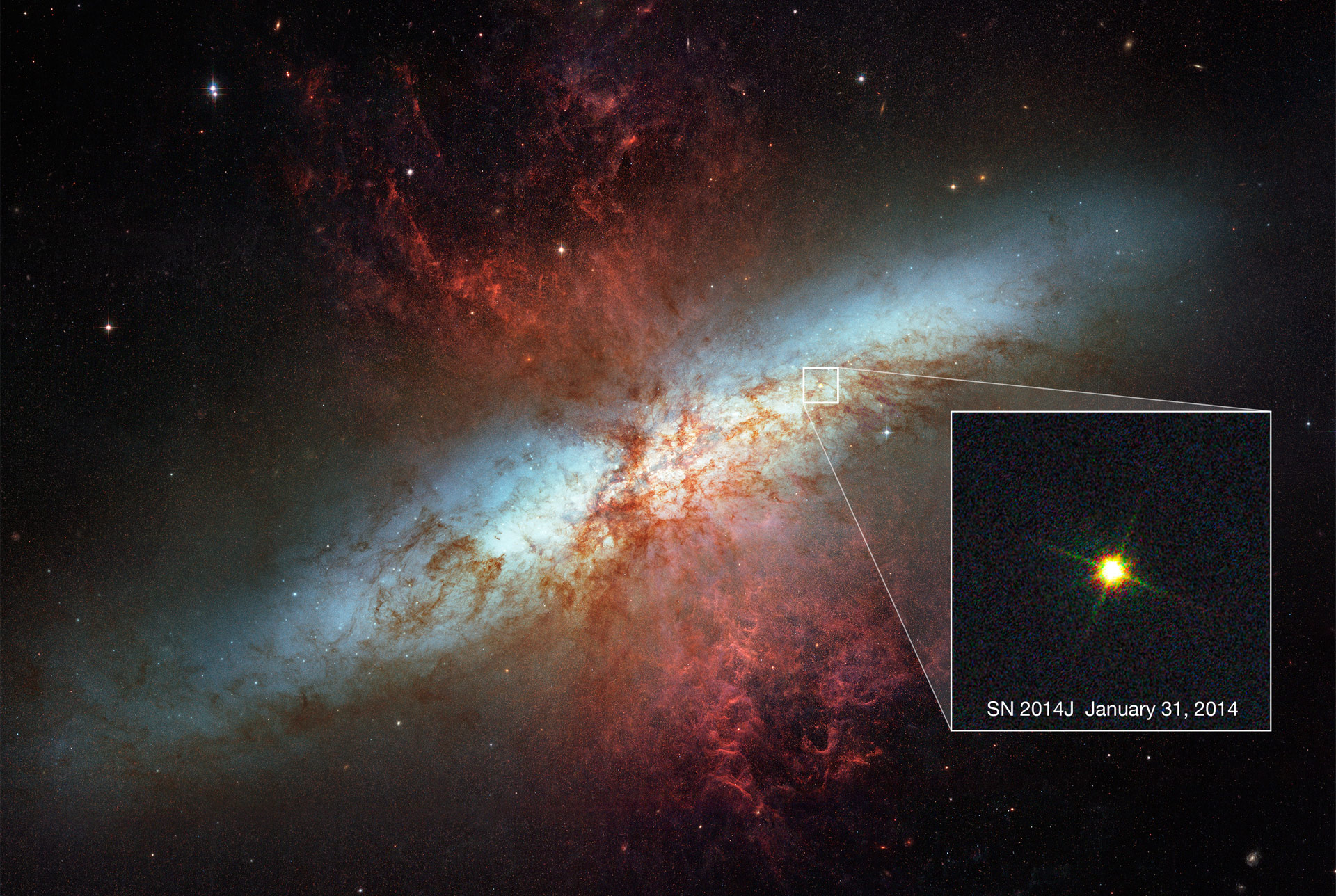
    Supernova 2014J Mysteries Revealed
    The above image shows galaxy M82 in which the supernova 2014J exploded. Credit: NASA, ESA, and The Hubble Heritage Team (STScI/AURA)

    Astronomers used a vast network of radio telescopes to obtain many images of supernova 2014J, revealing a lack of radio emission from the supernova and providing scientists the opportunity to learn more about these extremely important astrophysical phenomena and their underlying causes.

    The supernova, a giant explosion of a star and the closest one to the Earth in decades, was discovered earlier this year by chance at the University of London Observatory. These phenomena are extremely important to study because they provide key information about our universe, including how it is expanding and how galaxies evolve.

    The new research into its cause, published in the latest issue of the Astrophysical Journal, used vast networks of radio telescopes in the UK and across Europe including the seven telescopes of e-MERLIN operated from The University of Manchester’s Jodrell Bank Observatory. These enabled them to obtain extremely deep images revealing a lack of radio emission from the supernova.

    Known as 2014J, this was a Type la supernova caused by the explosion of a white dwarf star, the inner core of the star once it has run out of nuclear fuel and ejected its outer layers. A white dwarf star can explode if its mass increases to about 1.4x times that of the Sun. At this point its core temperature reaches the point where carbon starts to undergo nuclear fusion. This spreads rapidly through the star resulting in a catastrophic thermonuclear explosion which rips the star apart, causing it to appear like a brilliant ‘new star’ shining billions of times brighter than the Sun.

    For decades there has been a dispute about how this happens but these new results rule out the vast majority of models and show the merger of two white dwarf stars is by far the most likely cause.

    The research was led by Miguel Pérez-Torres, a researcher of the Spanish National Research Council who explained: “Supernovae play a fundamental role in the chemistry of galaxies and their evolution, as they are responsible for ejecting most of the heavy elements we see around us, including elements that cannot be formed in the interior of normal stars. A Nobel Prize was awarded in 2011 for the use of Type Ia supernovae to discover that the expansion of the Universe is accelerating. Yet, the basic question of what causes a Type Ia supernova was still a mystery”.

    Rob Beswick, a co-author of the research paper from the University of Manchester’s Jodrell Bank Center for Astrophysics added: “The explosion of a Type Ia supernova is a rare event in the nearby Universe. Supernova 2014J is the closest Type Ia supernova to Earth since 1986, and it’s likely that more than a hundred years will pass until we see another such supernova so close to us. This was an amazing opportunity to learn more about these extremely important astrophysical phenomena and their underlying cause.”

    Reference: “Constraints on the progenitor system and the environs of SN 2014J from deep radio observations” by M.A. Perez-Torres, P. Lundqvist, R. Beswick, C.-I. Bjornsson, T.W.M. Muxlow, Z. Paragi, S. Ryder, A. Alberdi, C. Fransson, J.M. Marcaide, I. Marti-Vidal, E. Ros, M. Argo and J.C. Guirado, 13 August 2014, The Astrophysical Journal.
    DOI: 10.1088/0004-637X/792/1/38

    Never miss a breakthrough: Join the SciTechDaily newsletter.
    Follow us on Google and Google News.

    Astronomy Astrophysics Supernova University of Manchester
    Share. Facebook Twitter Pinterest LinkedIn Email Reddit

    Related Articles

    Astronomers Solve 900-Year-Old Cosmic Mystery Surrounding Famous Chinese Supernova of 1181AD

    Fragments of Titanium Found Blasting Out of a Famous Supernova

    Evidence of “Pulsar Wind Nebula” May Solve 34-Year-Old Astronomical Mystery

    How Do the Most Massive Stars Explode? Bubbles With Titanium Trigger Titanic Explosions

    “Hoinga” Surprise – Debris of Stellar Explosion Found at Unusual Location

    New Clues to Remains of Star That Exploded Just Outside Our Galaxy

    Reclusive Neutron Star May Have Been Found in Famous Supernova SN 1987A

    Intriguing Remains of a Rare Stellar Explosion Discovered in Milky Way Center

    True Identity of Mysterious High-Energy Gamma-Ray Source Revealed

    Leave A Reply Cancel Reply

    • Facebook
    • Twitter
    • Pinterest
    • YouTube

    Don't Miss a Discovery

    Subscribe for the Latest in Science & Tech!

    Trending News

    Scientists Discover How Coffee Impacts Memory, Mood, and Gut Health

    Why Did the Neanderthals Disappear? Scientists Reveal Humans Had a Hidden Advantage

    Physicists Propose Strange Experiment Where Time Goes Quantum

    Magnesium Magic: New Drug Melts Fat Even on a High-Fat, High-Sugar Diet

    Weight-Loss Drugs Like Ozempic May Come With an Unexpected Cost

    Mezcal “Worm” in a Bottle Mystery: DNA Testing Reveals a Surprise

    New Research Reveals That Your Morning Coffee Activates an Ancient Longevity Switch

    This Is What Makes You Irresistible to Mosquitoes

    Follow SciTechDaily
    • Facebook
    • Twitter
    • YouTube
    • Pinterest
    • Newsletter
    • RSS
    SciTech News
    • Biology News
    • Chemistry News
    • Earth News
    • Health News
    • Physics News
    • Science News
    • Space News
    • Technology News
    Recent Posts
    • Harvard Scientists Reveal Secret Structure Behind How You Smell
    • Scientists Just Discovered the Hidden Trick That Keeps Your Cells Alive
    • This Simple Movement Could Be Secretly Cleaning Your Brain
    • Male Birth Control Breakthrough: Scientists Find Way To Turn Sperm Production Off and Back On
    • A Common Vitamin Could Hold the Key to Treating Fatty Liver Disease
    Copyright © 1998 - 2026 SciTechDaily. All Rights Reserved.
    • Science News
    • About
    • Contact
    • Editorial Board
    • Privacy Policy
    • Terms of Use

    Type above and press Enter to search. Press Esc to cancel.