
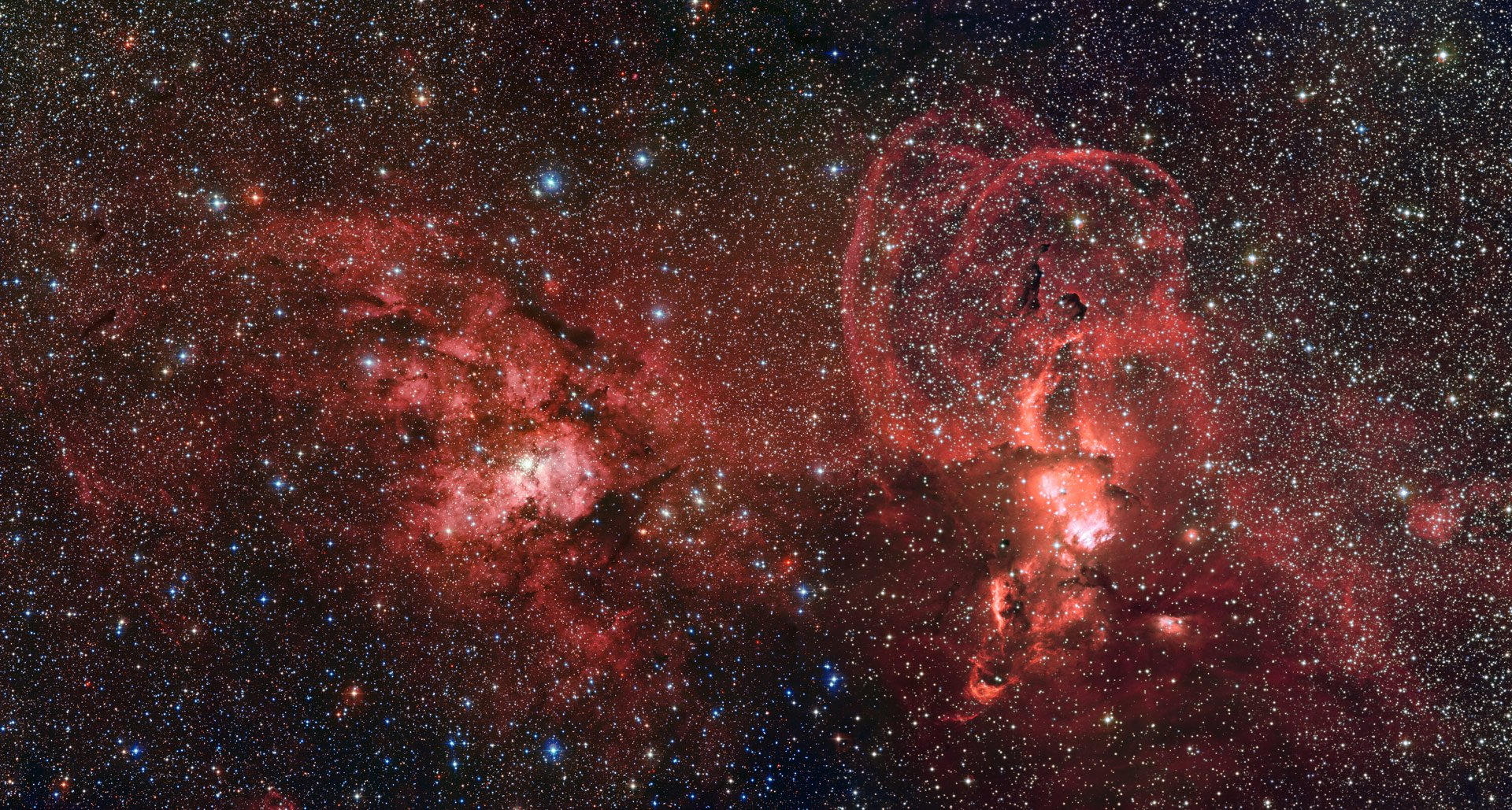
This new image from the European Southern Observatory shows two dramatic star formation regions (NGC 3603 and NGC 3576) in the southern Milky Way.
This image, captured by the Wide Field Imager at ESO’s La Silla Observatory in Chile, shows two dramatic star formation regions in the southern Milky Way. The first of these, on the left, is dominated by the star cluster NGC 3603, located 20,000 light-years away, in the Carina–Sagittarius spiral arm of the Milky Way galaxy. The second object, on the right, is a collection of glowing gas clouds known as NGC 3576 that lies only about half as far from Earth.
NGC 3603 is a very bright star cluster and is famed for having the highest concentration of massive stars that have been discovered in our galaxy so far. At the center lies a Wolf–Rayet multiple star system, known as HD 97950. Wolf–Rayet stars are at an advanced stage of stellar evolution, and start off with around 20 times the mass of the Sun. But, despite this large mass, Wolf–Rayet stars shed a considerable amount of their matter due to intense stellar winds, which blast the star’s surface material off into space at several million kilometers per hour, a crash diet of cosmic proportions.
NGC 3603 is in an area of very active star formation. Stars are born in dark and dusty regions of space, largely hidden from view. But as the very young stars gradually start to shine and clear away their surrounding cocoons of material they become visible and create glowing clouds in the surrounding material, known as HII regions. HII regions shine because of the interaction of ultraviolet radiation given off by the brilliant hot young stars with the hydrogen gas clouds. HII regions can measure several hundred light-years in diameter, and the one surrounding NGC 3603 has the distinction of being the most massive in our galaxy.
The cluster was first observed by John Herschel on 14 March 1834 during his three-year expedition to systematically survey the southern skies from near Cape Town. He described it as a remarkable object and thought that it might be a globular star cluster. Future studies showed that it is not an old globular, but a young open cluster, one of the richest known.
NGC 3576, on the right of the image, also lies in the Carina–Sagittarius spiral arm of the Milky Way. But it is located only about 9000 light-years from Earth — much closer than NGC 3603, but appearing next to it in the sky.
This pan video gives a close-up view of a spectacular mosaic of images from the Wide Field Imager on the MPG/ESO 2.2-meter telescope at ESO’s La Silla Observatory in Chile that shows two dramatic star formation regions in the southern Milky Way. The first is of these, on the left, is dominated by the star cluster NGC 3603, located 20,000 light-years away, in the Carina–Sagittarius spiral arm of the Milky Way galaxy. The second object, on the right, is a collection of glowing gas clouds known as NGC 3576 that lies only about half as far from Earth. Credit: ESO/G. Beccari. Music: movetwo
NGC 3576 is notable for two huge curved objects resembling the curled horns of a ram. These odd filaments are the result of stellar winds from the hot, young stars within the central regions of the nebula, which have blown the dust and gas outwards across a hundred light-years. Two dark silhouetted areas known as Bok globules are also visible in this vast complex of nebulae. These black clouds near the top of the nebula also offer potential sites for the future formation of new stars.
NGC 3576 was also discovered by John Herschel in 1834, making it a particularly productive and visually rewarding year for the English astronomer.
Never miss a breakthrough: Join the SciTechDaily newsletter.
Follow us on Google and Google News.