
Laboratory Experiment Shows That Bacteria Really Eat and Digest Plastic
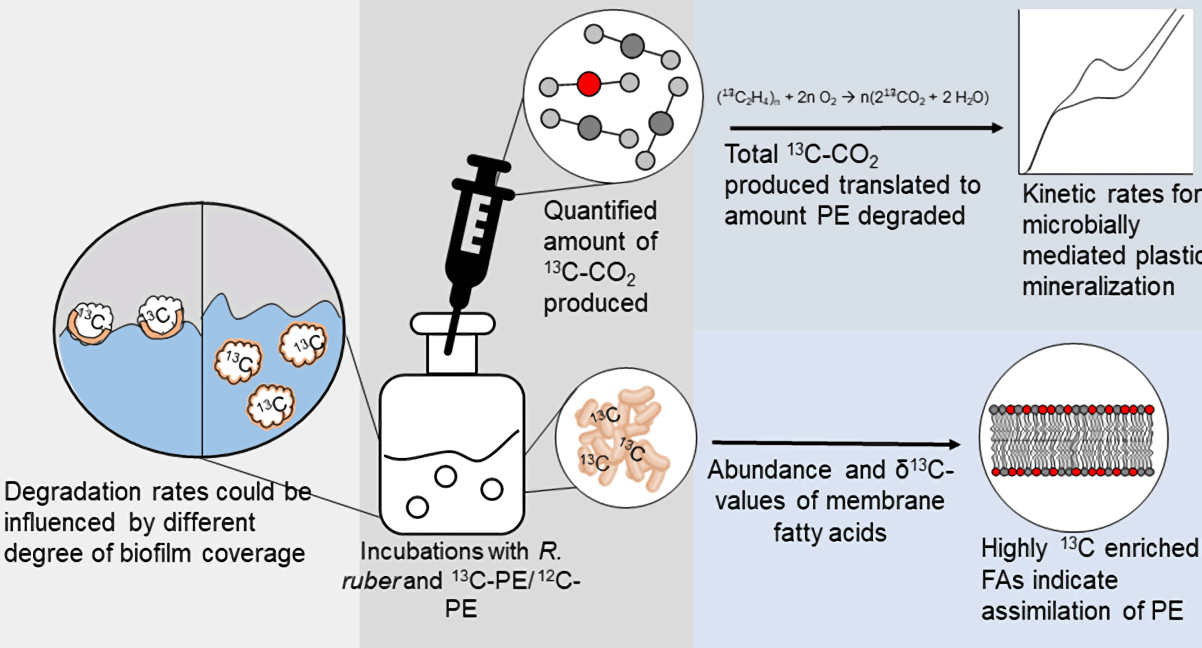
The bacterium Rhodococcus ruber eats and actually digests plastic. This has been shown in laboratory experiments by PhD student Maaike Goudriaan at Royal Netherlands Institute for Sea Research (NIOZ). Based on a model study with plastic in artificial seawater in the lab, Goudriaan calculated that bacteria can break down about one percent of the fed plastic per year into CO2 and other harmless substances. “But,” Goudriaan emphasizes, “this is certainly not a solution to the problem of the plastic soup in our oceans. It is, however, another part of the answer to the question of where all the ‘missing plastic’ in the oceans has gone.”
Special Plastic
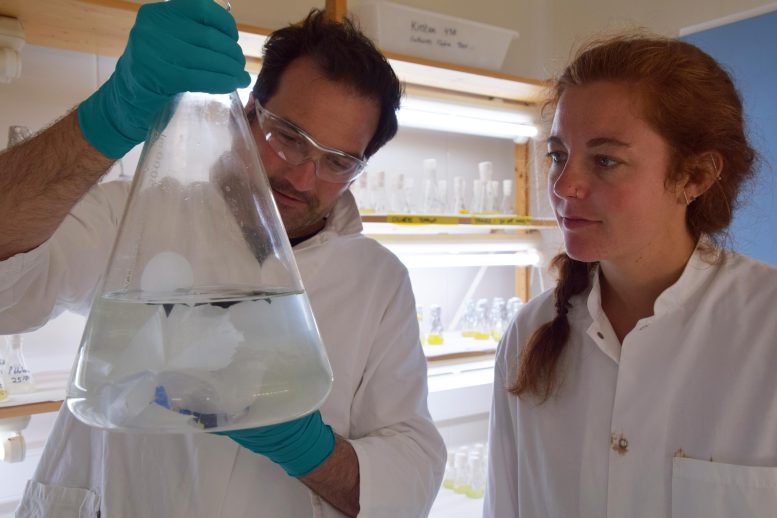
Goudriaan had a special plastic manufactured especially for these experiments with a distinct form of carbon (13C) in it. When she fed that plastic to bacteria after pretreatment with “sunlight” — a UV lamp — in a bottle of simulated seawater, she saw that special version of carbon appear as CO2 above the water. “The treatment with UV light was necessary because we already know that sunlight partially breaks down plastic into bite-sized chunks for bacteria,” the researcher explains.
Proof of Principle
“This is the first time we have proven in this way that bacteria actually digest plastic into CO2 and other molecules,” Goudriaan states. It was already known that the bacterium Rhodococcus ruber can form a so-called biofilm on plastic in nature. It had also been measured that plastic disappears under that biofilm. “But now we have really demonstrated that the bacteria actually digest the plastic.”
Underestimate
When Goudriaan calculates the total breakdown of plastic into CO2, she estimates that the bacteria can break down about one percent of the available plastic per year. “That’s probably an underestimate,” she adds. “We only measured the amount of carbon-13 in CO2, so not in the other breakdown products of the plastic. There will certainly be 13C in several other molecules, but it’s hard to say what part of that was broken down by the UV light and what part was digested by the bacteria.”
No Solution
Even though marine microbiologist Goudriaan is very excited about the plastic-eating bacteria, she stresses that microbial digestion is not a solution to the huge problem of all the plastic floating on and in our oceans. “These experiments are mainly a proof of principle. I see it as one piece of the jigsaw, in the issue of where all the plastic that disappears into the oceans stays. If you try to trace all our waste, a lot of plastic is lost. Digestion by bacteria could possibly provide part of the explanation.”
From Lab to Mudflats
To discover whether ‘wild’ bacteria also eat plastic ‘in the wild’, follow-up research needs to be done. Goudriaan already did some pilot experiments with real sea water and some sediment that she had collected from the Wadden Sea floor. “The first results of these experiments hints at plastic being degraded, even in nature,” she says. “A new PhD student will have to continue that work. Ultimately, of course, you hope to calculate how much plastic in the oceans really is degraded by bacteria. But much better than cleaning up, is prevention. And only we humans can do that,” Goudriaan says.
Sunlight Pulps the Plastic Soup
Recently Goudriaan’s colleague Annalisa Delre published a paper about sunlight which breaks down plastics on the ocean’s surfaces. Floating microplastic is broken down into ever smaller, invisible nanoplastic particles that spread across the entire water column, but also to compounds that can then be completely broken down by bacteria. This is shown by experiments in the laboratory of NIOZ, on Texel.
In the latest issue of the Marine Pollution Bulletin, PhD student Annalisa Delre and colleagues calculate that about two percent of visibly floating plastic may disappear from the ocean surface in this way each year. “This may seem small, but year after year, this adds up. Our data show that sunlight could thus have degraded a substantial amount of all the floating plastic that has been littered into the oceans since the 1950s,” says Delre.
Reference: “A stable isotope assay with 13C-labeled polyethylene to investigate plastic mineralization mediated by Rhodococcus ruber” by Maaike Goudriaan, Victor Hernando Morales, Marcel T. J. van der Meer, Anchelique Mets, Rachel T. Ndhlovu, Johan van Heerwaarden, Sina Simon, Verena B. Heuer, Kai-Uwe Hinrichs and Helge Niemann, 30 November 2022, Marine Pollution Bulletin.
DOI: 10.1016/j.marpolbul.2022.114369
Never miss a breakthrough: Join the SciTechDaily newsletter.
Follow us on Google and Google News.
3 Comments
Just imagine when the plastic eating bug breaks free? All the plastic in the world gone. To include; all of your child’s toys, all of your toys, your medical implants, etc, etc. Do you really want that bug on the loose? just sayin’…..
I read a SYFI book about this very thing where plastic in everyday items mysteriously started to decompose. Cannot remember the title. Will attempt to find it.
So remove the large stuff and stop polluting plastic and nature will take care of the rest eventually.