
Close Menu
    Facebook X (Twitter) Instagram
    SciTechDaily
    • Biology
    • Chemistry
    • Earth
    • Health
    • Physics
    • Science
    • Space
    • Technology
    Facebook X (Twitter) Pinterest YouTube RSS
    SciTechDaily
    Home»Biology»Scientists Examine Microbial Life on a Sand Grain
    Biology

    Scientists Examine Microbial Life on a Sand Grain

    By Max Planck InstituteDecember 5, 2017No Comments3 Mins Read
    Facebook Twitter Pinterest Telegram LinkedIn WhatsApp Email Reddit
    Share
    Facebook Twitter LinkedIn Pinterest Telegram Email Reddit
    Every Grain of Sand is a Metropolis for Bacteria
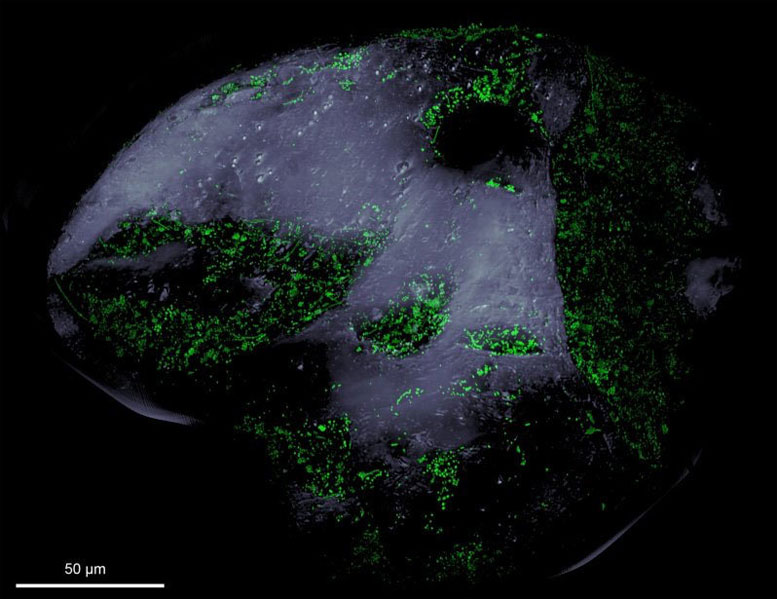
    View of a sand grain under a fluorescence microscope: The green spots are stained bacteria, which have mainly colonized depressions on the grain. © MPIMM/CC-SA BY 4.0

    A newly published study details microbial life on a sand grain: from bulk sediment to single grains.

    Just ima­gine, you are sit­ting on a sunny beach, con­ten­tedly let­ting the warm sand trickle through your fin­gers. Mil­lions of sand grains. What you prob­ably can’t ima­gine: at the same time, bil­lions upon bil­lions of bac­teria are also trick­ling through your fin­gers. Between 10,000 and 100,000 mi­croor­gan­isms live on each single grain of sand, as re­vealed in a study by researchers from the Max Planck Institute for Marine Microbiology in Bremen. This means that an in­di­vidual grain of sand can have twice as many res­id­ents as, say, the city of Fairb­anks, Alaska!

    It has long been known that sand is a densely pop­u­lated and act­ive hab­itat. Now David Probandt and his col­leagues have de­scribed the mi­cro­bial com­munity on a single grain of sand us­ing mod­ern mo­lecu­lar meth­ods. To do this, they used samples taken from the south­ern North Sea, near the is­land of Hel­go­land, off the Ger­man coast.

    The bac­teria do not col­on­ize the sand grains uni­formly. While ex­posed areas are prac­tic­ally un­col­on­ized, the bac­teria bustle in cracks and de­pres­sions. “They are well pro­tec­ted there”, ex­plains Probandt.  “When wa­ter flows around the grains of sand and they are swirled around, rub­bing against each other, the bac­teria are safe within these de­pres­sions.” These sites may also act as hid­ing grounds from pred­at­ors, who comb the sur­face of the sand grains in search of food.

    Impressive diversity

    However, the di­versity of the bac­teria, and not just their num­bers, is im­press­ive. “We found thou­sands of dif­fer­ent spe­cies of bac­teria on each in­di­vidual grain of sand”, says Probandt.

    Some bac­teria spe­cies and groups can be found on all in­vest­ig­ated sand grains, oth­ers only here and there. “More than half of the in­hab­it­ants on all grains are the same. We as­sume that this core com­munity on all sand grains dis­plays a sim­ilar func­tion”, ex­plains Probandt. “In prin­ciple, each grain has the same fun­da­mental pop­u­la­tion and in­fra­struc­ture.” We can there­fore really dis­cover a great deal about the bac­terial di­versity of sand in gen­eral from in­vest­ig­at­ing a single grain of sand.

    Sandy coasts are enormous filters

    Sand-dwell­ing bac­teria play an im­port­ant role in the mar­ine eco­sys­tem and global ma­ter­ial cycles. Be­cause these bac­teria pro­cess, for ex­ample, car­bon and ni­tro­gen com­pounds from sea­wa­ter and flu­vial in­flows, the sand acts as an enorm­ous puri­fy­ing fil­ter. Much of what is flushed into the seabed by sea­wa­ter does­n’t come back out.

    “Every grain of sand func­tions like a small bac­terial pantry”, ex­plains Probandt. They de­liver the ne­ces­sary sup­plies to keep the car­bon, ni­tro­gen and sul­phur cycles run­ning. “Whatever the con­di­tions may be that the bac­terial com­munity on a grain of sand is ex­posed to – thanks to the great di­versity of the core com­munity there is al­ways someone to pro­cess the sub­stances from the sur­round­ing wa­ter.”

    Reference: David Probandt, et al., “Microbial life on a sand grain: from bulk sediment to single grains” by David Probandt, Thilo Eickhorst, Andreas Ellrott, Rudolf Amann and Katrin Knittel, 1 December 2017, The ISME Journal.
    DOI: 10.1038/ismej.2017.197

    Never miss a breakthrough: Join the SciTechDaily newsletter.
    Follow us on Google and Google News.

    Bacteria Marine Biology Max Planck Institute Microbiology Microorganisms
    Share. Facebook Twitter Pinterest LinkedIn Email Reddit

    Related Articles

    Missing Link Identified: Mystery of Photosynthetic Algae Evolution Finally Solved

    Littlest Shop of Horrors: Hungry Green Algae Prefer to Eat Bacteria Alive

    “Unprecedented” New Form of Symbiosis Discovered

    Bioluminescent Bacteria Kill Rivals and Establish Symbiosis in Squid Using Genetic Regulatory Factors

    Bacterium Thioglobus Perditus Gains Energy from Sulfur

    New Research Shows Human Intestinal Bacteria Can Trigger Multiple Sclerosis

    New Study Details How Bacteria Become Individualists

    Bacteria Can Be Spatially Excluded from the Exchange of Amino Acids

    Plants Choose and Make Use of the Bacteria They Allow into Their Roots

    Leave A Reply Cancel Reply

    • Facebook
    • Twitter
    • Pinterest
    • YouTube

    Don't Miss a Discovery

    Subscribe for the Latest in Science & Tech!

    Trending News

    Scientists Finally Uncover How a “Forever Chemical” Causes Birth Defects

    Scientists Uncover the Earliest Brain Changes That May Predict Alzheimer’s Decades Before Symptoms

    Surprising New Study Challenges a Century-Old Theory of Habit Formation

    Scientists Turn Seawater Into Drinking Water Without Toxic Brine

    Vitamin D Drug Shows Surprising Promise Against One of the Deadliest Cancers

    NASA’s X-59 Sonic Boom Killer Is Ready for Its Biggest Test Yet

    The Best Exercise Combination for Longevity, According to a 30-Year Study

    Popular Weight-Loss Drug Found To Slow Biological Aging in Landmark Human Trial

    Follow SciTechDaily
    • Facebook
    • Twitter
    • YouTube
    • Pinterest
    • Newsletter
    • RSS
    SciTech News
    • Biology News
    • Chemistry News
    • Earth News
    • Health News
    • Physics News
    • Science News
    • Space News
    • Technology News
    Recent Posts
    • The Probiotic Breakthrough for Natural Anxiety Relief and Better Mental Health
    • Animal vs. Plant Protein: Scientists Found a Surprising Nutritional Difference
    • Tiny Genetic Change Turns Female Mice Into Males, Scientists Discover
    • Scientists Discover Strange New Spider Species That Disguises Itself as a Fungus
    • This Simple Drink Could Help Calm the Inflammation Behind Many Diseases
    Copyright © 1998 - 2026 SciTechDaily. All Rights Reserved.
    • Science News
    • About
    • Contact
    • Editorial Board
    • Privacy Policy
    • Terms of Use

    Type above and press Enter to search. Press Esc to cancel.