
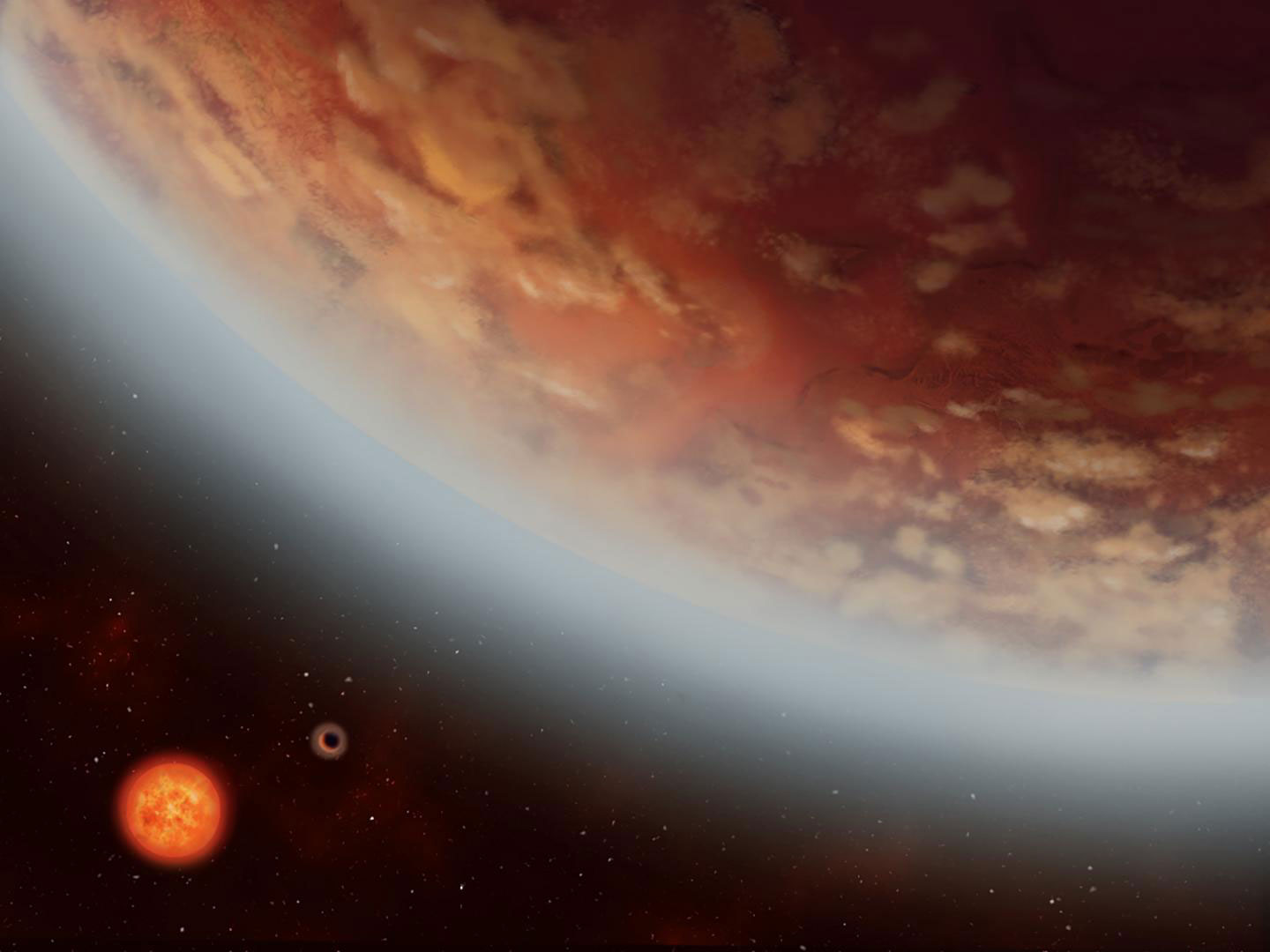
New research using data collected by the European Southern Observatory (ESO) has revealed that a little-known exoplanet called K2-18b could well be a scaled-up version of Earth.
Just as exciting, the same researchers also discovered for the first time that the planet has a neighbor.
“Being able to measure the mass and density of K2-18b was tremendous, but to discover a new exoplanet was lucky and equally exciting,” says lead author Ryan Cloutier, a Ph.D. student in U of T Scarborough’s Centre for Planet Science, U of T’s Department of Astronomy and Astrophysics, and Université de Montréal Institute for research on exoplanets (iREx).
Both planets orbit K2-18, a red-dwarf star located about 111 light-years away in the constellation Leo. When the planet K2-18b was first discovered in 2015, it was found to be orbiting within the star’s habitable zone, making it an ideal candidate to have liquid surface water, a key element in harboring conditions for life as we know it.
The data set used by the researchers came from the High Accuracy Radial Velocity Planet Searcher (HARPS) using the ESO’s 3.6m telescope at La Silla Observatory, in Chile. HARPS allows for measurements of radial velocities of stars, which can be affected by the presence of nearby planets, to be taken with the highest accuracy currently available. The instrument makes it possible to detect very small planets orbiting those stars.
In order to figure out whether K2-18b was a scaled-up version of Earth (mostly rock), or a scaled-down version of Neptune (mostly gas), researchers had to first figure out the planet’s mass, using radial velocity measurements taken with HARPS.
“If you can get the mass and radius, you can measure the bulk density of the planet and that can tell you what the bulk of the planet is made of,” says Cloutier.
After using a machine-learning approach to figure out the mass measurement, Cloutier and his team were able to determine the planet is either a mostly rocky planet with a small gaseous atmosphere – like Earth, but bigger – or a mostly water planet with a thick layer of ice on top of it.
“With the current data, we can’t distinguish between those two possibilities,” he says. “But with the James Webb Space Telescope (JWST) we can probe the atmosphere and see whether it has an extensive atmosphere or it’s a planet covered in water.”
The JWST, which will be launched in 2019, will be instrumental in collecting a range of data for studying the solar system, early universe, and exoplanets.
“There’s a lot of demand to use this telescope, so you have to be meticulous in choosing which exoplanets to look at,” says René Doyon, a co-author on the paper who is also the principal investigator for NIRISS, the Canadian Space Agency instrument onboard JWST.
“K2-18b is now one of the best targets for atmospheric study, it’s going to the near top of the list.”
It was while looking through the data of K2-18b that Cloutier noticed something unusual. In addition to a signal occurring every 39 days from the rotation of K2-18, and one taking place every 33 days from the orbit of K2-18b, he noticed a different signal occurring every nine days.
“When we first threw the data on the table we were trying to figure out what it was. You have to ensure the signal isn’t just noise, and you need to do careful analysis to verify it, but seeing that initial signal was a good indication there was another planet,” Cloutier says.
Cloutier collaborated with an international team of researchers, including his supervisor U of T Scarborough Associate Professor Kristen Menou from the Center for Planetary Sciences, and from the Observatoire Astronomique de l’Université de Genève, the Institute for research on exoplanets (iREx), Université de Grenoble, and Universidade do Porto.
While the newly described planet K2-18c is closer to its star, and probably too hot to be in the habitable zone, like K2-18b it also appears to be a Super-Earth meaning it has a mass similar to Earth. Cloutier, who had set the goal of discovering a new exoplanet within his Ph.D., considers himself very lucky to have discovered it in this dataset.
“It wasn’t a eureka moment because we still had to go through a checklist of things to do in order to verify the data. Once all the boxes were checked it sunk in that, wow, this actually is a planet.”
The research, which received support from the Natural Sciences and Research Council of Canada (NSERC) and the Institute for Research on Exoplanets, will be published in the journal Astronomy and Astrophysics.
Reference: “Characterization of the K2-18 multi-planetary system with HARPS: A habitable zone super-Earth and discovery of a second, warm super-Earth on a non-coplanar orbit” by R. Cloutier, N. Astudillo-Defru, R. Doyon, X. Bonfils, J.-M. Almenara, B. Benneke, F. Bouchy, X. Delfosse, D. Ehrenreich, T. Forveille, C. Lovis, M. Mayor, K. Menou, F. Murgas, F. Pepe, J. Rowe, N. C. Santos, S. Udry and A. Wünsche, 5 December 2017, Astronomy & Astrophysics.
DOI: 10.1051/0004-6361/201731558
PDF
Never miss a breakthrough: Join the SciTechDaily newsletter.
Follow us on Google and Google News.