
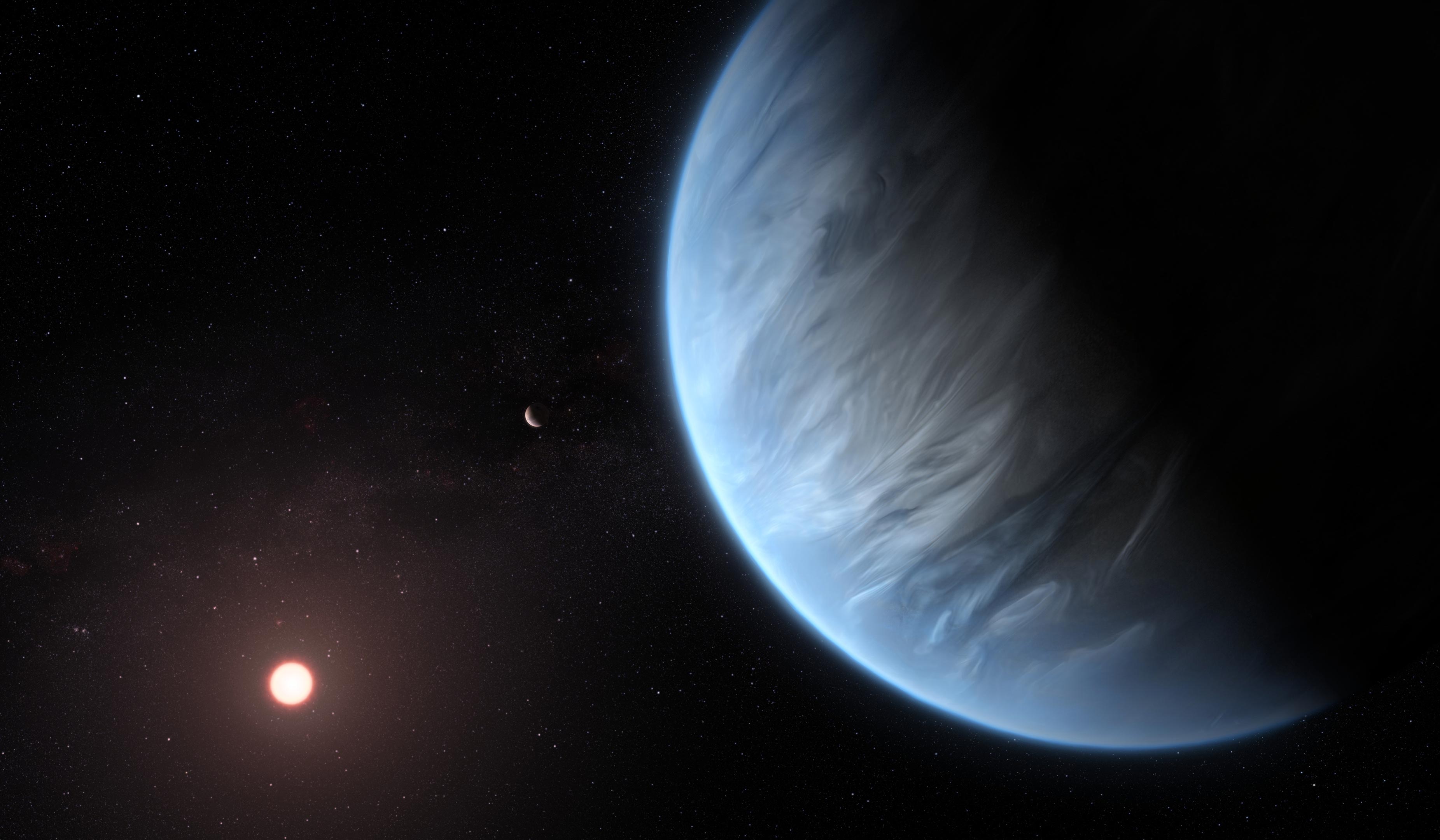
Planet Weather Forecast: Cloudy with Rain
To date, approximately 4,000 planets have been found orbiting other stars. The majority are extremely hostile to any chances for life: with exotic atmospheres, wide temperature extremes, and oddball orbits. Astronomers have now made an important step toward the ultimate goal of finding an exoplanet with an atmosphere more like Earth’s, and having moderate temperatures.
Water vapor has been identified in the atmosphere of a planet called K2-18b, located 110 light-years away. And, where there’s water there could be clouds and rain. The planet is also at the right distance from its star to have a temperate climate where the water doesn’t evaporate or freeze. But don’t go looking for real estate yet.
The planet is in a category not found in our solar system. It is larger than Earth but smaller than Neptune. It might have a rocky surface, but it is more likely a giant ball of liquid and gas, like Neptune. Hundreds of known exoplanets fall into this mass range. So, it’s important for astronomers to characterize the worlds and assess the chances for supporting life as we know it.
NASA’s Hubble Finds Water Vapor on Habitable-Zone Exoplanet for the First Time
Its size and surface gravity are much larger than Earth’s, and its radiation environment may be hostile, but a distant planet called K2-18b has captured the interest of scientists all over the world. For the first time, researchers have detected water vapor signatures in the atmosphere of a planet beyond our solar system that resides in the “habitable zone,” the region around a star in which liquid water could potentially pool on the surface of a rocky planet.
Astronomers at the Center for Space Exochemistry Data at the University College London in the United Kingdom used data from NASA’s Hubble Space Telescope to find water vapor in the atmosphere of K2-18b, an exoplanet around a small red dwarf star about 110 light-years away in the constellation Leo. If confirmed by further studies, this will be the only exoplanet known to have both water in its atmosphere and temperatures that could sustain liquid water on a rocky surface. Liquid water would only be possible if the planet turns out to be terrestrial in nature, rather than resembling a small version of Neptune.
Given the high level of activity of its red dwarf star, K2-18b may be more hostile to life as we know it than Earth, as it is likely to be exposed to more high-energy radiation. The planet, discovered by NASA’s Kepler Space Telescope in 2015, also has a mass eight times greater than Earth’s. That means the surface gravity on this planet would be significantly higher than on our planet.
The team used archive data from 2016 and 2017 captured by Hubble and developed open-source algorithms to analyze the host star’s light filtered through K2-18b’s atmosphere. The results revealed the molecular signature of water vapor, and also suggest the presence of hydrogen and helium in the planet’s atmosphere.
With data from the Hubble Space Telescope, water vapor has been detected in the atmosphere of an exoplanet within the habitable zone of its host star. K2-18b, which is eight times the mass of Earth, is the only planet orbiting a star outside the solar system (or “exoplanet”) known to have both water and temperatures that could support life. Credit: NASA’s Goddard Space Flight Center
The authors of the paper, published in Nature Astronomy, believe that other molecules, including nitrogen and methane, may be present but they remain undetectable with current observations. Further studies are required to estimate cloud coverage and the percentage of atmospheric water present. A paper from a different team of scientists using Hubble observations has been submitted to the Astronomical Journal.
K2-18b is one of hundreds of “super-Earths” — exoplanets with masses between those of Earth and Neptune — found by Kepler. NASA’s TESS mission is expected to detect hundreds more super-Earths in the coming years. The next generation of space telescopes, including the James Webb Space Telescope, will be able to characterize exoplanet atmospheres in more detail.
The Hubble Space Telescope is a project of international cooperation between ESA (the European Space Agency) and NASA.
Never miss a breakthrough: Join the SciTechDaily newsletter.
Follow us on Google and Google News.