
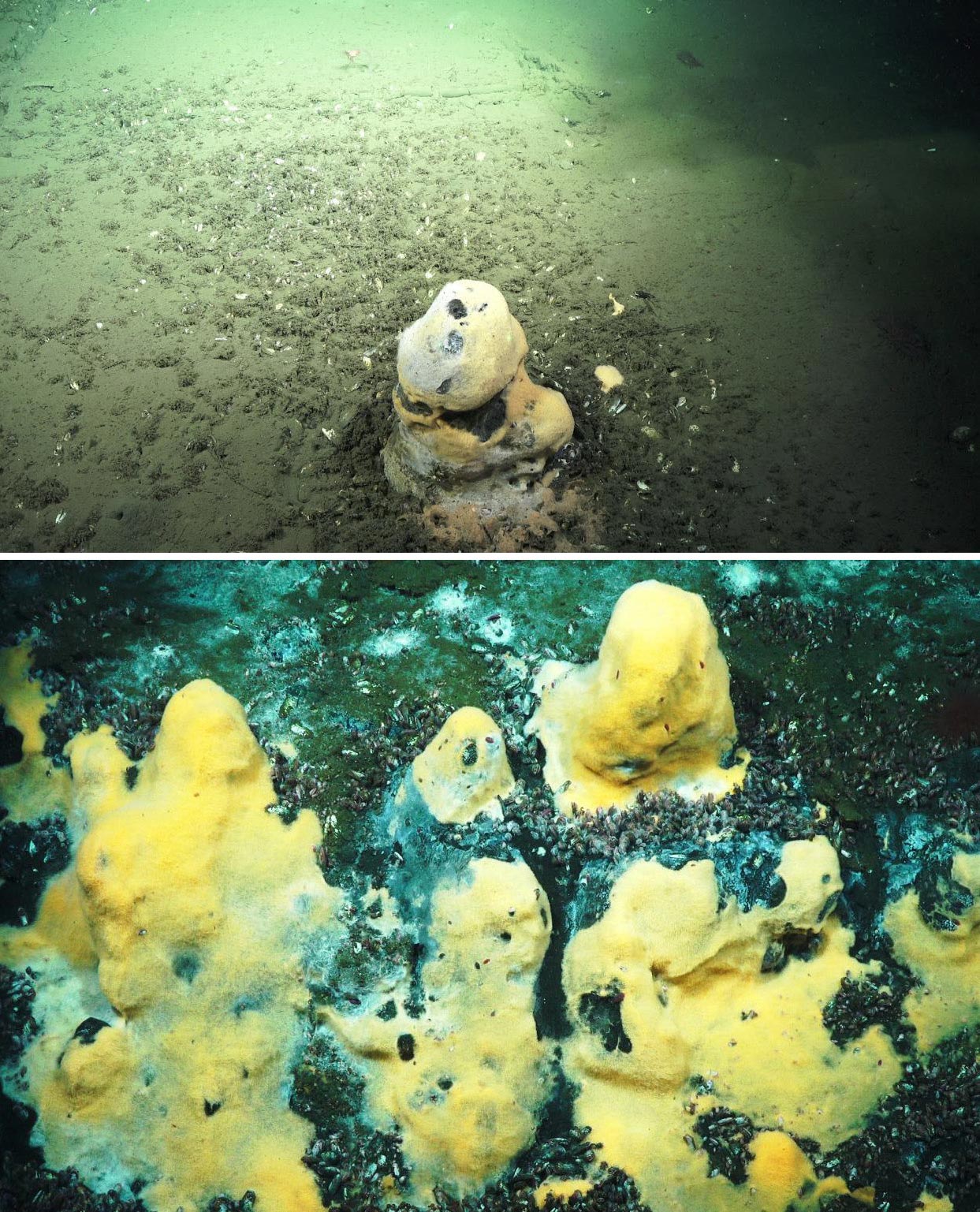
Methane-eating microbes help regulate Earth’s temperatures with remarkably high metabolic rates within seafloor carbonate rocks.
Methane is a strong greenhouse gas that plays a key role in Earth’s climate. Anytime we use natural gas, whether we light up our kitchen stove or barbeque, we are using methane.
Only three sources on Earth produce methane naturally: volcanoes, subsurface water-rock interactions, and microbes. Between these three sources, most is generated by microbes, which have deposited hundreds of gigatons of methane into the deep seafloor. At seafloor methane seeps, it percolates upwards toward the open ocean, and microbial communities consume the majority of this methane before it reaches the atmosphere. Over the years, researchers are finding more and more methane beneath the seafloor, yet very little ever leaves the oceans and gets into the atmosphere. Where is the rest going?
A team of researchers led by Jeffrey J. Marlow, former postdoctoral researcher in Organismic and Evolutionary Biology at Harvard University, discovered microbial communities that rapidly consume the methane, preventing its escape into Earth’s atmosphere. The study published in Proceedings of the National Academy of Sciences collected and examined methane-eating microbes from seven geologically diverse seafloor seeps and found, most surprisingly, that the carbonate rocks from one site in particular hosts methane-oxidizing microbial communities with the highest rates of methane consumption measured to date.
Carbonate Rocks: A Natural Biofilter
“The microbes in these carbonate rocks are acting like a methane bio filter consuming it all before it leaves the ocean,” said senior author Peter Girguis, Professor of Organismic and Evolutionary Biology, Harvard University. Researchers have studied microbes living in seafloor sediment for decades and know these microbes are consuming methane. This study, however, examined microbes that thrive in the carbonate rocks in great detail.
Seafloor carbonate rocks are common, but in select locations, they form unusual chimney-like structures. These chimneys reach 12 to 60 inches in height and are found in groups along the seafloor resembling a stand of trees. Unlike many other types of rocks, these carbonate rocks are porous, creating channels that are home to a very dense community of methane-consuming microbes. In some cases, these microbes are found in much higher densities within the rocks than in the sediment.
During a 2015 expedition funded by the Ocean Exploration Trust, Girguis discovered a carbonate chimney reef off the coast of southern California at the deep sea site Point Dume. Girguis returned in 2017 with funding from NASA to build a sea floor observatory. Upon joining Girguis’s lab, Marlow, currently Assistant Professor of Biology at Boston University, was studying microbes in carbonates. The two decided to conduct a community study and gather samples from the site.
“We measured the rate at which the microbes from the carbonates eat methane compared to microbes in sediment,” said Girguis. “We discovered the microbes living in the carbonates consume methane 50 times faster than microbes in the sediment. We often see that some sediment microbes from methane-rich mud volcanoes, for example, may be five to ten times faster at eating methane, but 50 times faster is a whole new thing. Moreover, these rates are among the highest, if not the highest, we’ve measured anywhere.”
“These rates of methane oxidation, or consumption, are really extraordinary, and we set out to understand why,” said Marlow.
Porous Rocks Enhance Methane Supply and Metabolism
The team found that the carbonate chimney sets up an ideal home for the microbes to eat a lot of methane really fast. “These chimneys exists because some methane in fluid flowing out from the subsurface is transformed by the microbes into bicarbonate, which can then precipitate out of the seawater as carbonate rock,” said Marlow. “We’re still trying to figure out where that fluid — and its methane — is coming from.”
The micro-environments within the carbonates may contain more methane than the sediment due to its porous nature. Carbonates have channels that are constantly irrigating the microbes with fresh methane and other nutrients allowing them to consume methane faster. In sediment, the supply of methane is often limited because it diffuses through smaller, winding channels between mineral grains.
A startling find was that, in some cases, these microbes are surrounded by pyrite, which is electrically conductive. One possible explanation for the high rates of methane consumption is that the pyrite provides an electrical conduit that passes electrons back and forth, allowing the microbes to have higher metabolic rates and consume methane quickly.
“These very high rates are facilitated by these carbonates which provide a framework for the microbes to grow,” said Girguis. “The system resembles a marketplace where carbonates allow a bunch of microbes to aggregate in one place and grow and exchange — in this case, exchange electrons — which allows for more methane consumption.”
Energy Sharing via Electrons in Porous Rocks
Marlow agreed, “When microbes work together they’re either exchanging building blocks like carbon or nitrogen, or they’re exchanging energy. And one kind of way to do that is through electrons, like an energy currency. The pyrite interspersed throughout these carbonate rocks could help that electron exchange happen more swiftly and broadly.”
In the lab, the researchers put the collected carbonates into high pressure reactors and recreated conditions on the sea floor. They gave them isotopically labeled methane with added Carbon-14 or Deuterium (Hydrogen-2) in order to track methane production and consumption. The team next compared the data from Point Dume to six additional sites, from the Gulf of Mexico to the coast of New England. In all locations, carbonate rocks at methane seeps contained methane-eating microbes.
“Next we plan to disentangle how each of these different parts of the carbonates — the structure, electrical conductivity, fluid flow, and dense microbial community — make this possible. As of now, we don’t know the exact contribution of each,” said Girguis.
“First, we need to understand how these microbes sustain their metabolic rate, whether they’re in a chimney or in the sediment. And we need to know this in our changing world in order to build our predictive power,” said Marlow. “Once we clarify how these many interconnected factors come together to turn methane to rock, we can then ask how we might apply these anaerobic methane-eating microbes to other situations, like landfills with methane leaks.”
Reference: “Carbonate-hosted microbial communities are prolific and pervasive methane oxidizers at geologically diverse marine methane seep sites” by Jeffrey J. Marlow, Daniel Hoer, Sean P. Jungbluth, Linda M. Reynard, Amy Gartman, Marko S. Chavez, Mohamed Y. El-Naggar, Noreen Tuross, Victoria J. Orphan and Peter R. Girguis, Proceedings of the National Academy of Sciences.
DOI: 10.1073/pnas.2006857118
Never miss a breakthrough: Join the SciTechDaily newsletter.
Follow us on Google and Google News.
1 Comment
All those UFOs flew away…all but one! @ufogem and @ufospacggem Rock out! Now in captivity San Diego researchers email [email protected]