
Close Menu
    Facebook X (Twitter) Instagram
    SciTechDaily
    • Biology
    • Chemistry
    • Earth
    • Health
    • Physics
    • Science
    • Space
    • Technology
    Facebook X (Twitter) Pinterest YouTube RSS
    SciTechDaily
    Home»Technology»Scientists Have Created the World’s Smallest, Lightest, and Fastest Fully Functional Micro-Robots
    Technology

    Scientists Have Created the World’s Smallest, Lightest, and Fastest Fully Functional Micro-Robots

    By Washington State UniversityFebruary 21, 20242 Comments4 Mins Read
    Facebook Twitter Pinterest Telegram LinkedIn WhatsApp Email Reddit
    Share
    Facebook Twitter LinkedIn Pinterest Telegram Email Reddit
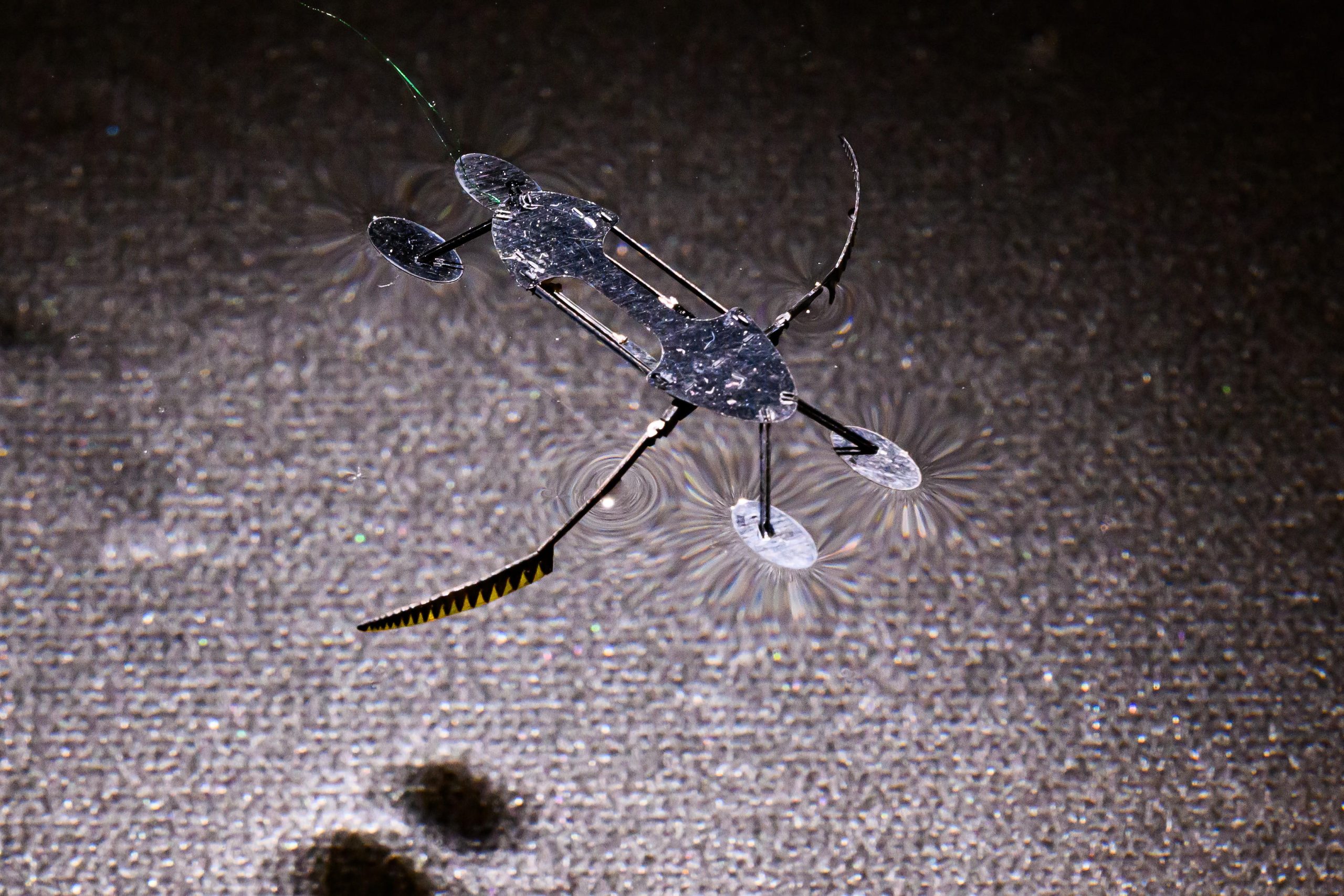
    Water Skimmer
    Researchers at Washington State University have developed the smallest and fastest micro-robots, potentially transforming fields from artificial pollination to surgery. Utilizing shape memory alloys for movement, these robots—significantly lighter and quicker than previous models—aspire to achieve greater autonomy and efficiency by mimicking natural insect behavior. Credit: WSU Photo Services

    Two insect-like robots, a mini-bug and a water strider, developed at Washington State University, are the smallest, lightest and fastest fully functional micro-robots ever known to be created.

    Such miniature robots could someday be used for work in areas such as artificial pollination, search and rescue, environmental monitoring, micro-fabrication, or robotic-assisted surgery. Reporting on their work in the proceedings of the IEEE Robotics and Automation Society’s International Conference on Intelligent Robots and Systems, the mini-bug weighs in at eight milligrams while the water strider weighs 55 milligrams. Both can move at about six millimeters a second.

    Breakthroughs in Speed and Miniaturization

    “That is fast compared to other micro-robots at this scale although it still lags behind their biological relatives,” said Conor Trygstad, a PhD student in the School of Mechanical and Materials Engineering and lead author on the work. An ant typically weighs up to five milligrams and can move at almost a meter per second.

    The key to the tiny robots is their tiny actuators that make the robots move. Trygstad used a new fabrication technique to miniaturize the actuator down to less than a milligram, the smallest ever known to have been made.
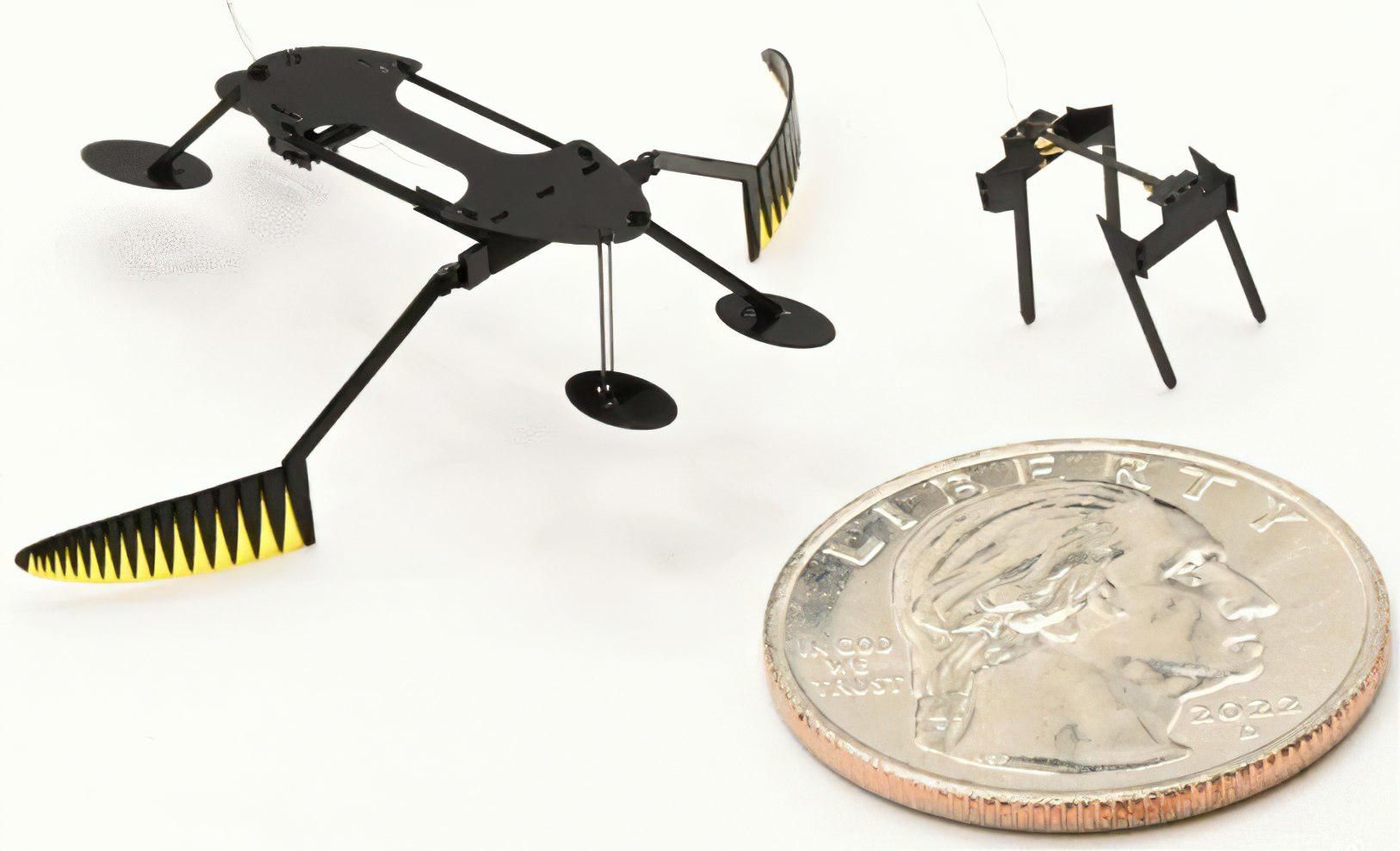
    Water Skimmer Robot Size Comparison
    A WSU-created robot is placed next to a quarter to illustrate its size. Credit: WSU

    “The actuators are the smallest and fastest ever developed for micro-robotics,” said Néstor O. Pérez-Arancibia, Flaherty Associate Professor in Engineering at WSU’s School of Mechanical and Materials Engineering who led the project.

    Advanced Actuator Technology

    The actuator uses a material called a shape memory alloy that is able to change shapes when it’s heated. It is called ‘shape memory’ because it remembers and then returns to its original shape. Unlike a typical motor that would move a robot, these alloys don’t have any moving parts or spinning components.

    “They’re very mechanically sound,” said Trygstad. “The development of the very lightweight actuator opens up new realms in micro-robotics.”

    Shape memory alloys are not generally used for large-scale robotic movement because they are too slow. In the case of the WSU robots, however, the actuators are made of two tiny shape memory alloy wires that are 1/1000 of an inch in diameter. With a small amount of current, the wires can be heated up and cooled easily, allowing the robots to flap their fins or move their feet at up to 40 times per second. In preliminary tests, the actuator was also able to lift more than 150 times its own weight.

    Compared to other technologies used to make robots move, the SMA technology also requires only a very small amount of electricity or heat to make them move.

    Future Directions and Enhancements

    “The SMA system requires a lot less sophisticated systems to power them,” said Trygstad.

    Trygstad, an avid fly fisherman, has long observed water striders and would like to further study their movements. While the WSU water strider robot does a flat flapping motion to move itself, the natural insect does a more efficient rowing motion with its legs, which is one of the reasons that the real thing can move much faster.

    The researchers would like to copy another insect and develop a water strider-type robot that can move across the top of the water surface as well as just under it. They are also working to use tiny batteries or catalytic combustion to make their robots fully autonomous and untethered from a power supply.

    Reference: “A New 1-mg Fast Unimorph SMA-Based Actuator for Microrobotics” by Conor K. Trygstad, Xuan-Truc Nguyen and Néstor O. Pérez-Arancibia, 13 December 2023, IEEE Xplore.
    DOI: 10.1109/IROS55552.2023.10342518

    Never miss a breakthrough: Join the SciTechDaily newsletter.
    Follow us on Google and Google News.

    Popular Robotics Washington State University
    Share. Facebook Twitter Pinterest LinkedIn Email Reddit

    Related Articles

    New Inexpensive Robots Find Leaks from Inside Pipes

    MIT Develops a System That Can 3D Print the Basic Structure of an Entire Building

    Engineers Develop Micro-tentacles So Tiny Robots Can Handle Delicate Objects

    Cancer-Fighting DNA Nanorobots Could Target Specific Cells for Repair

    Sandia’s Robot Hand Can Replace Battery in Flashlight

    DARPA & Harvard’s Soft, Self-Camouflaging Robot

    Robonaut 2: A Robotic Space Station Crew Member

    Researchers Use Robot Fish to Lead Golden Shiner School

    Harvard Scientists Develop $5 Rubber Robot

    2 Comments

    1. John Bayer on February 23, 2024 5:58 pm

      “An ant typically weighs up to five milligrams and can move at almost a meter per second.”

      That’s no ordinary ant! I’ve never seen one *that* fast.

      Reply
    2. Howard Nelson on February 27, 2024 1:04 pm

      Are you pro or anti-ant?

      Reply
    Leave A Reply Cancel Reply

    • Facebook
    • Twitter
    • Pinterest
    • YouTube

    Don't Miss a Discovery

    Subscribe for the Latest in Science & Tech!

    Trending News

    One of the Universe’s Largest Stars May Be Getting Ready To Explode

    Scientists Discover Enzyme That Could Supercharge Ozempic-Like Weight Loss Drugs

    Popular Sweetener Linked to DNA Damage – “It’s Something You Should Not Be Eating”

    Ancient “Rock” Microbes May Reveal How Complex Life Began

    Researchers Capture Quantum Interference in One of Nature’s Rarest Atoms

    “A Plague Is Upon Us”: The Mass Death That Changed an Ancient City Forever

    Scientists Discover Game-Changing New Way To Treat High Cholesterol

    This Small Change to Your Exercise Routine Could Be the Secret to Living Longer

    Follow SciTechDaily
    • Facebook
    • Twitter
    • YouTube
    • Pinterest
    • Newsletter
    • RSS
    SciTech News
    • Biology News
    • Chemistry News
    • Earth News
    • Health News
    • Physics News
    • Science News
    • Space News
    • Technology News
    Recent Posts
    • New Research Uncovers Hidden Side Effects of Popular Weight-Loss Drugs
    • Scientists Rethink Extreme Warming After Surprising Ocean Discovery
    • The Surprising Role of Asteroids in the Origin of Life
    • Scientists Raise Concerns Over Newly Recognized Pollutant Found Everywhere in the Air
    • New Study Challenges 40-Year Puzzle About Childhood Body Fat
    Copyright © 1998 - 2026 SciTechDaily. All Rights Reserved.
    • Science News
    • About
    • Contact
    • Editorial Board
    • Privacy Policy
    • Terms of Use

    Type above and press Enter to search. Press Esc to cancel.