
Close Menu
    Facebook X (Twitter) Instagram
    SciTechDaily
    • Biology
    • Chemistry
    • Earth
    • Health
    • Physics
    • Science
    • Space
    • Technology
    Facebook X (Twitter) Pinterest YouTube RSS
    SciTechDaily
    Home»Physics»Physicists Solve 70-Year-Old Magnetic Wave Mystery
    Physics

    Physicists Solve 70-Year-Old Magnetic Wave Mystery

    By Emma Gallagher, Queen's University BelfastMarch 6, 20181 Comment5 Mins Read
    Facebook Twitter Pinterest Telegram LinkedIn WhatsApp Email Reddit
    Share
    Facebook Twitter LinkedIn Pinterest Telegram Email Reddit
    Scientists Crack 70-Year-Old Magnetic Wave Mystery
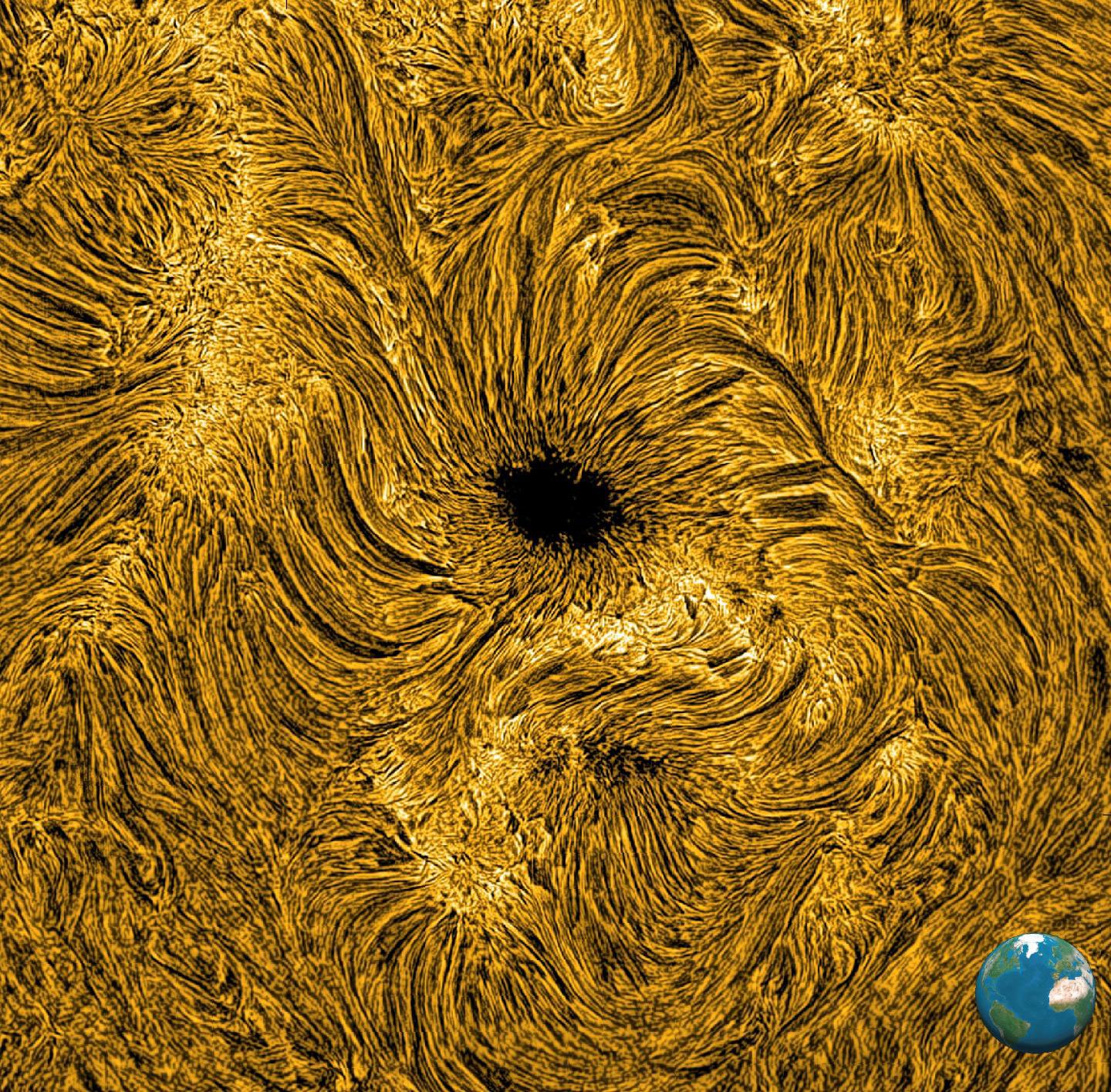
    A view of a sunspot on the solar surface, visible here as a dark collection of plasma with magnetic field strengths similar to those found in modern hospital MRI machines. However, it is the size of the sunspot, which is comparable to that of our own Earth (see the scale Earth depicted in the lower-right corner), that gives these structures immense power and energy. The recent work published in Nature Physics reveals first-time evidence for how a rare breed of magnetic waves, which originate within the center of sunspots, can form shockwaves that heat the surrounding plasma by thousands of degrees. Credit: Queen’s University Belfast

    Scientists at Queen’s University Belfast have led an international team to the ground-breaking discovery that magnetic waves crashing through the Sun may be key to heating its atmosphere and propelling the solar wind.

    The Sun is the source of energy that sustains all life on Earth but much remains unknown about it. However, a group of researchers at Queen’s have now unlocked some mysteries in a research paper, which has been published in Nature Physics.

    In 1942, Swedish physicist and engineer Hannes Alfvén predicted the existence of a new type of wave due to magnetism acting on a plasma, which led him to obtain the Nobel Prize for Physics in 1970. Since his prediction, Alfvén waves have been associated with a variety of sources, including nuclear reactors, the gas cloud that envelops comets, laboratory experiments, medical MRI imaging, and in the atmosphere of our nearest star — the Sun.
    Scientists Solve 70-Year-Old Magnetic Wave Mystery
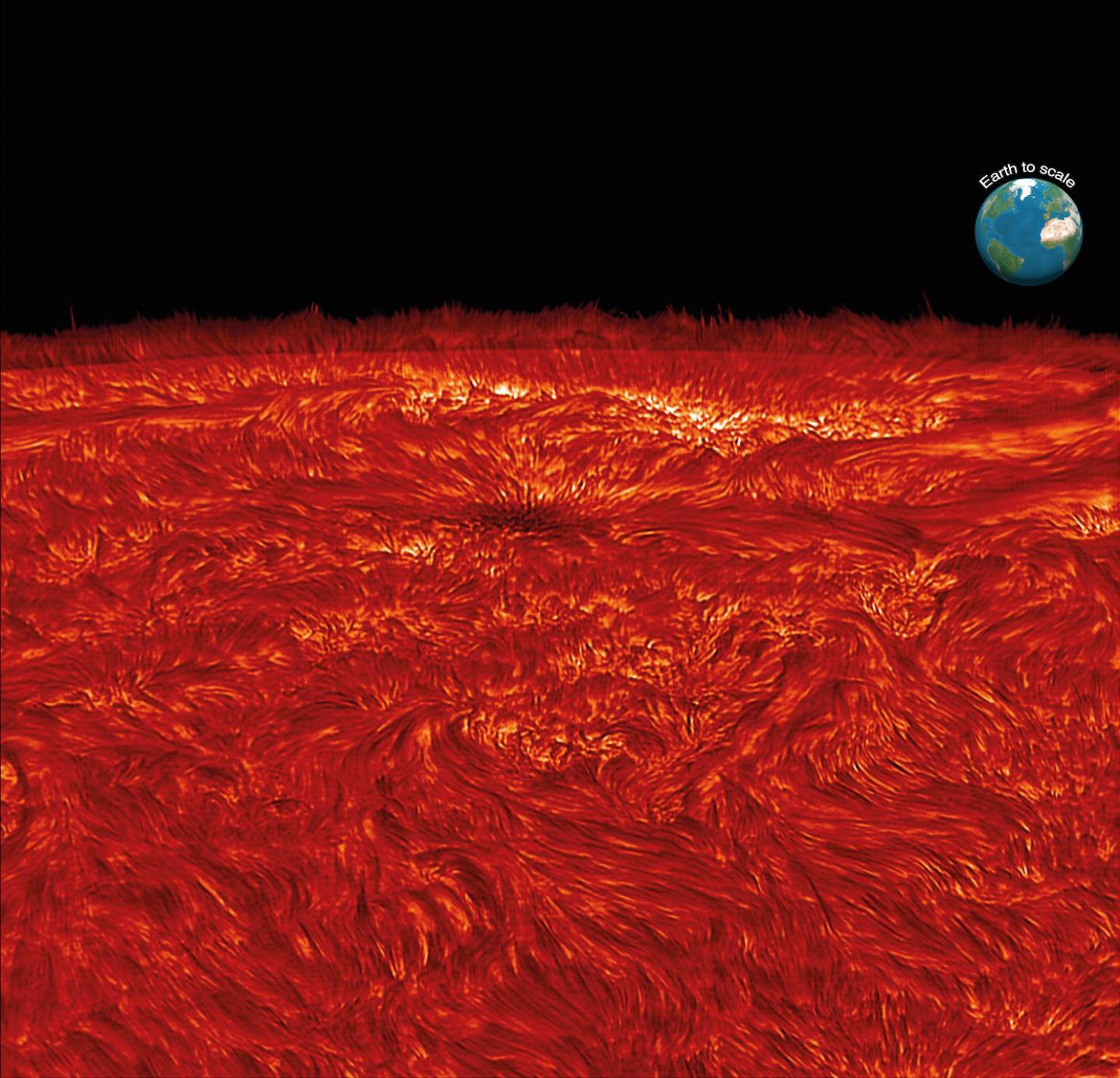
    A sunspot located towards the edge of the Sun, visible here as a dark collection of plasma with magnetic field strengths similar to those found in modern hospital MRI machines. However, it is the size of the sunspot, which is comparable to that of our own Earth (see the scale Earth depicted in the upper-right corner), that gives these structures immense power and energy. Extending upwards from the highly magnetic sunspot are field lines that can guide and direct dynamic motions from within the Sun’s deepest layers. The recent work published in Nature Physics reveals first-time evidence for how a rare breed of magnetic waves, guided upwards from the surface of the Sun, can form shockwaves that heat the surrounding plasma by thousands of degrees. Credit: Emma Gallagher

    Scientists have suggested for many years that these waves may play an important role in maintaining the Sun’s extremely high temperatures but until now had not been able to prove it.

    Dr. David Jess from the School of Mathematics and Physics at Queen’s University Belfast explains: “For a long time scientists across the globe have predicted that Alfvén waves travel upwards from the solar surface to break in the higher layers, releasing enormous amounts of energy in the form of heat. Over the last decade, scientists have been able to prove that the waves exist but until now there was no direct evidence that they had the capability to convert their movement into heat.”

    “At Queen’s, we have now led a team to detect and pinpoint the heat produced by Alfvén waves in a sunspot. This theory was predicted some 75 years ago but we now have the proof for the very first time. Our research opens up a new window to understanding how this phenomenon could potentially work in other areas such as energy reactors and medical devices.”

    The international team included Queen’s University Belfast; the Space Research Institute, Austria; Ilia State University, Georgia; the National Solar Observatory, USA; Instituto de Astrofísica de Canarias, Spain; Lockheed Martin, USA and California State University Northridge, USA.

    The study used advanced high-resolution observations from the Dunn Solar Telescope in New Mexico (USA) alongside complementary observations from NASA’s Solar Dynamics Observatory, to analyze the strongest magnetic fields that appear in sunspots. These sunspots have intense fields similar to modern MRI machines in hospitals and are much bigger than our own planet.

    Dr. Samuel Grant from Queen’s comments: “By breaking the Sun’s light up into its constituent colors, our international team of researchers was able to examine the behavior of certain elements from the periodic table within the Sun’s atmosphere, including calcium and iron.”

    “Once these elements had been extracted, intense flashes of light were detected in the image sequences. These intense flashes had all the hallmarks of the Alfvén waves converting their energy into shock waves, in a similar way to a supersonic aircraft creating a boom as it exceeds the speed of sound. The shock waves then ripple through the surrounding plasma, producing extreme heat. Using supercomputers, we were able to analyze the data and show for the first time in history that the Alfvén waves were capable of increasing plasma temperatures violently above their calm background.”

    Reference: “Alfvén wave dissipation in the solar chromosphere” by Samuel D. T. Grant, David B. Jess, Teimuraz V. Zaqarashvili, Christian Beck, Hector Socas-Navarro, Markus J. Aschwanden, Peter H. Keys, Damian J. Christian, Scott J. Houston and Rebecca L. Hewitt, 5 March 2018, Nature Physics.
    DOI: 10.1038/s41567-018-0058-3

    Never miss a breakthrough: Join the SciTechDaily newsletter.
    Follow us on Google and Google News.

    Astronomy Chromosphere Queen's University Belfast Sun
    Share. Facebook Twitter Pinterest LinkedIn Email Reddit

    Related Articles

    Solar Surprise: Scientists Discover Unprecedented High-Energy Light Coming From the Sun

    CLASP Provides First-Ever Polarization Measurements of UV Light from Sun’s Outer Atmosphere

    Sunrise Observatory Provides the First High-Resolution Images of the Chromosphere

    First Images From Project 1640

    Ready for Launch, NASA’s SUMI Rocket to Study the Sun’s Magnetic Fields

    Ultrafine Loops of Solar Material Scattered on the Sun’s Surface

    Earth in Motion and the Galaxies Around it

    NASA’s NuSTAR is One Step Closer to Launching

    Strong Geomagnetic Storms a Possibility After Active Sunspot 1401 Erupted

    1 Comment

    1. L. Loukopoulos on March 7, 2018 4:06 pm

      A free will bouncing ball lightning on a dew drenched Faulkner wire fence has a limited life before it explodes. The limit is the amount of energy that a sphere of radius R can contain. If your new found theory is correct then the consequences of magnetism in a plasma may constitute a weak form of perpetual “motion” that ultimately could mature into little big bangs that could erode the sun. What would Steve Hawking and Benji feel about this? Is there anyone out there who thinks that this mechanism can be explained by Ideals?

      Reply
    Leave A Reply Cancel Reply

    • Facebook
    • Twitter
    • Pinterest
    • YouTube

    Don't Miss a Discovery

    Subscribe for the Latest in Science & Tech!

    Trending News

    Could Low Vitamin D Be Making Your Pain Worse?

    Scientists Discover Once-Weekly Workout That Melts Belly Fat Surprisingly Effectively

    Scientists Just Tested a Thruster Powerful Enough for Human Missions to Mars

    Doctors Say Your Ice Pack Might Be Making Injuries Worse

    Scientists Discover 43-Foot Sea Reptile Twice the Size of a Great White Shark

    Bees and Birds Are Drinking Alcohol From Flowers

    Scientists Discover How Obesity May Trigger Alzheimer’s Disease

    Scientists Confirm Alcohol Causes Widespread Health Damage

    Follow SciTechDaily
    • Facebook
    • Twitter
    • YouTube
    • Pinterest
    • Newsletter
    • RSS
    SciTech News
    • Biology News
    • Chemistry News
    • Earth News
    • Health News
    • Physics News
    • Science News
    • Space News
    • Technology News
    Recent Posts
    • Just Minutes of Intense Exercise Could Slash Disease Risk by 50%
    • People Who Stop Ozempic Often Don’t Gain the Weight Back
    • Why More People in Their 30s Are Suddenly Getting Colon Cancer
    • Scientists Discover Sperm Seem To Bypass a Fundamental Law of Physics
    • The Secret Behind Indigenous Andeans’ “Digestive Superpower” May Be Potatoes
    Copyright © 1998 - 2026 SciTechDaily. All Rights Reserved.
    • Science News
    • About
    • Contact
    • Editorial Board
    • Privacy Policy
    • Terms of Use

    Type above and press Enter to search. Press Esc to cancel.