
- Scientists use an extended, 22-year solar cycle to make the forecast
- Uses timings based on work on a ‘solar clock’ led by University of Warwick physicists
In direct contradiction to the official forecast, a team that includes University of Warwick scientists and led by the National Center for Atmospheric Research (NCAR) is predicting that the Sunspot Cycle that started this fall could be one of the strongest since record-keeping began.
In a new article published in Solar Physics, the research team predicts that Sunspot Cycle 25 will peak with a maximum sunspot number somewhere between approximately 210 and 260, which would put the new cycle in the company of the top few ever observed.
The cycle that just ended, Sunspot Cycle 24, peaked with a sunspot number of 116, and the consensus forecast from a panel of experts convened by the National Aeronautics and Space Administration (NASA) and the National Oceanic and Atmospheric Administration (NOAA) is predicting that Sunspot Cycle 25 will be similarly weak. The panel predicts a peak sunspot number of 115.
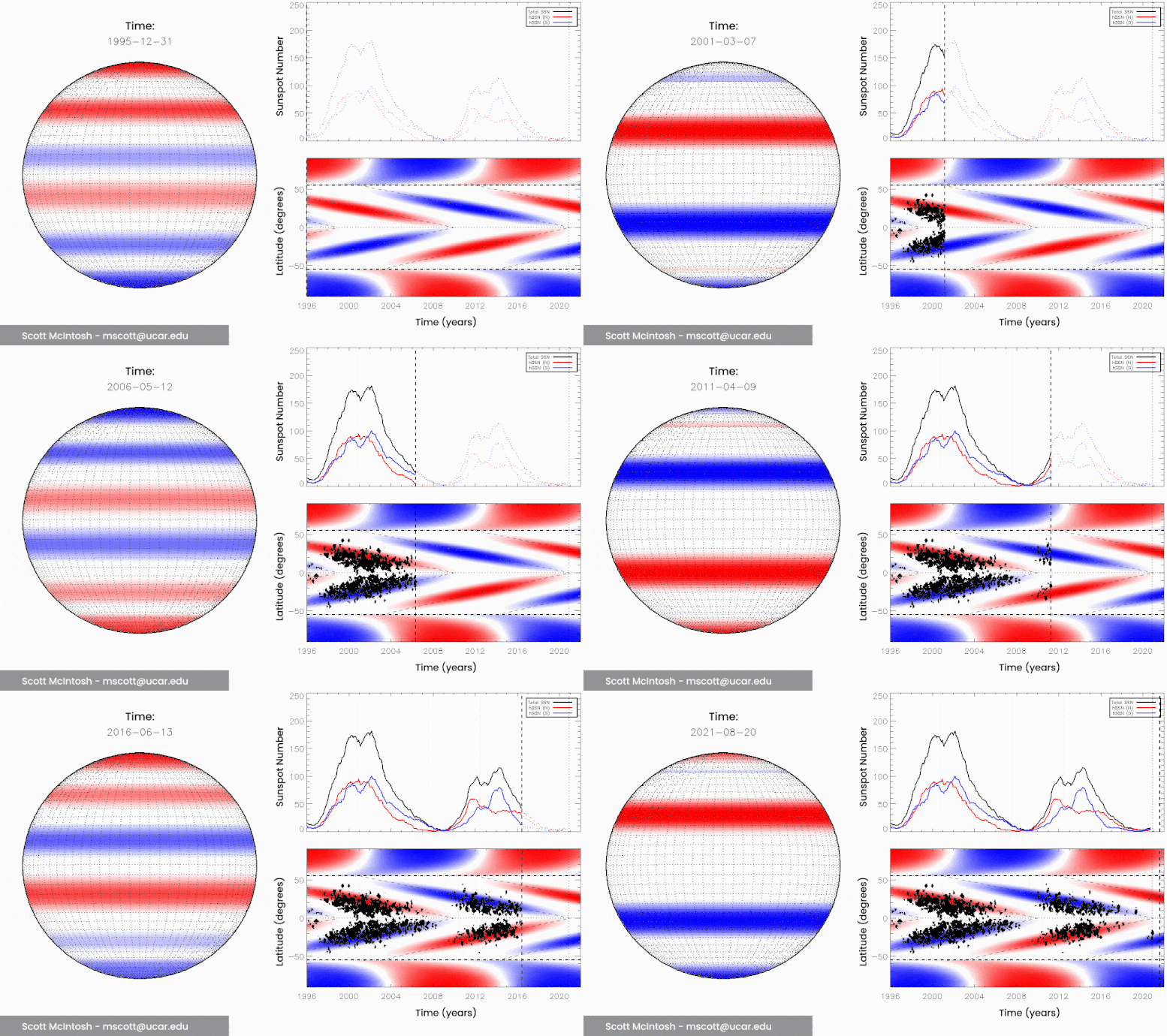
If the new NCAR-led forecast is borne out, it would lend support to the research team’s unorthodox theory – detailed in a series of papers published over the last decade – that the Sun has overlapping 22-year magnetic cycles that interact to produce the well-known, approximately 11-year sunspot cycle as a byproduct. The 22-year cycles repeat like clockwork and could be a key to finally making accurate predictions of the timing and nature of sunspot cycles, as well as many of the effects they produce, according to the study’s authors.
This study uses previous research that devised a ‘solar clock’ for the variation in solar activity led by Professor Sandra Chapman, one of the co-authors from the University of Warwick Department of Physics. She said: “The roughly 11-year solar cycle of activity in fact varies from one cycle to the next. We recently [1] developed a new method to map this irregular cycle into a regular ‘solar clock’, which is useful for monitoring the solar cycle variation in space weather risk. This current study uses the same method to look back in time to get more accurate timings of the cycle lengths. Since shorter cycles are followed by more active ones, this leads to a prediction for the size of the upcoming solar maximum. We learn something important about the physics of the sun whether or not our prediction turns out to be right- one way we might turn out to be wrong would be if the sun started to behave in a new way.“
“Scientists have struggled to predict both the length and the strength of sunspot cycles because we lack a fundamental understanding of the mechanism that drives the cycle,” said NCAR Deputy Director Scott McIntosh, a solar physicist who led the study. “If our forecast proves correct, we will have evidence that our framework for understanding the Sun’s internal magnetic machine is on the right path.”
The new research was supported by the National Science Foundation, which is NCAR’s sponsor, and NASA’s Living With a Star Program.
Sunspot Cycle 25 starts with a bang; what will follow?
In McIntosh’s previous work, he and his colleagues sketched the outline of a 22-year extended solar cycle using observations of coronal bright points, ephemeral flickers of extreme ultraviolet light in the solar atmosphere. These bright points can be seen marching from the Sun’s high latitudes to the equator over about 20 years. As they cross the mid-latitudes, the bright points coincide with the emergence of sunspot activity.
McIntosh believes the bright points mark the travel of magnetic field bands, which wrap around the Sun. When the bands from the northern and southern hemispheres – which have oppositely charged magnetic fields – meet at the equator, they mutually annihilate one another leading to a “terminator” event. These terminators are crucial markers on the Sun’s 22-year clock, McIntosh says, because they flag the end of a magnetic cycle, along with its corresponding sunspot cycle, — and act as a trigger for the following magnetic cycle to begin.
While one set of oppositely charged bands is about halfway through its migration toward the equatorial meetup, a second set appears at high latitudes and begins its own migration. While these bands appear at high latitudes at a relatively consistent rate — every 11 years — they sometimes slow as they cross the mid-latitudes, which appears to weaken the strength of the upcoming solar cycle.
This happens because the slowdown acts to increase the amount of time that the oppositely charged sets of bands overlap and interfere with one another inside the Sun. The slow-down extends the current solar cycle by pushing the terminator event out in time. Shifting the terminator out in time has the effect of eating away at the spot productivity of the next cycle.
“When we look back over the 270-year long observational record of terminator events, we see that the longer the time between terminators, the weaker the next cycle,” said study co-author Bob Leamon, a researcher at the University of Maryland Baltimore County. “And, conversely, the shorter the time between terminators, the stronger the next solar cycle is.”
This correlation has been difficult for scientists to see in the past because they have traditionally measured the length of a sunspot cycle from solar minimum to solar minimum, which is defined using an average rather than a precise event. In the new study, the researchers measured instead to terminators, which allows for much greater precision.
While terminator events occur approximately every 11 years and mark the beginning and end of the sunspot cycle, the time between terminators can vary by years. For example, Sunspot Cycle 4 began with a terminator in 1786 and ended with a terminator in 1801, an unprecedented 15 years later. The following cycle, 5, was incredibly weak with a peak amplitude of just 82 sunspots. That cycle would become known as the beginning of the “Dalton” Grand Minimum.
Similarly, Sunspot Cycle 23 began in 1998 and did not end until 2011, 13 years later. Sunspot Cycle 24, which is just ending, was quite weak as well, but it was also quite short — just shy of 10 years long – and that’s the basis for the new study’s bullish prediction that Sunspot Cycle 25 will be strong.
“Once you identify the terminators in the historical records, the pattern becomes obvious,” said McIntosh. “A weak Sunspot Cycle 25, as the community is predicting, would be a complete departure from everything that the data has shown us up to this point.”
Reference: “Overlapping Magnetic Activity Cycles and the Sunspot Number: Forecasting Sunspot Cycle 25 Amplitude” by Scott W. McIntosh, Sandra Chapman, Robert J. Leamon, Ricky Egeland and Nicholas W. Watkins, 24 November 2020, Solar Physics.
DOI: 10.1007/s11207-020-01723-y
This material is based upon work supported by the National Center for Atmospheric Research, a major facility sponsored by the National Science Foundation and managed by the University Corporation for Atmospheric Research. Any opinions, findings and conclusions or recommendations expressed in this material do not necessarily reflect the views of the National Science Foundation.
Never miss a breakthrough: Join the SciTechDaily newsletter.
Follow us on Google and Google News.
1 Comment
The use of the word “charged” is unusual with respect to magnetic fields. I would suggest substituting “polarized.”