
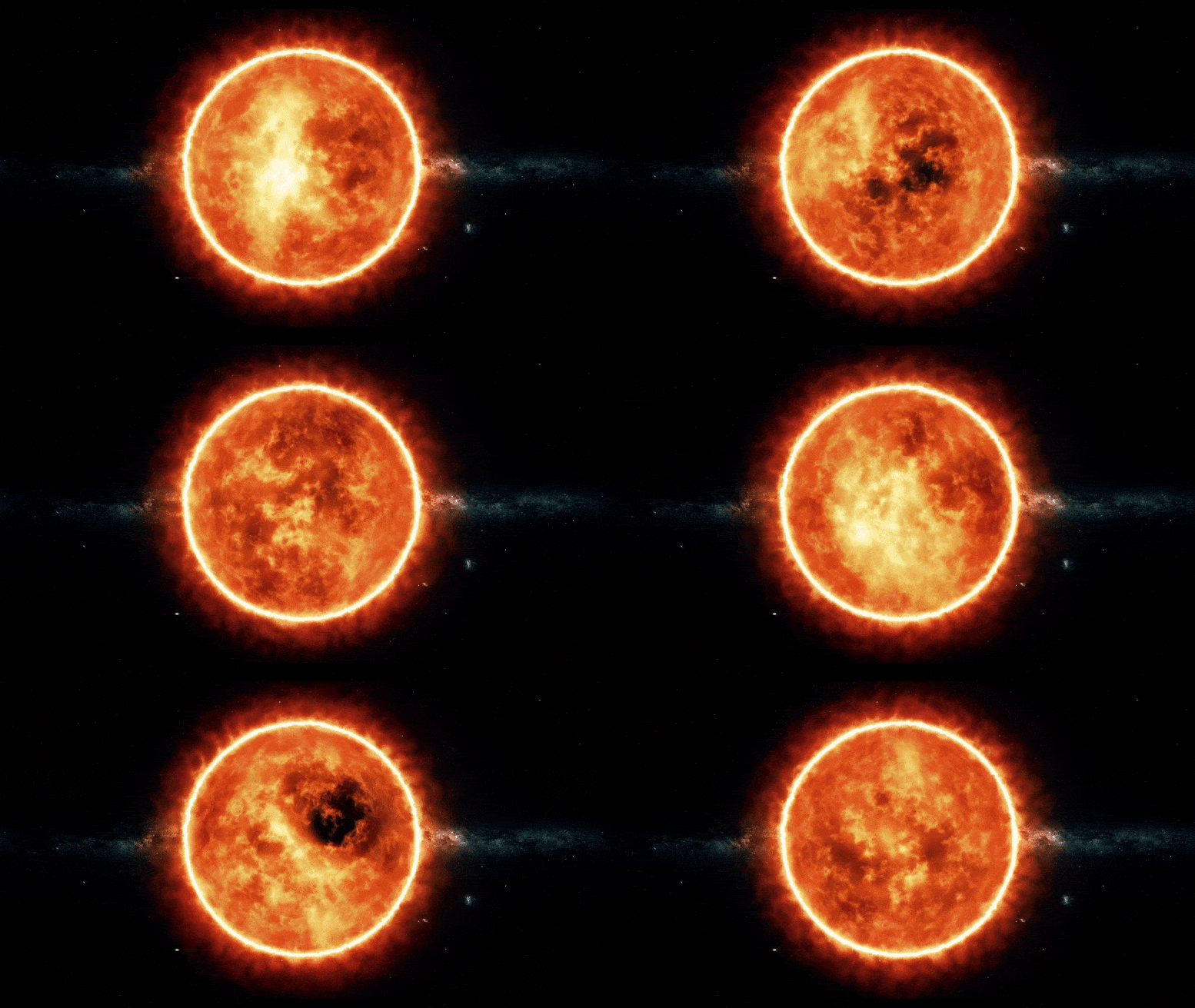
- New solar cycle clock resolves timings of solar activity, revealing the long and the short of the Sun’s seasons.
- Research led by University of Warwick suggests the switching between seasons can be fast.
- The declining phase (or season) between maximum and minimum solar activity varies in duration by a factor of two between one roughly 11-year solar cycle and the next.
- May help us to understand how the sun reverses magnetic polarity- a complete magnetic cycle is roughly 22 years but no two cycles are the same.
- Knowing timings of the solar seasons from the sun clock assists operation of systems affected by space weather such as satellites, communications, and power grids.
Violent activity on our Sun leads to some of the most extreme space weather events on Earth, impacting systems such as satellites, communications systems, power distribution and aviation. The roughly 11 year cycle of solar activity has three ‘seasons’, each of which affects the space weather felt at Earth differently: (i) solar maximum, the sun is active and disordered, when space weather is stormy and events are irregular (ii) the declining phase, when the sun and solar wind becomes ordered, and space weather is more moderate and (iii) solar minimum, when activity is quiet.
In a new study led by the University of Warwick and published in The Astrophysical Journal, scientists found that the change from solar maximum to the declining phase is fast, happening within a few (27 day) solar rotations. They also showed that the declining phase is twice as long in even-numbered solar cycles as it is in odd-numbered cycles.
Mapping the Sun’s Magnetic Rhythm
No two solar cycles are the same in amplitude or duration. To study the solar seasons, the scientists built a sun clock from the daily sunspot number record available since 1818. This maps the irregular solar cycles onto a regular clock. The magnetic polarity of the sun reverses after each roughly 11-year solar cycle giving a roughly 22-year magnetic cycle (named after George Ellery Hale) and to explore this, a 22-year clock was constructed. The effect on space weather on Earth can be tracked back using the longest continuous records of geomagnetic activity over the past 150 years, and once the clock is constructed, it can be used to study multiple observations of seasonal solar activity which affect the Earth.
With the greater detail afforded by the sun clock, the scientists could see that the switch from solar maximum to the declining phase is fast, occurring within a few (27-day) solar rotations. There was also a clear difference in the duration of the declining phase when the sun’s magnetic polarity is ‘up’ compared to ‘down’: in even-numbered cycles, it is around twice as long as odd-numbered cycles. As we are about to enter cycle 25, the scientists anticipate that the next declining phase will be short.
Lead author Professor Sandra Chapman of the University of Warwick Department of Physics said: “By combining well known methods in a new way, our clock resolves changes in the Sun’s climate to within a few solar rotations. Then you find the changes between some phases can be really sharp.
“If you know you’ve had a long cycle, you know the next one’s going to be short, we can estimate how long it’s going to last. Knowing the timing of the climate seasons helps to plan for space weather. Operationally it is useful to know when conditions will be active or quiet, for satellites, power grids, communications.”
The results also provide a clue to understanding how the Sun reverses polarity after every cycle.
Professor Chapman adds: “I also think it is remarkable that something the size of the sun can flip its magnetic field every 11 years, and going down-up is different to going up-down. Somehow the sun ‘knows which way up it is’, and this is an intriguing problem, at the heart of how the sun generates its magnetic field.”
Reference: “The Sun’s Magnetic (Hale) Cycle and 27 Day Recurrences in the aa Geomagnetic Index” by S. C. Chapman, S. W. McIntosh, R. J. Leamon, and N. W. Watkins, 17 August 2021, The Astrophysical Journal.
DOI: 10.3847/1538-4357/ac069e
Never miss a breakthrough: Join the SciTechDaily newsletter.
Follow us on Google and Google News.