
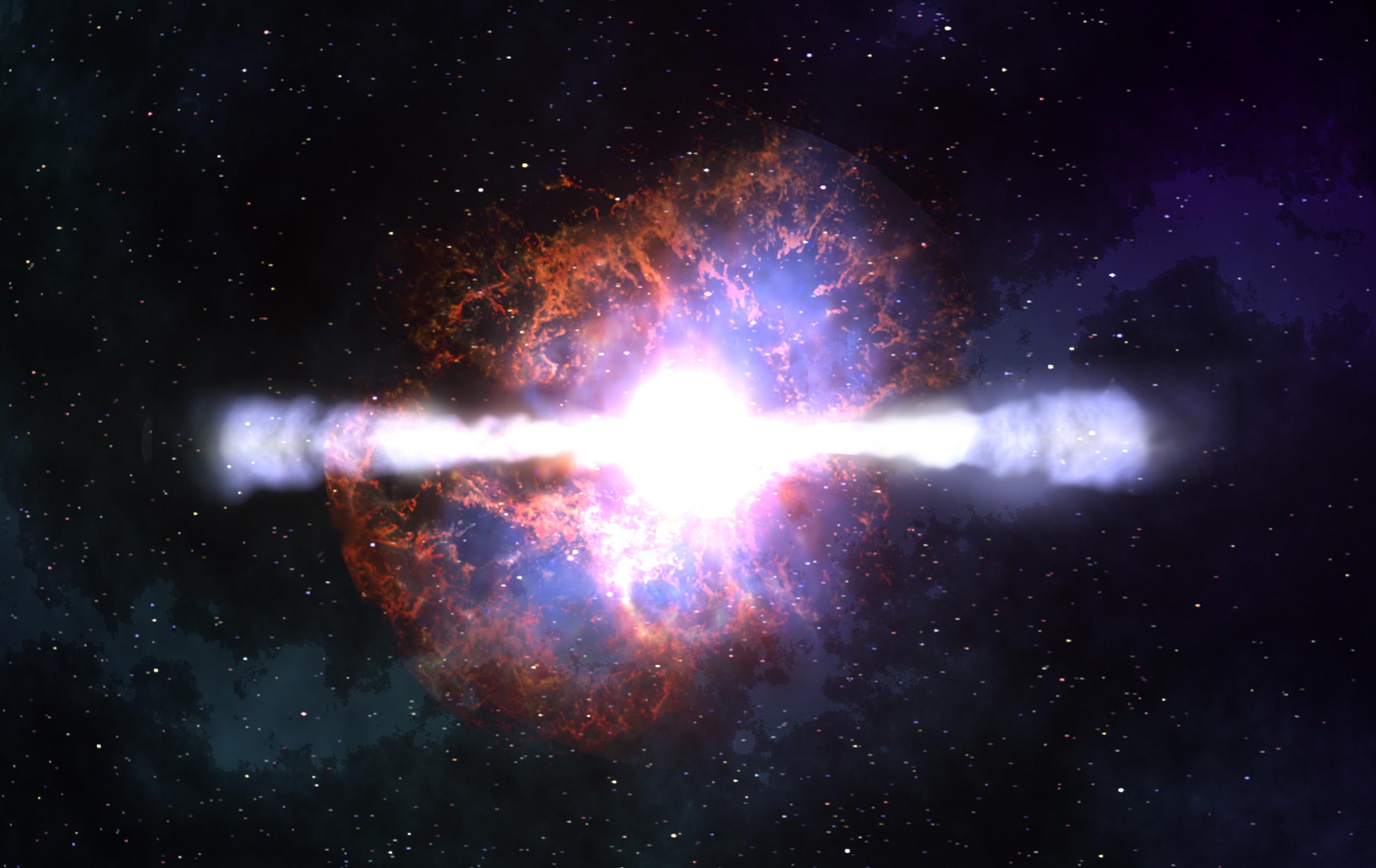
For the first time, scientists have shown that supernova remnants produce most cosmic rays, with a 70/30 split between protons and electrons. The findings confirm that these stellar explosions are key engines powering cosmic radiation.
Around a century ago, scientists began to realize that some of the radiation we detect in Earth’s atmosphere is not local in origin. This eventually gave rise to the discovery of cosmic rays, high-energy protons, and atomic nuclei that have been stripped of their electrons and accelerated to relativistic speeds (close to the speed of light). However, there are still several mysteries surrounding this strange (and potentially lethal) phenomenon.
This includes questions about their origins and how the main component of cosmic rays (protons) are accelerated to such high velocity. Thanks to new research led by Nagoya University, scientists have quantified the amount of cosmic rays produced in a supernova remnant for the first time. This research has helped resolve a 100-year mystery and is a major step towards determining precisely where cosmic rays come from.
While scientists theorize that cosmic rays originate from many sources – our Sun, supernovae, gamma-ray bursts (GRBs), and Active Galactic Nuclei (aka. quasars) – their exact origin has been a mystery since they were first discovered in 1912. Similarly, astronomers have theorized that supernova remnants (the after-effects of supernova explosions) are responsible for accelerating them to nearly the speed of light.
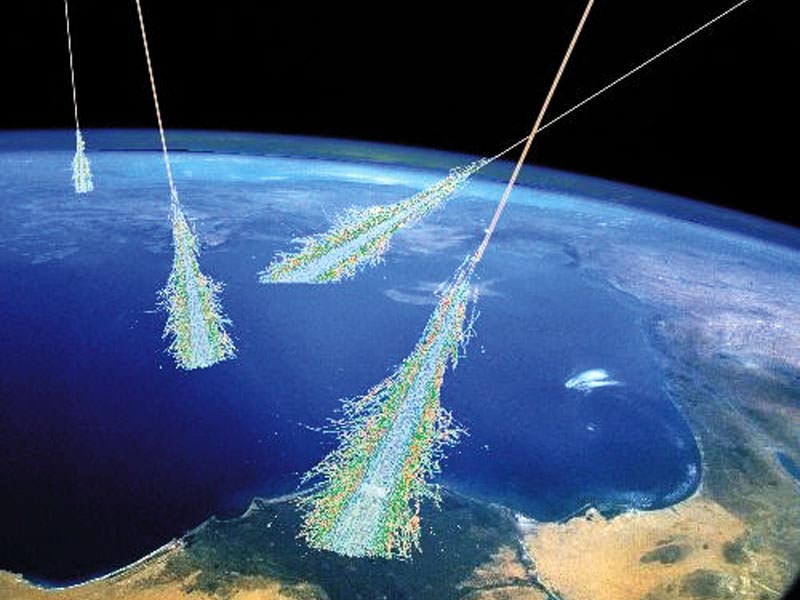
Cosmic Rays and the Evolution of Galaxies
As they travel through our galaxy, cosmic rays play a role in the chemical evolution of the interstellar medium (ISM). As such, understanding their origin is critical to understanding how galaxies evolve. In recent years, improved observations have led some scientists to speculate that supernova remnants give rise to cosmic rays because the protons they accelerate interact with protons in the ISM to create very high-energy (VHE) gamma rays.
However, gamma-rays are also produced by electrons that interact with photons in the ISM, which can be in the form of infrared photons or radiation from the Cosmic Microwave Background (CMB). Therefore, determining which source is greater is paramount to determining the origin of cosmic rays. Hoping to shed light on this, the research team – which included members from Nagoya University, the National Astronomical Observatory of Japan (NAOJ), and the University of Adelaide, Australia – observed the supernova remnant RX J1713.7-3946 (RX J1713).

The key to their research was the novel approach they developed to quantify the source of gamma-rays in interstellar space. Past observations have shown that the intensity of VHE gamma-rays caused by protons colliding with other protons in the ISM is proportional to the interstellar gas density, which is discernible using radio-line imaging. On the other hand, gamma-rays caused by the interaction of electrons with photons in the ISM are also expected to be proportional to the intensity of nonthermal X-rays from electrons.
For the sake of their study, the team relied on data obtained by the High Energy Stereoscopic System (HESS), a VHE gamma-ray observatory located in Namibia (and operated by the Max Planck Institute for Nuclear Physics). They then combined this with X-ray data obtained by the ESA’s X-ray Multi-Mirror Mission (XMM-Newton) observatory and data on the distribution of gas in the interstellar medium.
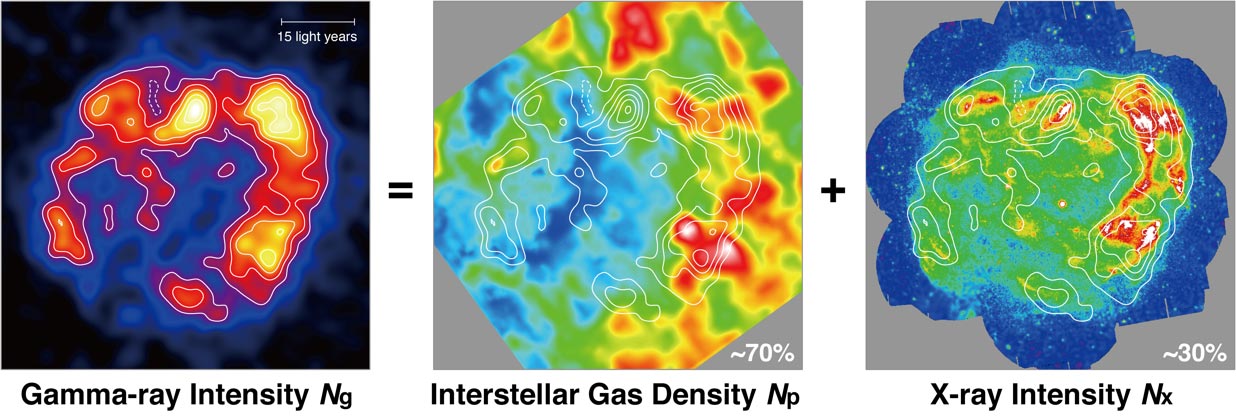
They then combined all three data sets and determined that protons account for 67 ± 8% of cosmic rays while cosmic-ray electrons account for 33 ± 8% – roughly a 70/30 split. These findings are groundbreaking since they are the first time that the possible origins of cosmic rays have been quantified. They also constitute the most definitive evidence to date that supernova remnants are the source of cosmic rays.
Gas-Rich vs. Gas-Poor Regions
These results also demonstrate that gamma-rays from protons are more common in gas-rich interstellar regions, whereas those caused by electrons are enhanced in the gas-poor regions. This supports what many researchers have predicted, which is that the two mechanisms work together to influence the evolution of the ISM. Said Emeritus Professor Yasuo Fukui, who was the study’s lead author:
“This novel method could not have been accomplished without international collaborations. [It] will be applied to more supernova remnants using the next-generation gamma-ray telescope CTA (Cherenkov Telescope Array) in addition to the existing observatories, which will greatly advance the study of the origin of cosmic rays.”
In addition to leading this project, Fukui has been working to quantify interstellar gas distribution since 2003 using the NANTEN radio telescope at the Las Campanas Observatory in Chile and the Australia Telescope Compact Array. Thanks to Professor Gavin Rowell and Dr. Sabrina Einecke of the University of Adelaide (co-authors on the study) and the H.E.S.S. team, the spatial resolution and sensitivity of gamma-ray observatories has finally reached the point where it is possible to draw comparisons between the two.
Meanwhile, co-author Dr. Hidetoshi Sano of the NAOJ led the analysis of archival datasets from the XMM-Newton observatory. In this respect, this study also shows how international collaborations and data-sharing are enabling all kinds of cutting-edge research. Along with improved instruments, improved methods and greater opportunities for cooperation are leading to an age where astronomical breakthroughs are becoming a regular occurrence!
Adapted from an article originally published on Universe Today.
For more on this discovery, see Unveiling a 100-Year-Old Astrophysics Mystery: Where the Milky Way’s Cosmic Rays Come From.
Reference: “Pursuing the Origin of the Gamma Rays in RX J1713.7-3946 Quantifying the Hadronic and Leptonic Components” by Yasuo Fukui, Hidetoshi Sano, Yumiko Yamane, Takahiro Hayakawa, Tsuyoshi Inoue, Kengo Tachihara, Gavin Rowell and Sabrina Einecke, 9 July 2021, The Astrophysical Journal.
DOI: 10.3847/1538-4357/abff4a
Never miss a breakthrough: Join the SciTechDaily newsletter.
Follow us on Google and Google News.
1 Comment
CMB is composed of waves from two types origin.First type is originated from the proton- proton collision contributes 66.66%,while second type originated from collision of electron with photon has 33.33% contribution to the total amount calculated at the primery step.Next this composition come to an average of 70% and 30% respectively, for first and second types of origin as described before.