
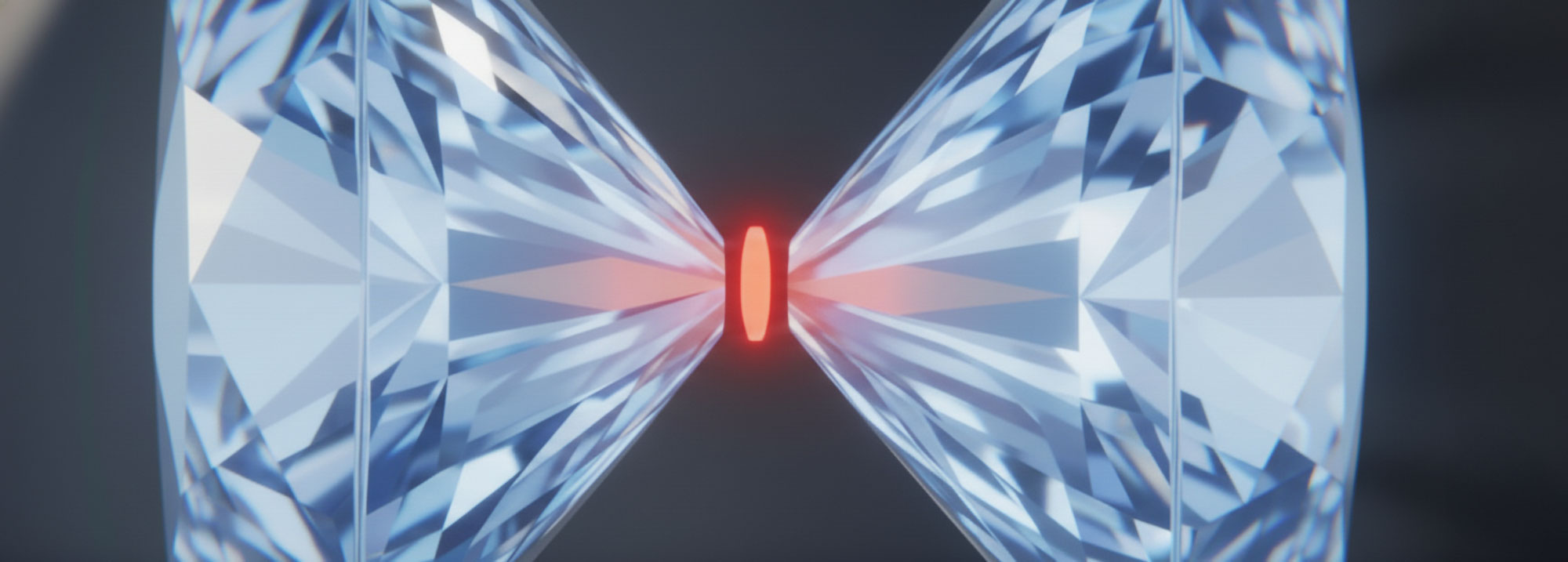
Boron nitride sensors enable quantum measurements under crushing pressure, redefining high-pressure physics.
The quantum world is already full of mysteries, but what happens when this strange domain of subatomic particles is subjected to immense pressure? Studying quantum behavior in such conditions has long been a challenge for one simple reason: it is extremely difficult to design sensors that can endure such intense forces.
In a major step forward, a team of physicists at Washington University in St. Louis (WashU) has developed quantum sensors made from an ultra-strong sheet of crystallized boron nitride. These sensors are capable of detecting stress and magnetic fields in materials exposed to pressures more than 30,000 times greater than Earth’s atmosphere.
“We’re the first ones to develop this sort of high-pressure sensor,” said Chong Zu, assistant professor of physics in Arts & Sciences and a member of WashU’s Center for Quantum Leaps. “It could have a wide range of applications in fields ranging from quantum technology, material science, to astronomy and geology.”
The team reported their results in Nature Communications. The paper’s co-authors include graduate students from Zu’s lab—Guanghui He, Ruotian “Reginald” Gong, Zhongyuan Liu, and Changyu Yao; graduate student Zack Rehfuss; postdoctoral researcher Mingfeng Chen; and Xi Wang and Sheng Ran, both assistant professors of physics.
How the new quantum sensors were made
To construct the sensors, the researchers used neutron radiation beams to remove boron atoms from thin sheets of boron nitride. These atomic vacancies instantly capture electrons, whose spin energies respond sensitively to local changes in magnetic fields, stress, temperature, and other physical conditions. By monitoring the spin behavior of these electrons, scientists can extract detailed, quantum-level information about the materials under investigation.
Zu and colleagues previously had created quantum sensors by making vacancies in diamonds, which power WashU’s two quantum diamond microscopes. While effective, diamond sensors have a drawback: Because diamonds are three-dimensional, it’s hard to place the sensors close to the material being studied.
In contrast, sheets of boron nitride can be less than 100 nanometers thick — about 1,000 times thinner than a human hair. “Because the sensors are in a material that’s essentially two-dimensional, there’s less than a nanometer (a billionth of a meter) between the sensor and the material that it’s measuring,” Zu said.
Diamonds still play an important role. “To measure materials under high pressure, we need to put the material on a platform that won’t break,” He explained.
Diamonds, the hardest substance in nature, serve this purpose. He and other members of the Zu lab created “diamond anvils” — two flat diamond surfaces, each about 400 micrometers wide, roughly the width of four dust particles — that squeeze together in a high-pressure chamber. “The easiest way to create high pressure is to apply great force over a small surface,” He explained.
Testing materials and future applications
Tests showed that the new sensors could detect subtle shifts in the magnetic field of a two-dimensional magnet. Next, the researchers plan to test other materials, including specimens of rocks like those found in the high-pressure environment of the Earth’s core. “Measuring how these rocks respond to pressure could help us better understand earthquakes and other large-scale events,” Zu said.
The sensors also could advance research on superconductivity, the ability to conduct electricity without resistance. Currently, known superconductors require extremely high pressure and low temperatures. Previous claims that some materials can act as superconductors at room temperature have proven to be highly controversial. “With this sort of sensor, we can collect the necessary data to end the debate,” said Gong, who, along with He, was co-first author of the paper.
The new sensors underscore the value of the NSF NRT training grant, Zu said. “The program encourages collaboration between universities,” he said. “Now that we have these sensors, the high-pressure chamber and the diamond anvils, we’ll have more opportunities for exploration.”
Reference: “Probing stress and magnetism at high pressures with two-dimensional quantum sensors” by Guanghui He, Ruotian Gong, Zhipan Wang, Zhongyuan Liu, Jeonghoon Hong, Tongxie Zhang, Ariana L. Riofrio, Zackary Rehfuss, Mingfeng Chen, Changyu Yao, Thomas Poirier, Bingtian Ye, Xi Wang, Sheng Ran, James H. Edgar, Shixiong Zhang, Norman Y. Yao and Chong Zu, 32 August 2025, Nature Communications.
DOI: 10.1038/s41467-025-63535-7
The research received support from a National Science Foundation Research Traineeship (NRT) grant, which also enabled He to conduct six months of collaborative work at Harvard University with physicist Norman Yao, who contributed as a co-author.
Never miss a breakthrough: Join the SciTechDaily newsletter.
Follow us on Google and Google News.
9 Comments
The quantum world is already full of mysteries, studying quantum behavior in such conditions has long been a challenge for one simple reason: it is extremely difficult to design sensors that can endure such intense forces.
WHY?
Please ask researchers to think deeply:
What is the quantum?
Quantum mechanics is algebra. Quantum is a product of physics’s wild imagination for mathematics. The real physical world is the emergence of geometric topological shape interactions and self-organization. Topological spin is the most fundamental motion and structure in the universe, creating everything and shaping the world. The so-called quantum is just one manifestation of topological spin. Correct and scientific theories will enable researchers to think rationally.
The branch of mathematics known as topology has become a cornerstone of modern physics. The perpetually swirling topological vortices defy traditional physics’ expectations.
The development of the Topological Vortex Theory (TVT) reflects a progression from concrete physical phenomena to abstract mathematical modeling and, ultimately, to interdisciplinary unification.
——Excerpted from https://t.pineal.cn/blogs/4569/An-Overview-of-the-Development-of-Topological-Vortex-Theory-TVT.
When we pursue the ultimate truth of all things, the space in which our bodies and all things exist may itself be the final and deepest puzzle we need to explore. This is not only the pursuit of physics, but also the most magnificent exploration of the origin of the universe by human reason.
Based on the Topological Vortex Theory (TVT), space is an uniformly incompressible physical entity. Space-time vortices are the products of topological phase transitions of the tipping points in space, are the point defects in spacetime. Point defects do not only impact the thermodynamic properties, but are also central to kinetic processes. They create all things and shape the world through spin and self-organization.
In today’s physics, some so-called peer-reviewed journals—including Physical Review Letters, Nature, Science, and others—stubbornly insist on and promote the following:
1. Even though θ and τ particles exhibit differences in experiments, physics can claim they are the same particle. This is science.
2. Even though topological vortices and antivortices have identical structures and opposite rotational directions, physics can define their structures and directions as entirely different. This is science.
3. Even though two sets of cobalt-60 rotate in opposite directions and experiments reveal asymmetry, physics can still define them as mirror images of each other. This is science.
4. Even though vortex structures are ubiquitous—from cosmic accretion disks to particle spins—physics must insist that vortex structures do not exist and require verification. Only the particles that like God, Demonic, or Angelic are the most fundamental structures of the universe. This is science.
5. Even though everything occupies space and maintains its existence in time, physics must still debate and insist on whether space exists and whether time is a figment of the human mind. This is science.
6. Even though space, with its non-stick, incompressible, and isotropic characteristics, provides a solid foundation for the development of physics, physics must still insist that the ideal fluid properties of space do not exist. This is science.
and go on.
Is this the counterintuitive science they widely promote? What are the shames? Contemporary physics and so-called peer-reviewed publications (including Physical Review Letters, Science, Nature, etc.) stubbornly believe that two sets of counter rotating cobalt-60 are two mirror images of each other, constructing a more shocking pseudoscientific theoretical framework in the history of science than the “geocentric model”. This pseudo scientific framework and system have seriously hindered scientific progress and social development.
For nearly a century, physics has been manipulated by this pseudo scientific theoretical system and the interest groups behind it, wasting a lot of manpower, funds, and time. A large amount of pseudo scientific research has been conducted, and countless pseudo scientific papers have been published, causing serious negative impacts on scientific and social progress, as well as humanistic development.
Despite the significant challenges, the value of Topological Vortex Theory (TVT) lies in its heuristic and forward-looking nature. Observing any sustained electrical signal generated by this triadic coupling that surpasses the noise level in experiments would be a milestone.
Potential application prospects include:
1)Novel Micro-Energy Devices: Providing long-life, maintenance-free “ambient energy harvesters” for Micro-Electro-Mechanical Systems (MEMS) and implantable medical devices.
2)Brain-Inspired Computing and In-Memory Logic: Utilizing the rich dynamic states of topological vortices to simulate neuron and synapse behavior, enabling non-von Neumann computing with low energy consumption.
3)Fundamental Physics Experimental Platform: Providing an ideal model system for studying non-equilibrium statistical physics, topological order, and energy transport.
Topological Vortex Theory (TVT) proposes a heuristic concept for constructing a “perpetual electric body” based on topological vortex theory, integrating permanent magnets and radioactive elements. We have argued its theoretical possibility, outlined a path for realization, and deeply analyzed the scientific challenges it faces. This concept does not claim to break the laws of thermodynamics but seeks to explore the possibility of using a continuous external energy source (radioactive decay) to maintain a topologically protected, dynamic non-equilibrium state in an open system. It calls for collaboration among materials scientists, physicists, and chemists to open a new research direction at the intersection of topological materials, nuclear physics, and energy science. Ultimately, the value of the pursuit of the “perpetual electric body” may lie not in reaching the destination, but in the deeper understanding of matter and more innovative technologies that this journey itself will catalyze.
——Excerpted from https://t.pineal.cn/blogs/5137/A-Concept-for-Perpetual-Electric-Body-Based-on-Topological-Vortex
In the history of physics, Newton’s absolute space and Einstein’s relative spacetime are often seen as two mutually exclusive models of the universe. Topological Vortex Theory (TVT) argue that Newton’s absolute space is the physical background of the universe, characterized by non-viscosity, uniformly incompressibility, and isotropy, providing the ultimate stage for all physical phenomena. Einstein’s relative spacetime, in contrast, can be understood as a dynamic structure arising from topological excitations at critical energy points within this absolute background. The two are not in a “life-and-death” substitutive relationship but rather a symbiotic relationship of “background” and “excited state,” “stage” and “actor.” Denying the foundational status of absolute space is not only physically one-sided but also philosophically a form of historical nihilism, hindering the progress of physics towards a unified theory.
——Excerpted from https://t.pineal.cn/blogs/4913/On-the-Dialectical-Unity-of-Absolute-Space-and-Relative-Space.
In the history of physics, Newton’s absolute space and Einstein’s relative spacetime are often seen as two mutually exclusive models of the universe. Topological Vortex Theory (TVT) argue that Newton’s absolute space is the physical background of the universe, characterized by non-viscosity, uniformly incompressibility, and isotropy, providing the ultimate stage for all physical phenomena. Einstein’s relative spacetime, in contrast, can be understood as a dynamic structure arising from topological excitations at critical energy points within this absolute background. The two are not in a “life-and-death” substitutive relationship but rather a symbiotic relationship of “background” and “excited state,” “stage” and “actor.” Denying the foundational status of absolute space is not only physically one-sided but also philosophically a form of historical nihilism, hindering the progress of physics towards a unified theory.
——Excerpted from https://t.pineal.cn/blogs/4913/On-the-Dialectical-Unity-of-Absolute-Space-and-Relative-Space.
This is exciting work by a great team. Since one of the benefits of the boron nitride sensor is it’s two-dimensional nature and the statement that it can be placed very close to what is being measured, I’m wondering when you embed it in diamond, how thick is the diamond between the boron nitride and the material being sensed?
The atomic vacancies instantly capture electrons, whose spin energies respond sensitively to local changes in magnetic fields, stress, temperature, and other physical conditions. By monitoring the spin behavior of these electrons, scientists can extract detailed, quantum-level information about the materials under investigation. The correlation between quantum and spin is sometimes independent of thickness. Please ask researchers to consider where the driving force of quantum spin comes from?