

By forcing crystal structures to compete, scientists uncovered a new way to make magnetism twist.
Florida State University scientists have developed a new crystalline material whose magnetic behavior differs sharply from that of conventional magnets, opening potential paths toward advances in data storage and quantum technology.
Reporting their results in the Journal of the American Chemical Society, the team demonstrated that combining two chemically similar materials with distinct crystal structures can produce an entirely new structure. This newly formed material displays magnetic properties unlike those seen in either of the original compounds.
Magnetism arises because atoms behave like tiny magnets, a result of a property called atomic spin. Each spin can be pictured as a small arrow that marks the direction of an atom’s magnetic field. In ordinary magnetic materials, large numbers of these spins line up in an orderly way, either pointing in the same direction or in opposing patterns. This collective alignment gives rise to the familiar magnetism used in devices such as computers and smartphones.
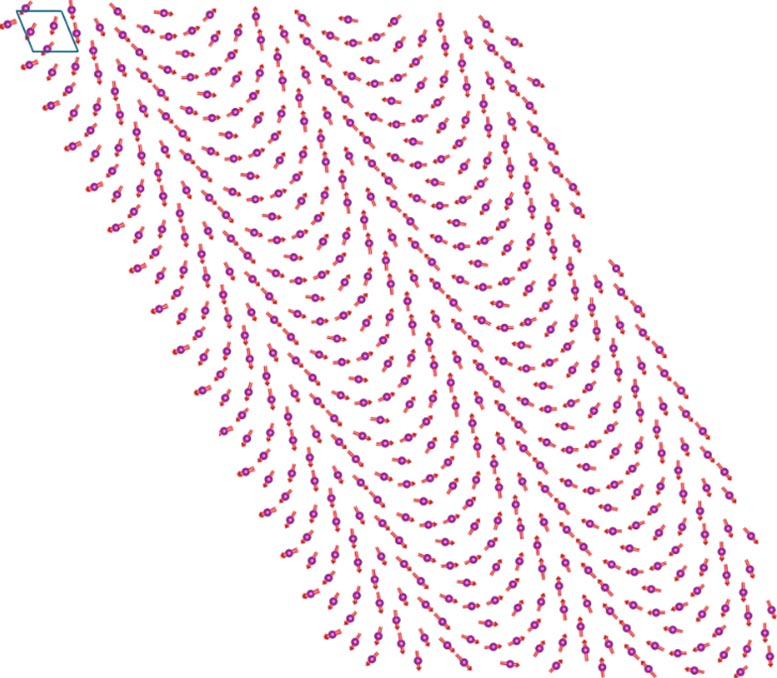
The Florida State researchers found that their method leads to far more intricate spin arrangements. Rather than lining up uniformly, the atomic spins organize into repeating swirling patterns. These structures, known as spin textures, strongly influence how the material behaves magnetically and set it apart from traditional magnets.
How it works
To create the material, the team blended two compounds that are close in chemical makeup but differ in the symmetry of their crystal structures. When these mismatched structures meet, they generate what scientists call “frustration,” meaning that neither structure is fully stable at the boundary between the two compositions. This instability plays a key role in producing the unusual magnetic patterns observed in the new crystal.
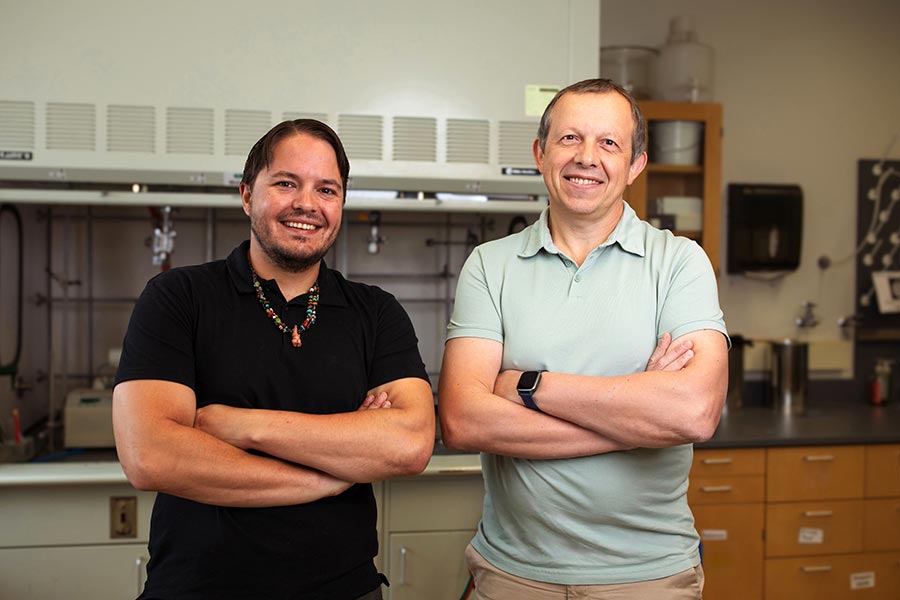
“We thought that maybe this structural frustration would translate into magnetic frustration,’” said co-author Michael Shatruk, a professor in the FSU Department of Chemistry and Biochemistry. “If the structures are in competition, maybe that will cause the spins to twist. Let’s find some structures that are chemically very close but have different symmetries.”
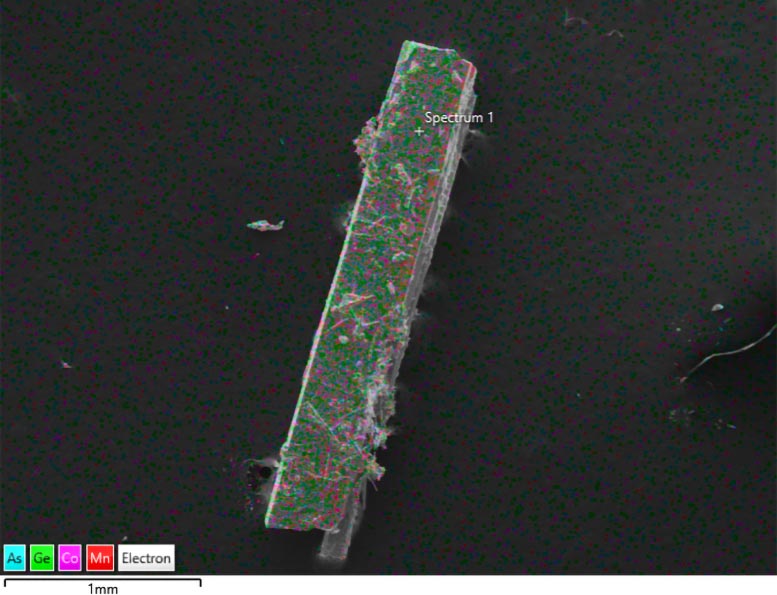
They combined a compound of manganese, cobalt and germanium with a compound of manganese, cobalt, and arsenic. Germanium and arsenic are neighbors in the periodic table.
After the mixture solidified into crystals, the research team examined the product and found the distinctive cycloidal spin textures that they were seeking. Such swirls of spins are known as skyrmion-like spin textures, and the search for more ways to find and manipulate skyrmion-hosting materials is a cutting-edge research area within chemistry and physics.
To determine this skyrmion-like magnetic structure, the team collected single-crystal neutron diffraction data on the TOPAZ instrument at the Spallation Neutron Source, a U.S. Department of Energy Office of Science user facility at Oak Ridge National Laboratory.
Why it matters
This research could be used to develop hard drives with greater information density or improve electron-transport efficiency. Because using magnets to move skyrmions takes little energy, incorporating materials with these magnetic patterns into electronic devices could reduce power consumption. In massive supercomputers with thousands of processors, these lower power loads can lead to huge savings in electrical and cooling costs.
The research could also help point scientists and engineers toward promising materials that can help develop fault-tolerant quantum computing, which can protect fragile quantum information and operate reliably despite errors and noise — the holy grail of quantum information processing.
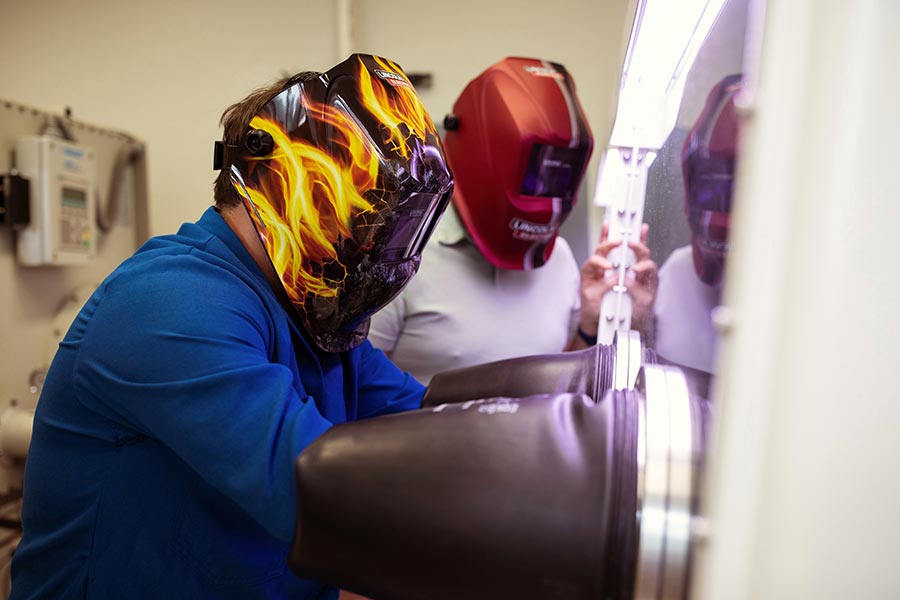
“With single-crystal neutron diffraction data from TOPAZ and new data-reduction and machine-learning tools from our LDRD project, we can now solve very complex magnetic structures with much greater confidence,” said Xiaoping Wang, a distinguished neutron scattering scientist at Oak Ridge National Laboratory. “That capability lets us move from simply finding unusual spin textures to intentionally designing and optimizing them for future information and quantum technologies.”
‘Chemical Thinking’ and materials by design
Previous research into skyrmions and related complex spin textures has been more like a hunt: considering different materials where these magnetic shapes were likely to be present and measuring their properties to confirm.
This study took a different approach. By creating a new material and leveraging the innovative idea of structural frustration, the researchers sought to better understand the principles that lead to the development of new magnetic patterns.
“It’s chemical thinking, because we’re thinking about how the balance between these structures affects them and the relation between them, and then how it might translate to the relation between atomic spins,” Shatruk said.
That understanding of the fundamental science at work could point to promising directions for future research.
“The idea is to be able to predict where these complex spin textures will appear,” said co-author Ian Campbell, a graduate student in Shatruk’s lab. “Traditionally, physicists will hunt for known materials that already exhibit the symmetry they’re seeking and measure their properties. But that limits the range of possibilities. We’re trying to develop a predictive ability to say, ‘If we add these two things together, we’ll form a completely new material with these desired properties.’”
A benefit of that approach is the ability to expand the ingredient list for making materials that contain skyrmion-like spin textures, allowing for cheaper, easier-to-grow crystals and a more robust supply chain for future technologies that might benefit from such materials.
Reference: “Skyrmion-like Spin Textures Emerging in the Material Derived from Structural Frustration” by YiXu Wang, Ian Campbell, Zachary P. Tener, Judith K. Clark, Jacnel Graterol, Andrei Rogalev, Fabrice Wilhelm, Hu Zhang, Yi Long, Richard Dronskowski, Xiaoping Wang and Michael Shatruk, 12 November 2025, Journal of the American Chemical Society.
DOI: 10.1021/jacs.5c12764
This research was supported by the National Science Foundation. The study used facilities at Florida State University and Oak Ridge National Laboratory.
Never miss a breakthrough: Join the SciTechDaily newsletter.
Follow us on Google and Google News.
3 Comments
Magnetism arises because atoms behave like tiny magnets, a result of a property called atomic spin. Each spin can be pictured as a small arrow that marks the direction of an atom’s magnetic field.
VERY GOOD.
Please ask the researchers to think deeply:
1. Why do atoms spin?
2. If the background space does not exhibit ideal fluid characteristics, do physical laws still have universality?
Topological Vortex Theory (TVT), through geometric-topological hybrid freedoms and fractal dynamics, revolutionizes our understanding of superposition diversity, interaction complexity, and information capacity in topological materials. The “colorful” nature of topological materials lies not only in their physical richness but also in their role as bridges between quantum and classical worlds—positioning them as key candidates for unifying relativity and quantum mechanics.
—— Excerpted from https://zhuanlan.zhihu.com/p/1900140514277320438.
When we pursue the ultimate truth of all things, the space in which our bodies and all things exist may itself be the final and deepest puzzle we need to explore. This is not only the pursuit of physics, but also the most magnificent exploration of the origin of the universe by human reason.
Based on the Topological Vortex Theory (TVT), space is an uniformly incompressible physical entity. Space-time vortices are the products of topological phase transitions of the tipping points in space, are the point defects in spacetime. Point defects do not only impact the thermodynamic properties, but are also central to kinetic processes. They create all things and shape the world through spin and self-organization.
In today’s physics, some so-called peer-reviewed journals—including Physical Review Letters, Nature, Science, and others—stubbornly insist on and promote the following:
1. Even though θ and τ particles exhibit differences in experiments, physics can claim they are the same particle. This is science.
2. Even though topological vortices and antivortices have identical structures and opposite rotational directions, physics can define their structures and directions as entirely different. This is science.
3. Even though two sets of cobalt-60 rotate in opposite directions and experiments reveal asymmetry, physics can still define them as mirror images of each other. This is science.
4. Even though vortex structures are ubiquitous—from cosmic accretion disks to particle spins—physics must insist that vortex structures do not exist and require verification. Only the particles that like God, Demonic, or Angelic are the most fundamental structures of the universe. This is science.
5. Even though everything occupies space and maintains its existence in time, physics must still debate and insist on whether space exists and whether time is a figment of the human mind. This is science.
6. Even though space, with its non-stick, incompressible, and isotropic characteristics, provides a solid foundation for the development of physics, physics must still insist that the ideal fluid properties of space do not exist. This is science.
and go on.
Is this the counterintuitive science they widely promote? Compromising with pseudo academic publications and peer review by pseudo scholars is an insult to science and public intelligence. Some so-called scholars no longer understand what shame is. The study of Topological Vortex Theory (TVT) reminds us that the most profound problems in physics often lie at the intersection of different theories. By exploring these border regions, we can not only resolve contradictions in existing theories but also discover new physical phenomena and application possibilities.
Under the topological vortex architecture, it is highly challenging for even two hydrogen atoms or two quarks to be perfectly symmetrical, let alone counter-rotating two sets of cobalt-60. Contemporary physics and so-called peer-reviewed publications (including Physical Review Letters, Science, Nature, etc.) stubbornly believe that two sets of counter rotating cobalt-60 are two mirror images of each other, constructing a more shocking pseudoscientific theoretical framework in the history of science than the “geocentric model”. This pseudo scientific framework and system have seriously hindered scientific progress and social development.
For nearly a century, physics has been manipulated by this pseudo scientific theoretical system and the interest groups behind it, wasting a lot of manpower, funds, and time. A large amount of pseudo scientific research has been conducted, and countless pseudo scientific papers have been published, causing serious negative impacts on scientific and social progress, as well as humanistic development.
Complexity does not necessarily mean that there is no logical and architectural framework to follow. Mathematics is the language and tool that reveals the motion of spacetime, rather than the motion itself. Although the physical form of spacetime vortices is extremely simple, their interaction patterns are highly complex, and we must develop more and richer mathematical languages to describe and understand them.
The development of the Topological Vortex Theory (TVT) reflects a progression from concrete physical phenomena to abstract mathematical modeling and, ultimately, to interdisciplinary unification. Its core innovation lies in forging the continuous spacetime geometry of general relativity with the discrete interactions of quantum field theory within the same topological dynamical system. The core idea of TVT — space is physical, and matter is its topological excitation—already provides a solid and elegant scientific path for understanding the origin of all things.
——Excerpted from https://scitechdaily.com/microscope-spacecrafts-most-precise-test-of-key-component-of-the-theory-of-general-relativity/#comment-909171 and https://t.pineal.cn/blogs/6255/A-Mathematical-and-Physical-Analysis-On-the-Origin-of-Objects.