

The study identifies a new class of layered antiferromagnets with spin-valley locking, offering efficient spin control without relying on spin–orbit coupling.
Altermagnets are a newly recognized class of materials that show momentum-dependent spin splitting without requiring spin-orbit coupling (SOC) or net magnetization. These materials have recently garnered international attention.
A research team led by Prof. Junwei Liu from the Department of Physics at the Hong Kong University of Science and Technology (HKUST), together with experimental collaborators, published groundbreaking findings in Nature Physics. Their work reports the first experimental observation of a two-dimensional layered altermagnet that remains stable at room temperature, confirming theoretical predictions made by Prof. Liu in Nature Communications in 2021.
The ability to generate and control spin-polarized electronic states is essential for advancing spintronics, which uses spin to encode and process information. Traditionally, spin polarization arises from coupling an electron’s spin with other properties, such as orbital motion or magnetic fields. This coupling can occur through SOC, which causes momentum-dependent spin splitting in crystals lacking inversion symmetry (as seen in the Rashba–Dresselhaus effect), or through time-reversal symmetry breaking in ferromagnets, leading to momentum-independent Zeeman-type splitting.
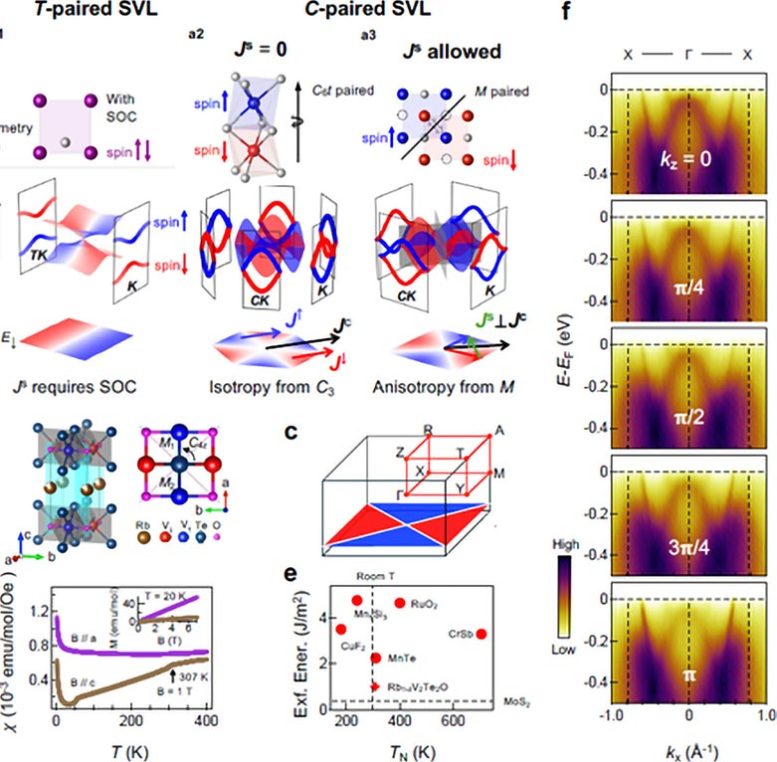
Prof. Liu and colleagues proposed a different mechanism in antiferromagnets. In this model, certain crystal symmetries allow sublattices to interact through exchange coupling, producing substantial spin splitting. This interaction gives rise to a unique phenomenon called C-paired spin-valley locking.
Remarkably, this mechanism does not rely on SOC or magnetization. It offers the stability of antiferromagnetic systems along with extended spin lifetimes. These unconventional materials have been named “altermagnets.” Their discovery was recognized as one of Science magazine’s top 10 breakthroughs of 2024.

Limitations of previous materials for spin current design
Despite extensive theoretical and experimental efforts to explore unconventional antiferromagnets based on emerging materials like α-MnTe, CrSb, MnTe2, and RuO2, none meet the symmetry and conductivity requirements for nonrelativistic spin-conserved spin currents due to altermagnetism. The magnetic sublattices of α-MnTe and CrSb possess C₃ symmetry, leading to isotropic conductance and nonpolarized currents.
In MnTe2, spin is not conserved due to its noncoplanar magnetic structure, and its low critical temperature (87 K) limits practical applications. For RuO2, it remains controversial whether its ground state is antiferromagnetic or nonmagnetic, despite evidence of the anomalous Hall effect and spin splitting.

Additionally, these materials are not layered, restricting their potential for exfoliation and integration with other materials to control properties at the microscopic level. This limitation hinders the exploration of effects in 2D materials, such as topological superconductors via the superconducting proximity effect, tunable electronic properties through gating, and moiré superlattices.
Therefore, exploring layered materials in altermagnets is essential for developing high-density, high-speed, and low-energy-consumption spintronic devices. Prof. Liu’s observation of a two-dimensional layered room-temperature altermagnet, sheds new light on this area.
First room-temperature layered altermagnet discovered
Based on theoretical predictions by Prof. Liu’s team for V₂Te₂O and V₂Se₂O in 2021, this work demonstrates the realization of C-paired spin-valley locking (SVL) in a layered, room-temperature antiferromagnet (AFM) compound Rb1-δV2Te2O using spin and angle-resolved photoemission spectroscopy (Spin-ARPES), scanning tunneling microscopy/spectroscopy (STM/STS), and first-principles calculations.

Key findings include the direct observation of C-paired SVL through Spin-ARPES measurements, which reveal opposite spin polarization signs between adjacent X and Y valleys connected by crystal symmetry C. Temperature-dependent ARPES measurements show SVL stability up to room temperature, consistent with the AFM phase transition temperature.
Additionally, ARPES measurements confirm a strong two-dimensional character with negligible dispersion in the kz direction, while quasi-particle interference patterns from STM maps reveal suppressed inter-valley scattering due to spin selection rules.
Prof. Liu’s work demonstrates the first layered room-temperature AFM metal with alternating magnetic sublattices and a new type of spin-splitting effect, providing an ideal platform for further studies and applications in spintronics and valleytronics. Importantly, all experimental results align well with first-principles calculations, reinforcing confidence in the theoretical work and suggesting potential access to spin-conserved currents and unconventional piezomagnetism. Similar spin-valley locking has also been observed in K-intercalated V₂Se₂O, further validating Prof. Liu’s theoretical predictions in 2021.
Reference: “Crystal-symmetry-paired spin–valley locking in a layered room-temperature metallic altermagnet candidate” by Fayuan Zhang, Xingkai Cheng, Zhouyi Yin, Changchao Liu, Liwei Deng, Yuxi Qiao, Zheng Shi, Shuxuan Zhang, Junhao Lin, Zhengtai Liu, Mao Ye, Yaobo Huang, Xiangyu Meng, Cheng Zhang, Taichi Okuda, Kenya Shimada, Shengtao Cui, Yue Zhao, Guang-Han Cao, Shan Qiao, Junwei Liu and Chaoyu Chen, 31 March 2025, Nature Physics.
DOI: 10.1038/s41567-025-02864-2
Never miss a breakthrough: Join the SciTechDaily newsletter.
Follow us on Google and Google News.
1 Comment
The ability to generate and control spin-polarized electronic states is essential for advancing spintronics, which uses spin to encode and process information.
VERY GOOD.
Please ask researchers to consider:
1. Is electron spin related to topological spin?
2. How does symmetry dominate natural laws?
The so-called peer-reviewed publications in physics today stubbornly believe that two sets of cobalt-60 rotating in opposite directions are two mirror images of each other, creating a more shameless pseudoscientific theoretical system in the history of science than the “geocentric model”. The author sincerely hopes that every researcher will not be misled by them and go astray. If researchers are interested, please browse https://zhuanlan.zhihu.com/p/1900140514277320438 and https://zhuanlan.zhihu.com/p/1897681888174396952.