

Researchers have identified antiferromagnetism in a real icosahedral quasicrystal, reigniting interest in the quest to uncover antiferromagnetic quasicrystals.
Quasicrystals (QCs) are a remarkable class of solid materials characterized by a unique atomic structure. Unlike conventional crystals, which have a periodic and repeating atomic arrangement, QCs exhibit long-range order without periodicity, a property known as quasiperiodicity.
This distinct structure gives rise to symmetries that are forbidden in traditional crystallography. Since their Nobel Prize-winning discovery, QCs have attracted significant interest in condensed matter physics, both for their unconventional magnetic behavior and their potential applications in fields like spintronics and magnetic refrigeration.
Recently, ferromagnetism was discovered in a family of icosahedral QCs (iQCs) composed of gold, gallium, and rare earth elements (Au-Ga-R). This finding, while notable, was not entirely unexpected, as translational periodicity is not required for ferromagnetic order to emerge.
In contrast, antiferromagnetism, the other primary form of magnetic order, is much more sensitive to the underlying crystal symmetry, making its realization in quasiperiodic systems more elusive.
Although theoretical models have long suggested that antiferromagnetism could occur in certain QCs, direct experimental evidence has remained absent. Most magnetic iQCs studied so far display spin-glass-like behavior, characterized by disordered, frozen magnetic states without long-range order. This has led to ongoing debate over whether quasiperiodicity is fundamentally incompatible with antiferromagnetic order—until now.
The First Observation of Antiferromagnetism in a Quasicrystal
In a groundbreaking study, a research team has finally discovered antiferromagnetism in a real QC. The team was led by Ryuji Tamura from the Department of Materials Science and Technology at Tokyo University of Science (TUS), along with Takaki Abe, also from TUS, Taku J. Sato from Tohoku University, and Max Avdeev from the Australian Nuclear Science and Technology Organisation and The University of Sydney. Their study was published in the journal Nature Physics on April 11, 2025.
“As was the case for the first report of antiferromagnetism in a periodic crystal in 1949, we present the first experimental evidence of antiferromagnetism occurring in an iQC,” says Tamura.
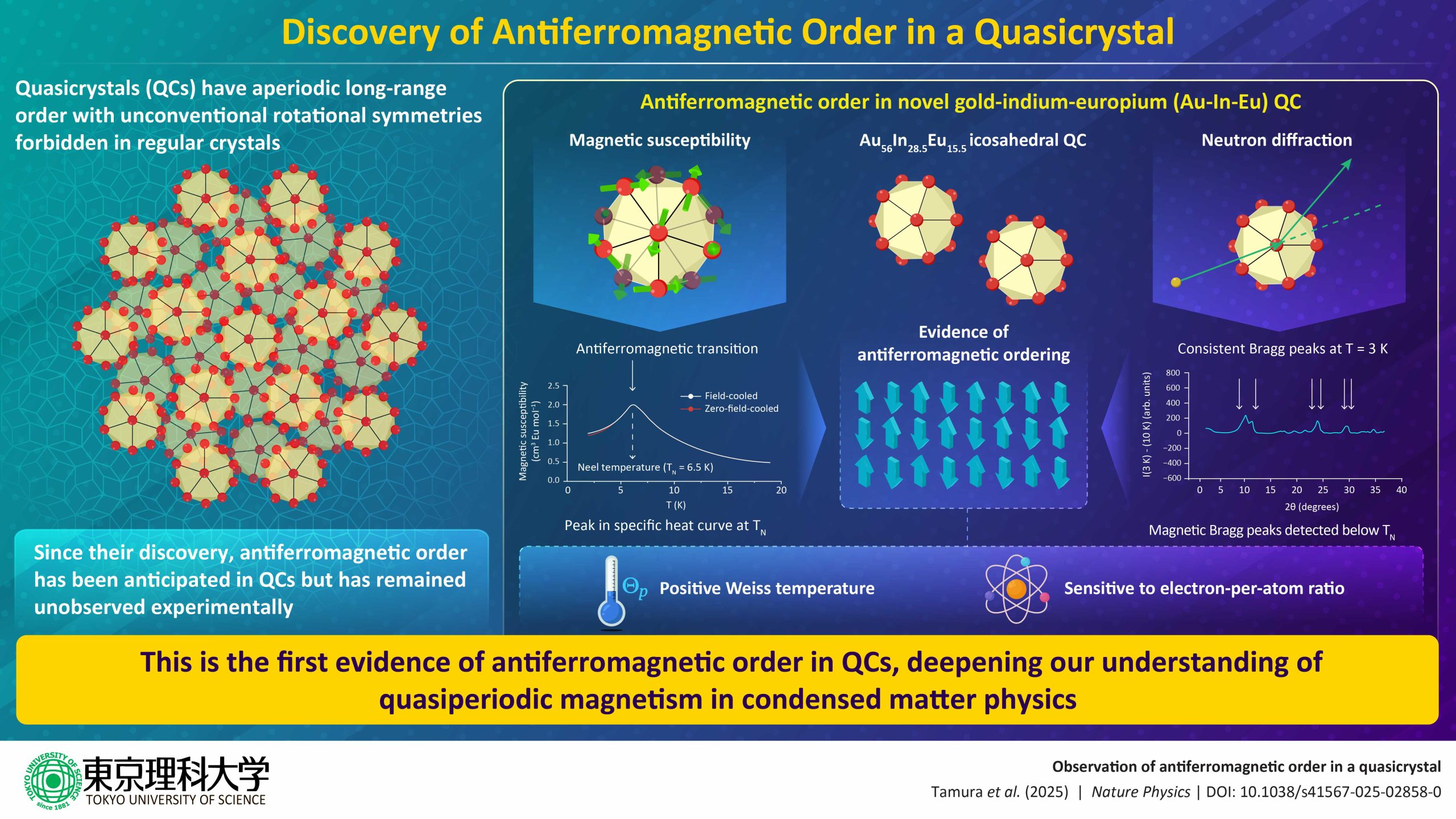
Building upon their recent discovery of ferromagnetism in the Au-Ga-R iQCs, the researchers identified a novel Tsai-type gold-indium-europium (Au-In-Eu) iQC, exhibiting 5-fold, 3-fold, and 2-fold rotational symmetries. The team conducted a series of bulk property measurements and neutron experiments to examine its magnetic nature. Magnetic susceptibility measurements showed a sharp cusp at a temperature of 6.5 Kelvin (K) for both the zero-field cooled and field-cooled conditions, consistent with an antiferromagnetic transition. Specific heat measurements also showed a peak at the same temperature, verifying that the cusp is due to a long-range magnetic order.
Neutron Experiments Confirm Long-Range Order
To further validate their results, the team performed neutron diffraction measurements of the iQC at temperatures of 10 K and 3 K. They observed additional magnetic Bragg peaks—sharp intensity peaks in the diffraction pattern indicating an ordered magnetic structure—at 3 K, which consistently showed an abrupt increase around the transition temperature of 6.5 K in temperature-dependence measurements, providing the first clear evidence of long-range antiferromagnetic order in a real QC.
As to why the Au-In-Eu iQC hosts an antiferromagnetic phase, the researchers found that, unlike previously studied iQCs, which commonly exhibit a negative Curie-Weiss temperature, this novel iQC has a positive Curie-Weiss temperature. Interestingly, they also discovered that with a slight increase in the electron-per-atom ratio through elemental substitution, the antiferromagnetic phase disappears and the iQC shows spin-glass behavior, much like previous iQCs. This suggests that iQCs with a positive Curie-Weiss temperature favor antiferromagnetic order establishment, opening new avenues for future studies to develop novel antiferromagnetic QCs by controlling the electron-per-atom ratio.
“This discovery finally resolves the longstanding issue of whether antiferromagnetic order is possible in real QCs,” adds Tamura. “Antiferromagnetic QCs could enable unprecedented functions, such as ultrasoft magnetic responses, and will bring about a revolution in spintronics and magnetic refrigeration in the future.”
The researchers’ discovery aligns with the United Nations’ sustainable development goals (SDGs)—affordable and clean energy (SDG 7), industry, innovation, and infrastructure (SDG 9)—by building energy-efficient electronics. Solving a decades-long mystery, this discovery not only reinvigorates the search for unexplored antiferromagnetic QCs but also opens a new research field of quasiperiodic antiferromagnets, with implications extending far beyond spintronics.
Reference: “Observation of antiferromagnetic order in a quasicrystal” by R. Tamura, T. Abe, S. Yoshida, Y. Shimozaki, S. Suzuki, A. Ishikawa, F. Labib, M. Avdeev, K. Kinjo, K. Nawa and T. J. Sato, 14 April 2025, Nature Physics.
DOI: 10.1038/s41567-025-02858-0
Funding: Japan Society for the Promotion of Science, Japan Science and Technology Agency, Australian Nuclear Science and Technology Organisation, Japan Atomic Energy Agency, Institute of Solid State Physics
Never miss a breakthrough: Join the SciTechDaily newsletter.
Follow us on Google and Google News.
1 Comment
This discovery not only reinvigorates the search for unexplored antiferromagnetic QCs but also opens a new research field of quasiperiodic antiferromagnets, with implications extending far beyond spintronics.
VERY GOOD!
Materials science knows no bounds. Spin physics based on topological vortices will dominate the future of materials science.