
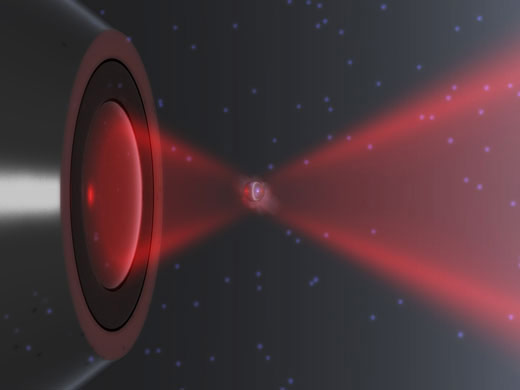
In a newly published study, an international team of researchers detail how they discovered that a nanoparticle trapped with laser light temporarily violates the second law of thermodynamics.
Objects with sizes in the nanometer range, such as the molecular building blocks of living cells or nanotechnological devices, are continuously exposed to random collisions with surrounding molecules. In such fluctuating environments, the fundamental laws of thermodynamics that govern our macroscopic world need to be rewritten. An international team of researchers from Barcelona, Zurich, and Vienna found that a nanoparticle trapped with laser light temporarily violates the famous second law of thermodynamics, something that is impossible on human time and length scale. They report their results in the latest issue of the prestigious scientific journal Nature Nanotechnology.
Surprises at the nanoscale
Watching a movie played in reverse often makes us laugh because unexpected and mysterious things seem to happen: glass shards lying on the floor slowly start to move towards each other, magically assemble, and suddenly an intact glass jumps on the table where it gently gets to a halt. Or snow starts to form a water puddle in the sun, steadily growing until an entire snowman appears as if molded by an invisible hand. When we see such scenes, we immediately realize that according to our everyday experience, something is out of the ordinary. Indeed, there are many processes in nature that can never be reversed. The physical law that captures this behavior is the celebrated second law of thermodynamics, which posits that the entropy of a system – a measure for the disorder of a system – never decreases spontaneously, thus favoring disorder (high entropy) over order (low entropy).
However, when we zoom into the microscopic world of atoms and molecules, this law softens up and looses its absolute strictness. Indeed, at the nanoscale the second law can be fleetingly violated. On rare occasions, one may observe events that never happen on the macroscopic scale such as, for example, heat transfer from cold to hot which is unheard of in our daily lives. Although on average the second law of thermodynamics remains valid even in nanoscale systems, scientists are intrigued by these rare events and are investigating the meaning of irreversibility at the nanoscale.
Nanoparticles in laser traps
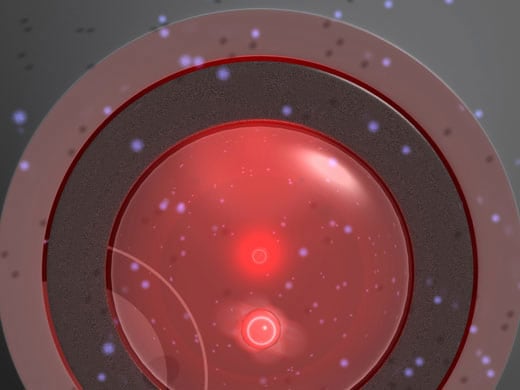
Recently, a team of physicists of the University of Vienna, the Institute of Photonic Sciences in Barcelona, and the Swiss Federal Institute of Technology in Zürich succeeded in accurately predicting the likelihood of events transiently violating the second law of thermodynamics. They immediately put the mathematical fluctuation theorem they derived to the test using a tiny glass sphere with a diameter of less than 100 nm levitated in a trap of laser light. Their experimental set-up allowed the research team to capture the nano-sphere and hold it in place, and, furthermore, to measure its position in all three spatial directions with exquisite precision. In the trap, the nano-sphere rattles around due to collisions with surrounding gas molecules. By a clever manipulation of the laser trap, the scientists cooled the nano-sphere below the temperature of the surrounding gas and, thereby, put it into a non-equilibrium state. They then turned off the cooling and watched the particle relaxing to the higher temperature through energy transfer from the gas molecules. The researchers observed that the tiny glass sphere sometimes, although rarely, does not behave as one would expect according to the second law: the nano-sphere effectively releases heat to the hotter surroundings rather than absorbing the heat. The theory derived by the researchers to analyze the experiment confirms the emerging picture on the limitations of the second law on the nanoscale.
Nanomachines out of equilibrium
The experimental and theoretical framework presented by the international research team in the renowned scientific journal Nature Nanotechnology has a wide range of applications. Objects with sizes in the nanometer range, such as the molecular building blocks of living cells or nanotechnological devices, are continuously exposed to a random buffeting due to the thermal motion of the molecules around them. As miniaturization proceeds to smaller and smaller scales nanomachines will experience increasingly random conditions. Further studies will be carried out to illuminate the fundamental physics of nanoscale systems out of equilibrium. The planned research will be fundamental to help us understand how nanomachines perform under these fluctuating conditions.
Reference: “Dynamic relaxation of a levitated nanoparticle from a non-equilibrium steady state” by Jan Gieseler, Romain Quidant, Christoph Dellago and Lukas Novotny, 30 March 2014, Nature Nanotechnology.
DOI: 10.1038/nnano.2014.40
Never miss a breakthrough: Join the SciTechDaily newsletter.
Follow us on Google and Google News.
2 Comments
News flash: the fluctuation theorem quantifies that the 2nd law of thermodynamics only applies at macroscopic scales; no laws were violated! thanks!
– A physicist
The second law should also apply at micro scales for long periods of time.