
Revolutionizing the First Law of Thermodynamics
Physicists at West Virginia University have overcome a long-standing limitation of the first law of thermodynamics.
Paul Cassak, a professor and associate director of the Center for KINETIC Plasma Physics at West Virginia University, and Hasan Barbhuiya, a graduate research assistant in the Department of Physics and Astronomy, are investigating the conversion of energy in superheated plasmas in space. Funded by the National Science Foundation, their findings, published in the Physical Review Letters journal, are set to revolutionize the understanding of how plasmas in space and labs are heated and could have far-reaching implications in physics and other sciences.

The first law of thermodynamics states that energy can neither be created nor destroyed, but it can be converted into different forms.
“Suppose you heat up a balloon,” Cassak said. “The first law of thermodynamics tells you how much the balloon expands and how much hotter the gas inside the balloon gets. The key is that the total amount of energy causing the balloon to expand and the gas to get hotter is the same as the amount of heat you put into the balloon. The first law has been used to describe many things — including how refrigerators and car engines work. It’s one of the pillars of physics.”
Developed in the 1850s, the first law of thermodynamics is only valid for systems in which a temperature can be properly defined, a state known as equilibrium. As an example, when combined, a cup of cold water and a cup of hot water will eventually reach a warm temperature between them. This warm temperature is the equilibrium. However, when the hot and cold water have not yet reached that endpoint, the water is out of equilibrium.
Likewise, in many areas of modern science, systems are not in equilibrium. For over 100 years, researchers have attempted to expand the first law for common materials not in equilibrium, but such theories only work when the system is nearly there — when the hot and cold water are almost mixed. The theories do not work, for example, in space plasmas, which are far from equilibrium.
The work of Cassak and Barbhuiya fills in the blanks on this limitation.
A Breakthrough for Non-Equilibrium Systems
“We generalized the first law of thermodynamics for systems that are not in equilibrium,” Cassak said. “We did a pencil and paper calculation to find how much energy is associated with matter not being in equilibrium, and it works whether the system is close to or far from equilibrium.”
Their research has numerous potential applications. The theory will help scientists understand plasmas in space, which is important for preparing for space weather. Space weather occurs when huge eruptions in the solar atmosphere blast superheated plasma into space. It can cause problems like power outages, interruptions to satellite communications, and the rerouting of airplanes.
“The result represents a really large step of our understanding,” Cassak said. “Until now, the state-of-the-art in our research area was to account for energy conversion only associated with expansion and heating, but our theory provides a way to calculate all the energy from not being in equilibrium.”
Potential Uses Across Scientific Fields
“Because the first law of thermodynamics is so widely used,” Barbhuiya said, “it is our hope that scientists in a wide array of fields could use our result.”
For example, it may be useful for studying low-temperature plasmas — which are important for etching in the semiconductor and circuit industry — as well as in other areas like chemistry and quantum computing. It might also help astronomers study how galaxies evolve in time.
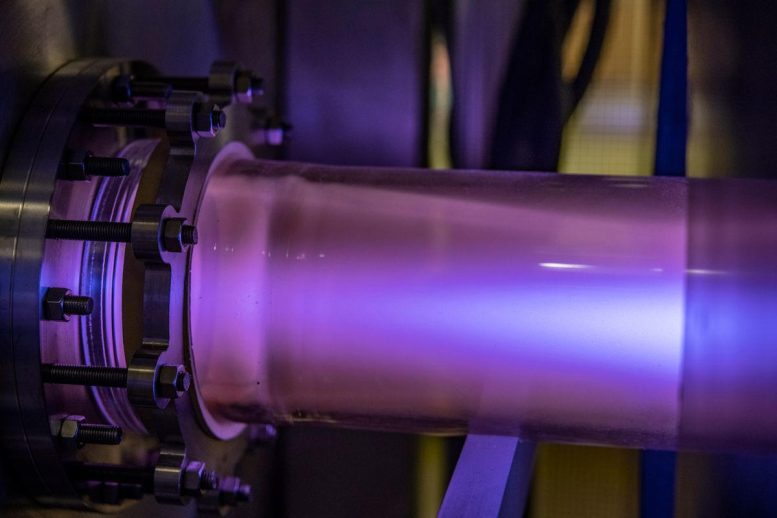
Groundbreaking research related to Cassak and Barbhuiya’s is being carried out in PHASMA, the PHAse Space MApping experiment, in the WVU Center for KINetic Experimental, Theoretical, and Integrated Computational Plasma Physics.
“PHASMA is making space-relevant measurements of energy conversion in plasmas that are not in equilibrium. These measurements are totally unique worldwide,” Cassak said.
Likewise, the breakthrough he and Barbhuiya have made will change the landscape of plasma and space physics, a feat that doesn’t happen often.
“There aren’t many laws of physics — Newton’s laws, the laws of electricity and magnetism, the three laws of thermodynamics, and the laws of quantum mechanics,” said Duncan Lorimer, professor and interim chair of the Department of Physics and Astronomy. “To take one of these laws that have been around over 150 years and improve on it is a major achievement.”
“These new first principles result in non-equilibrium statistical mechanics as applied to plasmas is a great example of the academic research enabled by NSF’s mission ‘to promote the progress of science’,” said Vyacheslav Lukin, a program director for plasma physics in the NSF Division of Physics.
Reference: “Quantifying Energy Conversion in Higher-Order Phase Space Density Moments in Plasmas” by Paul A. Cassak, M. Hasan Barbhuiya, Haoming Liang and Matthew R. Argall, 22 February 2023, Physical Review Letters.
DOI: 10.1103/PhysRevLett.130.085201
The study was funded by the National Science Foundation.
Joining WVU researchers on the project were Haoming Liang, University of Alabama in Huntsville, and Matthew Argall, University of New Hampshire.
Never miss a breakthrough: Join the SciTechDaily newsletter.
Follow us on Google and Google News.
18 Comments
Finally, we can now create or destroy energy. I’ve always hated the limitation of the first law of thermodynamics. It’s time to re-order the universe, so get to work on the next law.
The professors quoted don’t sound like idiots, but the University public relations office that wrote this does. Get the physics department to check your work after, in case you’ve written the opposite of what they did.
According to the topological vortex gravitational field theory, local imbalance is a local manifestation of global equilibrium, which is required for the balance of space-time motion. More is different.
KiNetic PP ?
This article is the equivalent of half baked. Since when did the laws of thermodynamics have limitations? I often wonder if the science community needs a basic refresher course in physics before they inadvertently assume we are all uneducated halfwits.
Srs.
Could you just NOT?
Nobody has time for this clickbaity nonsense.
Stops being fun when most links are lies and disinformation kills.
Looks like someone has wasted an awesome opportunity to baffle everyone with talk of wormholes and curved space-time.
Hey, if Al Gore and Bob Dylan can get Nobel prizes, let’s give one to these guys too.
Please tell me this isn’t an April fools joke.
Go Horns
I have always been interested in the laws of physics thank you the entire article was informative and comments intr interesting
I already wrote a comment your article was great informative and makes me feel a need to have more education in the laws of physics thank you
Great more laws to keep track of and follow; sigh. Thanks y’alls. Now who’s gonna do the policing?
Just kidding.
Actually these human-produced physics laws seem more like helping us break, skirt or bypass natural laws. Life is on its way to breaking reality (maybe with enough energy)!
Great work Mr. Barbhuiya and Mr. Cassak (looks like you are a large brain)! One step closer to divinity.
🌞nwards.🤖👽
🙏🌍🇺🇳
🫡🚀🌌
Reality✅
Only one way to beat the natural and that with God help in the gospel of salvation please see 1Corinthians chapter 15 – Jesus Christ destroyed sin and hence the power of death and raised because of living sinless will return to raise the saints and rule from Jerusalem also ‘Christadelphian bible talks’for excellent learning and Christadelphian videos’ to find out the prophetic picture of soon to be set up an everlasting kingdom of God on earth ( Daniel chapter 2:44)
The laws of science show relationships existing as observable in the present but God created and controls all things and s ok mething worth noting a scripture which declared ‘ eye has not seen nor ear heard the things God has prepared for those who LOVE him!!!
This article seems bogus
There are four laws of thermodynamics
Zeroth, first, second and third.
Wrong wrong wrong. It doesn’t matter whether or not a system is in equilibrium. The laws of thermodynamics apply to all closed systems, whether they are in equilibrium or not. Hence the term thermoDYNAMICS.
I was trying to read this article but a type 2 diabetes advertisement kept playing over and over and no way to close it out or mute it, forget this website and their article writers
Great, another clickbait pseudo-science article that gets half of the stuff wrong and the other half is just made up gibberish. Thanks for contributing to the misinformation epidemic, you are helping to dumb down humanity.