
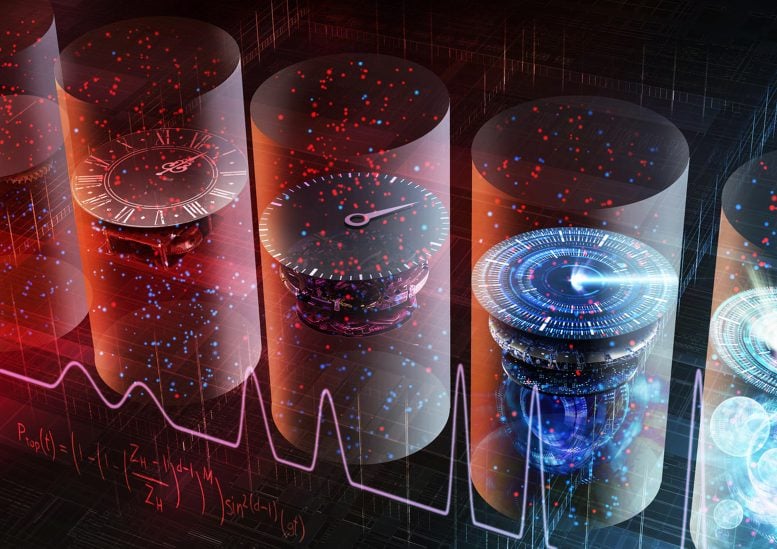
Erasing data perfectly and attaining the lowest possible temperature may appear unrelated, but they share a strong connection. Researchers at TU Wien have discovered a quantum formulation for the third law of thermodynamics.
The temperature of absolute zero, which is the lowest temperature possible, is -273.15 degrees Celsius. However, it is impossible to reach this temperature as objects can only get close to it. This concept is known as the third law of thermodynamics.
A group of researchers at TU Wien (Vienna) has recently explored the compatibility of the third law of thermodynamics with the principles of quantum physics. They successfully formulated a “quantum version” of this law, which posits that reaching absolute zero is theoretically possible. However, any viable method for achieving this requires three components: energy, time, and complexity. Absolute zero can only be attained if one of these elements is available in infinite supply.
Information and Thermodynamics: An Apparent Contradiction
When quantum particles reach absolute zero, their state is precisely known: They are guaranteed to be in the state with the lowest energy. The particles then no longer contain any information about what state they were in before. Everything that may have happened to the particle before is perfectly erased. From a quantum physics point of view, cooling and deleting information are thus closely related.
At this point, two important physical theories meet: Information theory and thermodynamics. But the two seem to contradict each other: “From information theory, we know the so-called Landauer principle. It says that a very specific minimum amount of energy is required to delete one bit of information,” explains Prof. Marcus Huber from the Atomic Institute of TU Wien. Thermodynamics, however, says that you need an infinite amount of energy to cool anything down exactly to absolute zero. But if deleting information and cooling to absolute zero are the same thing – how does that fit together?
Energy, Time, and Complexity
The roots of the problem lie in the fact that thermodynamics was formulated in the 19th century for classical objects – for steam engines, refrigerators, or glowing pieces of coal. At that time, people had no idea about quantum theory. If we want to understand the thermodynamics of individual particles, we first have to analyze how thermodynamics and quantum physics interact – and that is exactly what Marcus Huber and his team did.
“We quickly realized that you don’t necessarily have to use infinite energy to reach absolute zero,” says Marcus Huber. “It is also possible with finite energy – but then you need an infinitely long time to do it.” Up to this point, the considerations are still compatible with classical thermodynamics as we know it from textbooks. But then the team came across an additional detail of crucial importance:
“We found that quantum systems can be defined that allow the absolute ground state to be reached even at finite energy and in finite time – none of us had expected that,” says Marcus Huber. “But these special quantum systems have another important property: they are infinitely complex.” So you would need infinitely precise control over infinitely many details of the quantum system – then you could cool a quantum object to absolute zero in finite time with finite energy. In practice, of course, this is just as unattainable as infinitely high energy or infinitely long time.
Erasing Data in the Quantum Computer
“So if you want to perfectly erase quantum information in a quantum computer, and in the process transfer a qubit to a perfectly pure ground state, then theoretically you would need an infinitely complex quantum computer that can perfectly control an infinite number of particles,” says Marcus Huber. In practice, however, perfection is not necessary – no machine is ever perfect. It is enough for a quantum computer to do its job fairly well. So the new results are not an obstacle in principle to the development of quantum computers.
In practical applications of quantum technologies, temperature plays a key role today – the higher the temperature, the easier it is for quantum states to break and become unusable for any technical use. “This is precisely why it is so important to better understand the connection between quantum theory and thermodynamics,” says Marcus Huber. “There is a lot of interesting progress in this area at the moment. It is slowly becoming possible to see how these two important parts of physics intertwine.”
Reference: “Landauer Versus Nernst: What is the True Cost of Cooling a Quantum System?” by Philip Taranto, Faraj Bakhshinezhad, Andreas Bluhm, Ralph Silva, Nicolai Friis, Maximilian P.E. Lock, Giuseppe Vitagliano, Felix C. Binder, Tiago Debarba, Emanuel Schwarzhans, Fabien Clivaz and Marcus Huber, 27 March 2023, PRX Quantum.
DOI: 10.1103/PRXQuantum.4.010332
Never miss a breakthrough: Join the SciTechDaily newsletter.
Follow us on Google and Google News.
15 Comments
Topological vortices are points with spin in 2D fields. Point defects do not only impact the thermodynamic properties, but are also central to kinetic processes. By utilizing topological vortices, the connection between quantum theory and thermodynamics can be better understood.
If this computer was mine..
let’s dream.
H=340=410=IONINVERT=500INVERT=2INVERT=2=F8
Randeman it.
It is atomic computer.send it to nobelprize and do it.
My name is vahid soleimani.
Bye
“This concept is known as the third law of thermodynamics.”
I think that it would be more accurate to say that the difficulty of achieving absolute zero is a consequence of the Third Law of Thermodynamics.
We are entering? The new realm! It will be Great! It is?… Meant to be!! 😎
Alex, very cool
END OF LINE
Wow, that is nonsense!
So, in other words, it’s still impossible. Yes? Interesting research, but click-bait, obnoxious title for this article.
What a waste of an article. Infinite A, B, or C will give us this unattainable thing.
Infinite A, B, or C, are also unattainable. What did I even learn? Nothing? Some theory they can’t ever be tested because infinity is not testable? Ffs
This just be supposed!!!! Is yet impossible
I have to be there tomorrow at 0 point engineering energy atomic development radarscope neurology intergraded inhanced maneframe adaptive layering satolight intergraded system Airoispace control system
It’s an interesting result in physics that if you allow infinities (aside from renormalization, kinda) you can achieve all kinds of [nonsensical] interesting results.
In a way, modern physics had been a search to rid ourselves of the annoying infinities (even our pure, beloved GR has them)
True or False: but at the hypothetical absolute zero every gas (including hydrogen and noble gases) should be solids, otherwise, its not really ‘absolute zero’.
correction: …every [element] (including hydrogen and noble elements) should be solids…
soundwaves of Urbana with a charge of fusion from the photon would make soundwaves if charged with nitrogen.